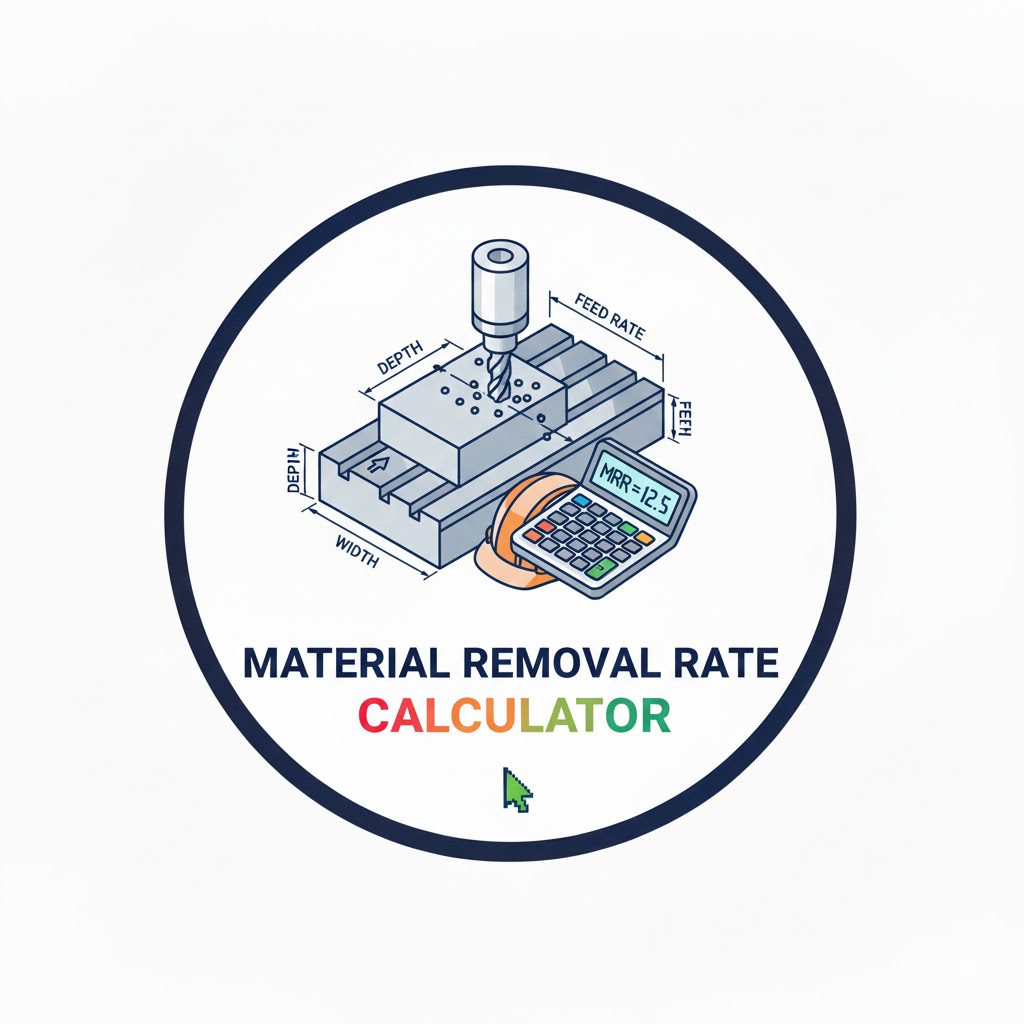
Calculate Material Removal Rate (MRR) for common machining operations – supports both metric and imperial units globally.
Material Removal Rate Calculator: A Complete Guide for Machining Efficiency
Material Removal Rate Calculator is an essential tool for machinists, engineers, and students who want to optimize their machining operations. Whether working with milling, turning, or drilling, knowing the material removal rate (MRR) helps improve productivity, reduce tool wear, and achieve precise machining results. This guide will explain the concept, provide real-world examples, and show how to use a metal removal rate estimator effectively.
Understanding Material Removal Rate (MRR)
Material removal rate, commonly referred to as MRR, measures the volume of material removed from a workpiece per unit of time. Expressed as mm³/min in metric or in³/min in imperial units, it is a critical indicator of machining efficiency.
MRR depends on several factors including:
Cutting speed (Vc): The speed at which the cutting tool engages the workpiece.
Feed rate (Vf or fr): How quickly the tool moves relative to the workpiece.
Depth of cut (ap, ae): Both axial and radial depth for milling or turning operations.
Using a machining material removal calculator ensures that these parameters are balanced correctly to avoid overloading tools or compromising surface finish.
Formula Examples:
Milling: MRR = ap × ae × Vf
Turning: MRR = ap × fr × Vc
Drilling: MRR = (π × D² / 4) × Vf
Material Removal Rate Calculator
Why MRR Matters
Optimizing MRR provides several advantages for both professionals and students learning machining fundamentals:
Efficiency: Higher MRR means more material removed in less time, improving overall productivity.
Surface Finish: Balancing feed, speed, and depth of cut helps maintain desired surface quality.
Energy Savings: Efficient machining reduces unnecessary energy consumption and operational costs.
A practical case study from an automotive machining workshop showed that optimizing MRR for turning operations reduced cycle time by 18% while maintaining part tolerances.
Using the Material Removal Rate Calculator
A cutting speed material removal calculator simplifies the computation process, especially for complex operations. Here’s how to use it effectively:
Select the machining operation: Milling, turning, or drilling.
Input cutting parameters: Depth of cut, feed rate, spindle speed, or drill diameter.
Choose the unit system: Metric or imperial.
Calculate MRR: The tool instantly provides the removal rate along with a breakdown of input parameters.
Real-World Examples:
Milling Example: Milling a steel plate with ap = 5 mm, ae = 10 mm, and Vf = 500 mm/min gives MRR = 5 × 10 × 500 = 25,000 mm³/min.
Turning Example: Turning a stainless-steel rod with ap = 2 mm, fr = 0.3 mm/rev, Vc = 200 m/min results in MRR = 2 × 0.3 × 200 = 120 mm³/min.
Drilling Example: Drilling a 10 mm diameter hole at fr = 0.2 mm/rev and Vc = 150 m/min gives MRR ≈ (π × 10² / 4) × Vf = 11,780 mm³/min.
Using a MRR (material removal rate) calculator eliminates human errors and ensures precise computations.
Tips for Optimizing MRR
Monitor tool temperature and wear during high MRR operations.
Adjust feed and speed to maintain a consistent surface finish.
Avoid excessive radial or axial depths that may cause vibrations.
Q1: Can MRR be increased indefinitely for faster machining? No. Increasing MRR beyond optimal values can cause tool damage, poor surface finish, and unsafe operation. Always balance parameters.
Q2: Does MRR differ for different materials? Yes. Harder materials require slower feeds and speeds, reducing MRR, while softer materials allow higher rates without compromising tool life.
Q3: Can students use MRR calculators for learning purposes? Absolutely. MRR calculators help students understand the relationship between cutting speed, feed rate, and material removal, providing practical hands-on learning.
Conclusion
A Material Removal Rate Calculator is indispensable for anyone involved in machining operations. By providing accurate, instant calculations for milling, turning, and drilling, it helps professionals save time, optimize productivity, and reduce costs. Combining it with other tools like engineering calculators ensures a comprehensive approach to machining efficiency. Using real-world examples, clear formulas, and expert guidance, this tool bridges the gap between theory and
You have not enough Humanizer words left. Upgrade your Surfer plan.
Ahmad Ali Is The Founder Of Ahmad Free Tools, Creating Free Online Tools That Help Users Complete Everyday Tasks Quickly And Efficiently. With 6000+ Online Tools Developed, He Is Recognized As An Expert In Building Practical, User-Friendly Digital Solutions.