Methane Emission from Livestock Calculator
Methane Emission from Livestock Calculator
Estimate annual methane (CH₄) emissions from livestock using IPCC Tier 1 global average emission factors.
Methane Emission from Livestock Calculator: Estimate Your Farm’s Greenhouse Impact
The Methane Emission from Livestock Calculator is a practical tool designed to help farmers, researchers, and environmental enthusiasts estimate the greenhouse gas (GHG) impact of their livestock. Imagine you are managing a small dairy farm with 200 cows. How much methane do they emit in a year, and how does that translate to CO₂ equivalents? Without proper estimation, it’s hard to plan mitigation strategies, measure sustainability, or report environmental impact.
This calculator provides a realistic, science-backed estimate of methane emissions based on IPCC Tier 1 global emission factors, enabling you to understand the environmental footprint of your herd and make informed decisions for sustainable livestock management.
Why Methane Emissions Matter
Methane (CH₄) is a potent greenhouse gas with a global warming potential (GWP) 28 times that of CO₂ over 100 years. Livestock, particularly ruminants like cows and sheep, are responsible for a significant share of global anthropogenic methane emissions—approximately 14.5% of all human-caused greenhouse gases.
Key points to note:
-
Dairy and beef cattle produce the largest amounts due to enteric fermentation.
-
Emissions vary by region, feed quality, and animal type.
-
Reducing methane is crucial for meeting climate targets and improving farm efficiency.
Understanding your livestock’s methane output can inform mitigation strategies, such as improved feed, manure management, and selective breeding.
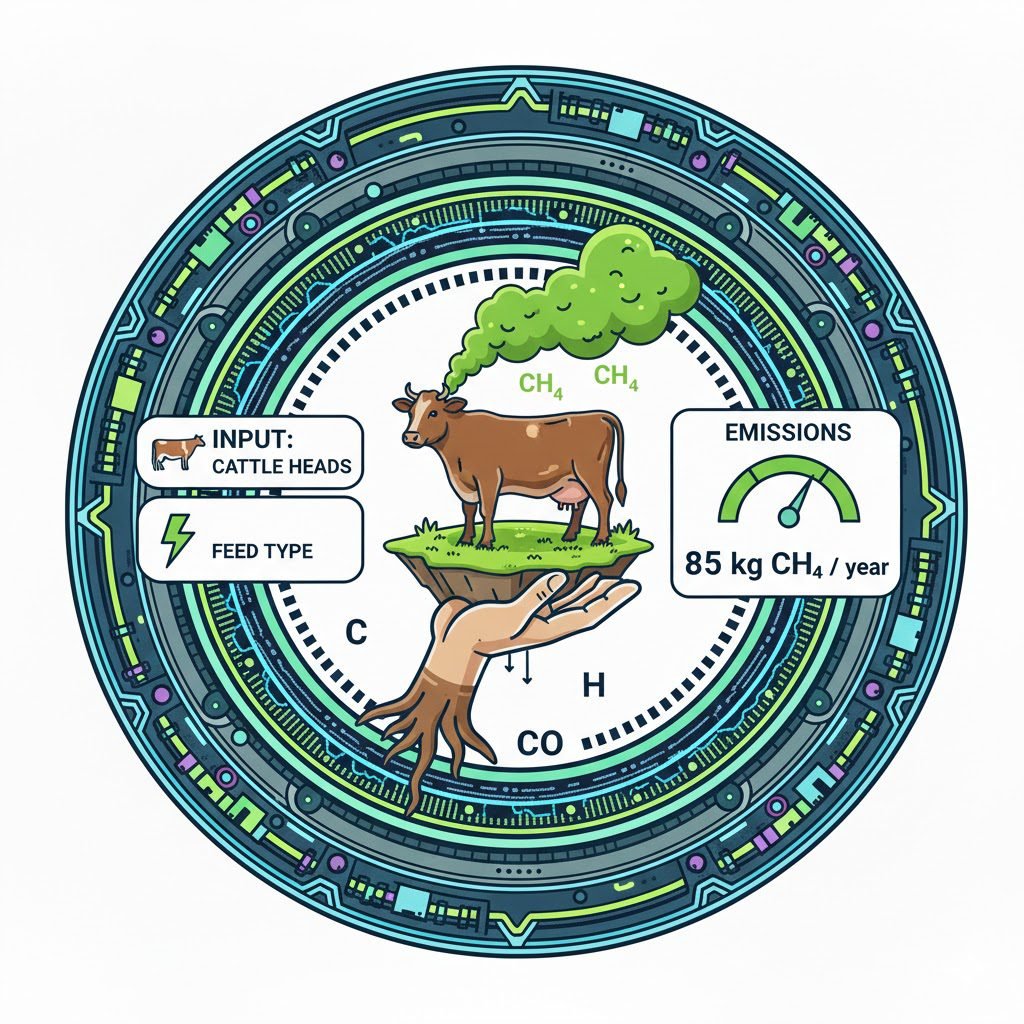
How the Methane Emission Calculator Works
The tool calculates annual methane emissions using a simple formula:
Inputs required:
-
Livestock Type – Choose from dairy cow, beef cattle, sheep, goat, pig, poultry, buffalo, or horse.
-
Region – Developed countries, developing countries, or global average (affects emission factor).
-
Number of Animals – Enter the size of your herd.
Outputs provided:
-
Annual methane emissions (kg and metric tons)
-
Equivalent CO₂ emissions (metric tons/year)
-
Approximate car equivalents for context
-
Impact level (low, moderate, high) with visual highlights
The calculator also includes educational insights, explaining mitigation options and environmental relevance.
Step-by-Step Examples
Example 1: Dairy Farm in Developed Country
-
Livestock: Dairy cows
-
Number: 100
-
Region: Developed
Calculation:
Interpretation:
This herd emits 327.6 tons CO₂e per year, classified as moderate impact. Sustainable feed and manure management can reduce emissions.
Example 2: Sheep Farm in Developing Country
-
Livestock: Sheep
-
Number: 500
-
Region: Developing
Interpretation:
Emissions are low-to-moderate. Improvements in grazing and feed digestibility can further reduce methane output.
Example 3: Mixed Buffalo Farm
-
Livestock: Buffalo
-
Number: 150
-
Region: Global Average
Interpretation:
Moderate impact. Feeding strategies, improved pasture, and manure management are key mitigation paths.
Practical Tips for Users
-
Experiment with herd size and region to see different emission outcomes.
-
Use the car equivalent metric to contextualize the impact for non-experts.
-
Track changes over time to measure the effectiveness of mitigation strategies.
-
Integrate data with other farm sustainability metrics like nutrient balance and manure management.
Related Tools for Environmental Management
-
Toxic Chemical Dose Calculator – Assess chemical exposure safely.
-
pH Neutralization Calculator – Calculate neutralization requirements for acidic or basic effluents.
-
Personal Exposure Index Calculator – Evaluate individual exposure to environmental hazards.
-
Explore more Environmental Chemistry Calculators for broader sustainability analysis.
These tools complement the Methane Emission Calculator, helping you manage farm and environmental impact holistically.
Frequently Asked Questions (FAQs)
1. Can this calculator measure manure emissions too?
No, the current tool focuses on enteric fermentation only. Manure adds additional methane and nitrous oxide emissions. Tier 2 or 3 methods are required for precise farm-level assessment.
2. Why do emission factors differ by region?
Developed regions often provide higher digestibility feed, leading to higher methane conversion efficiency but sometimes lower per-animal emissions. Developing regions may have less efficient feed and different herd management, affecting CH₄ output.
3. How can I reduce methane emissions from my herd?
-
Improve feed quality (e.g., additives like seaweed or fats)
-
Optimize manure management (composting, biogas systems)
-
Breed for feed efficiency
-
Monitor and adjust herd size to sustainable levels
Conclusion
The Methane Emission from Livestock Calculator is more than a simple calculator—it’s a decision-support tool for sustainable livestock management. By understanding methane output and CO₂ equivalents, farmers and environmental managers can:
-
Identify high-impact livestock categories
-
Explore mitigation strategies
-
Track sustainability improvements over time
Try the calculator today, experiment with different herd sizes, and integrate your results with other environmental tools to maximize farm efficiency and reduce greenhouse gas impact.