Car Weight Distribution Tool
Car Weight Distribution Tool
Calculate front/rear weight distribution and dynamic load transfer under acceleration and braking – helps understand handling, traction, and balance globally.
Car Weight Distribution Tool: Understand Your Vehicle’s Handling and Balance
When it comes to vehicle performance, weight distribution is one of the most critical yet often overlooked factors. Whether you’re a car enthusiast, a professional driver, or just someone curious about handling dynamics, understanding how weight shifts under different conditions can dramatically affect traction, stability, and overall driving confidence. That’s where the Car Weight Distribution Tool comes in—a simple yet powerful calculator that allows you to analyze front/rear weight distribution and dynamic load transfer for any car, under scenarios like acceleration, braking, and cornering.
This guide will walk you through how the tool works, why weight distribution matters, practical examples, and tips to optimize your vehicle’s handling.
Why Car Weight Distribution Matters
Vehicle weight is rarely static. Every time a car accelerates, brakes, or corners, load shifts between the front and rear wheels. Mismanaged weight distribution can lead to understeer, oversteer, or unpredictable handling—problems that affect safety and driving pleasure. Key reasons to understand weight distribution include:
-
Improved handling: A balanced car responds predictably to steering inputs.
-
Better traction: Proper load distribution enhances grip on acceleration and braking.
-
Vehicle stability: Reduces rollover risk and excessive body roll.
-
Performance tuning: Helps enthusiasts and engineers make informed suspension or weight placement adjustments.
Cars with front-wheel drive (FWD) often have a front-heavy bias (~60/40), leading to understeer, whereas rear-wheel drive (RWD) cars can have rear-heavy tendencies (~45/55), prone to oversteer. Knowing your car’s balance helps you anticipate its behavior in real-world conditions.
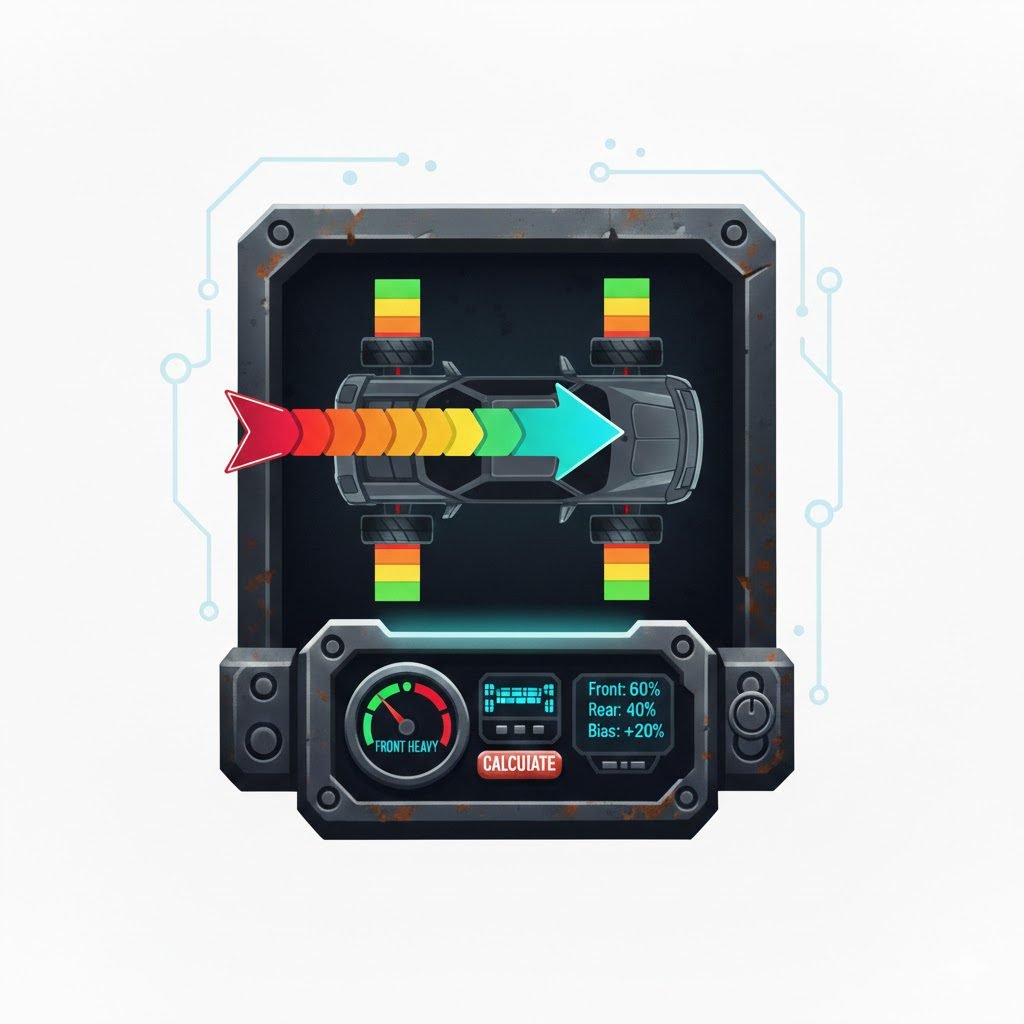
How the Car Weight Distribution Tool Works
The Car Weight Distribution Tool calculates both static and dynamic weight distribution using straightforward physics principles. Here’s what happens when you use it:
Inputs Required
-
Total Vehicle Weight (kg) – Complete curb weight of the car.
-
Static Front Weight (%) – Front axle weight proportion at rest.
-
Wheelbase (mm) – Distance between front and rear axles.
-
Center of Gravity Height (mm) – Height of the car’s center of mass.
-
Scenario Selection – Static, hard acceleration, hard braking, or cornering.
-
Intensity Level (g-force) – Magnitude of acceleration, braking, or cornering forces.
Output Calculations
-
Static Distribution
-
Dynamic Load Transfer (approximate)
-
For acceleration, front weight decreases while rear weight increases.
-
For braking, front weight increases while rear weight decreases.
-
For cornering, lateral load shifts occur, affecting grip on left/right wheels.
-
-
Dynamic Distribution & Handling Rating
-
Dynamic Front Weight (%) = Front Weight / Total Weight × 100
-
Dynamic Rear Weight (%) = 100 − Dynamic Front Weight
-
Handling Balance is assessed as:
-
Ideal (near 50/50) – stable and neutral
-
Front-heavy – tendency to understeer
-
Rear-heavy – tendency to oversteer
-
-
By providing both numerical values and descriptive handling insights, the tool makes vehicle dynamics accessible to anyone, without requiring advanced physics knowledge.
Step-by-Step Examples
Example 1: Braking in a Mid-Sized Sedan
-
Total Weight: 1500 kg
-
Static Front Weight: 60%
-
Wheelbase: 2700 mm
-
CoG Height: 550 mm
-
Scenario: Hard Braking
-
G-Force: 0.5
Calculation:
This shows why sedans often feel nose-heavy during emergency stops.
Example 2: Acceleration in a Rear-Wheel Drive Car
-
Total Weight: 1400 kg
-
Static Front Weight: 45%
-
Wheelbase: 2600 mm
-
CoG Height: 500 mm
-
Scenario: Hard Acceleration
-
G-Force: 0.7
Dynamic Front/Rear Calculation:
This explains why RWD cars can spin the rear wheels under aggressive acceleration.
Example 3: Cornering at 1g Lateral
-
Total Weight: 1600 kg
-
Static Front Weight: 55%
-
Wheelbase: 2800 mm
-
CoG Height: 600 mm
-
Scenario: Cornering
-
G-Force: 1
Here, the longitudinal front/rear balance remains roughly the same, but lateral load shifts across wheels affect tire grip and suspension tuning.
These examples demonstrate that dynamic weight distribution directly impacts handling, traction, and safety, emphasizing why understanding it is essential for both daily drivers and performance enthusiasts.
Practical Insights & Tips
-
Aim for near 50/50 weight distribution for neutral handling on performance cars.
-
Lower CoG reduces load transfer → more stable cornering and braking.
-
Longer wheelbase enhances longitudinal stability.
-
Adjust driving style based on front/rear bias:
-
FWD → avoid aggressive cornering at high speed to reduce understeer.
-
RWD → maintain throttle control to prevent rear oversteer.
-
-
Test different scenarios in the tool to see how braking, acceleration, or cornering affects balance.
Using this tool alongside other resources like the EV vs ICE Emission Comparison or the Green Route Finder can help you optimize your vehicle for both performance and environmental efficiency.
FAQs
1. Can I use this tool for trucks or SUVs?
Yes. Simply input the total vehicle weight, wheelbase, and CoG height. Remember that larger vehicles will experience higher load transfer due to taller CoG and heavier weight.
2. How accurate is the tool?
The calculator uses standard physics-based formulas to estimate weight transfer. It provides practical approximations suitable for daily driving analysis and vehicle setup guidance, though professional dynamics tuning may require advanced simulation tools.
3. What happens if my car has adjustable suspension?
Adjusting ride height or weight placement affects center of gravity and distribution. You can simulate these changes in the tool by updating CoG height or static weight percentages.
Conclusion
The Car Weight Distribution Tool is an essential resource for anyone interested in vehicle dynamics. By entering your car’s weight, wheelbase, and center of gravity, you can visualize how load shifts in different driving scenarios, understand handling tendencies, and make smarter adjustments.
Whether you’re tuning a performance car, optimizing daily driving safety, or learning about vehicle physics, this tool provides actionable insights. Explore related calculators like the Emission Cost per Mile Calculator or Freight Carbon Calculator for broader transport and efficiency analysis.
Take control of your car’s balance, test different scenarios, and discover how subtle changes in weight distribution can dramatically improve your driving experience.