Time Stretch for Large Batches
Time Stretch for Large Batches
Scale up recipes without guessing — calculate how much extra time large batches need for cooking, baking, boiling, roasting, or simmering due to pot size, heat distribution, and volume effects.
How to Scale Recipes Without Guesswork
Scaling recipes for large groups or meal prep can be tricky. Many cooks struggle to figure out exactly how much longer a stew, roast, or baked goods will take when the quantity increases. This is where Time Stretch for Large Batches becomes invaluable. By understanding how batch size, pot depth, and cooking methods affect cooking time, you can save time, avoid undercooked meals, and maintain consistent results.
Whether you are hosting a family gathering, preparing meals for a catering service, or just doubling your weekly recipes, knowing how to adjust cooking time accurately is a game-changer.
What Does “Time Stretch for Large Batches” Mean?
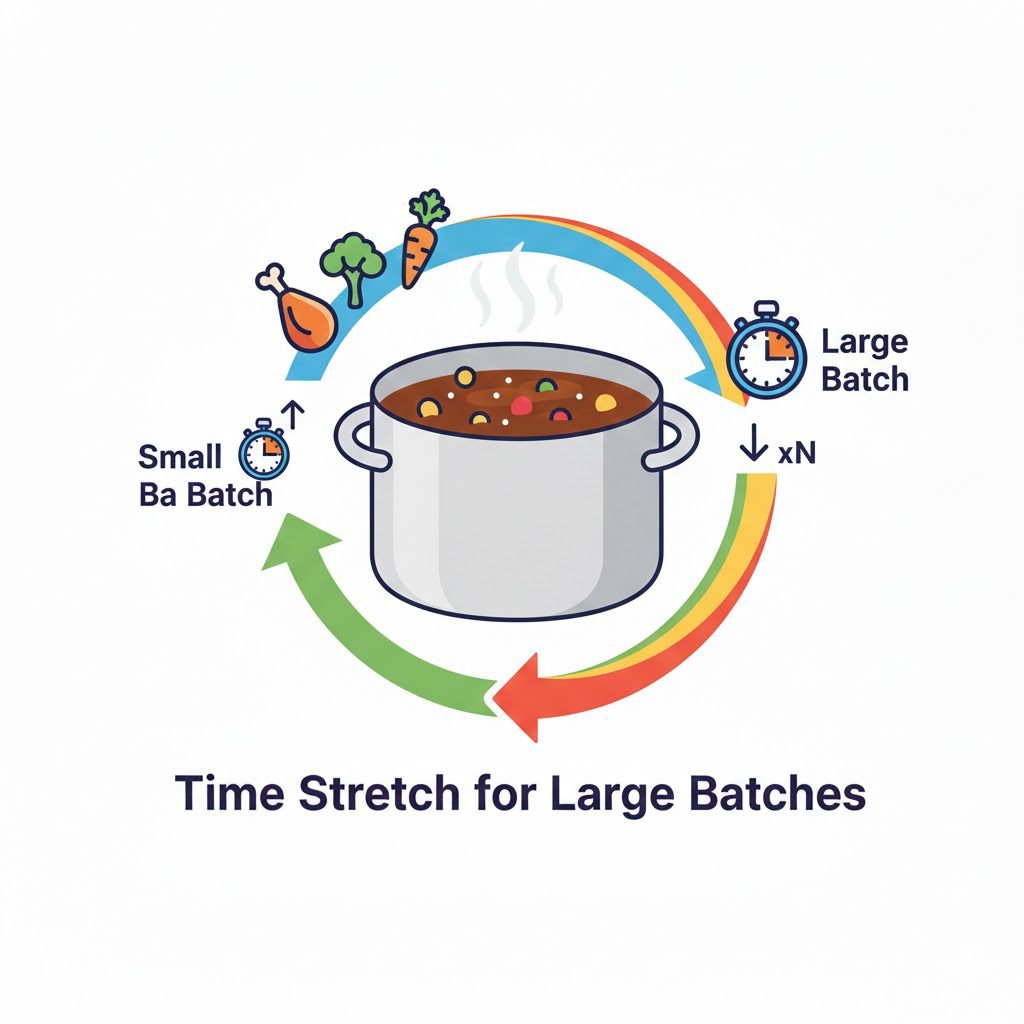
Simply put, time stretch refers to the additional cooking time required when increasing a recipe’s volume. Cooking is not always linear; doubling a stew doesn’t mean it will cook in exactly twice the original time. Factors like heat distribution, pot size, and cooking method affect how quickly heat penetrates the food.
For example, a 45-minute soup for four people may need up to 70 minutes if scaled to serve sixteen. Ignoring this adjustment can result in undercooked centers, uneven baking, or overcooked edges.
How Does the Tool Work?
Our Time Stretch for Large Batches calculator simplifies this process by factoring in four essential inputs:
-
Original Recipe Time: The baseline cooking duration in minutes.
-
Scaling Factor: How many times larger the batch is compared to the original.
-
Cooking Method: Options include stovetop, oven, deep frying, slow cooking, pressure cooking, and small-batch baking. Each method has a unique impact on heat transfer.
-
Pot or Pan Size: Indicates whether you are using the same pot (deeper layer) or a larger pot/pan (shallower layer).
The Calculation Logic
The tool uses a practical formula to estimate additional cooking time:
-
Method Factor: Represents how volume affects cooking for each method. For example, stovetop dishes have a factor of 0.2 (20% increase per scale).
-
Pot Modifier: Adjusts for deeper layers slowing down heat penetration (same pot = 1.3, larger pot = 1.0).
This formula is capped at realistic limits to prevent overestimation, ensuring the calculation mirrors real-world cooking conditions.
Which Cooking Methods Require the Most Time Adjustment?
Different methods respond differently to scaling:
-
Stovetop (soups, sauces, stews): Extra time increases noticeably due to slower heat penetration in deep pots.
-
Oven (roasts, casseroles, baking): Slight adjustment, but watch for uneven baking.
-
Deep Frying / High Heat: Minimal stretch, though oil recovery time may slow down cooking.
-
Slow Cooker / Braising: Almost linear; extra time is minimal.
-
Pressure Cooker / Instant Pot: Least affected, as pressure equalizes temperature quickly.
-
Small-Batch Baking (cookies, muffins): Requires more attention for edges; extra time can be significant.
Understanding these differences allows you to plan better, avoiding surprises and burnt meals.
Step-by-Step Examples for Real-Life Scenarios
Example 1: Scaling Soup on the Stovetop
-
Original time: 45 minutes
-
Batch size: 4×
-
Cooking method: Stovetop
-
Pot: Same (deep layer)
Calculation:Extra Time = 45 × 0.2 × (4 − 1) × 1.3 ≈ 35 minutes
Total Time: 45 + 35 = 80 minutes
Practical tip: Stir frequently to prevent scorching at the bottom of a deep pot.
Example 2: Baking a Larger Casserole
-
Original time: 60 minutes
-
Batch size: 2×
-
Cooking method: Oven
-
Pot: Larger (shallower layer)
Calculation:Extra Time = 60 × 0.15 × (2 − 1) × 1.0 = 9 minutes
Total Time: 69 minutes
Tip: Rotate trays halfway through and consider using convection for even cooking.
Example 3: Slow Cooker for Braised Meat
-
Original time: 6 hours
-
Batch size: 1.5×
-
Cooking method: Slow cooker
-
Pot: Same
Calculation:Extra Time = 360 × 0.08 × (1.5 − 1) × 1.3 ≈ 19 minutes
Total Time: 6 hours 19 minutes
Tip: Do not overfill the slow cooker—leave at least 1/3 space to allow proper circulation.
These examples highlight how practical adjustments prevent undercooked centers or uneven textures.
Why Pot Size and Depth Matter
The pot or pan’s shape influences heat distribution:
-
Deeper pots slow down heat penetration, requiring more cooking time.
-
Shallow, wider pans allow heat to reach the food faster, slightly reducing the extra time needed.
This is why the tool accounts for pot size as a modifier, reflecting real-life kitchen physics rather than arbitrary numbers.
How to Use the Tool Effectively
-
Enter the original recipe time.
-
Set your batch size using the scaling factor.
-
Choose the appropriate cooking method.
-
Indicate whether you are using the same or a larger pot.
-
Click Calculate to get an instant estimate.
The tool also provides step-by-step advice, such as rotating trays, checking doneness with thermometers, or adding time in small increments for precise results.
FAQs About Scaling Cooking Time
Q1: Can I trust the extra time calculation for all recipes?
Yes, the tool provides practical estimates. Exact time may vary slightly depending on pot shape, stove power, altitude, and food density.
Q2: Should I stir or rotate food differently for larger batches?
Absolutely. For stovetop dishes, stir more often. For ovens, rotate trays to ensure even heat distribution.
Q3: Does pressure cooking require more time for bigger batches?
Pressure cooking is mostly unaffected. The tool applies a minimal time stretch since pressure equalizes temperature efficiently.
Conclusion
Scaling recipes for larger batches no longer needs to be a guessing game. By understanding Time Stretch for Large Batches, you can adjust cooking times confidently, maintain food quality, and save effort in the kitchen. The calculator simplifies this process, providing instant, realistic estimates based on batch size, cooking method, and pot size.
Try different inputs, experiment with your favorite recipes, and see how consistent results become effortless. You can also explore related tools like our Tea Calorie Calculator, Water Hardness Impact Tool, or Zero Waste Kitchen Guide to optimize your kitchen experience further.