Investment Calculator
Investment Calculator
Calculate the future value of an investment with regular contributions. Formula: FV = PV × (1 + r/n)^(nt) + PMT × [((1 + r/n)^(nt) - 1) / (r/n)], where PV=initial, PMT=periodic contribution, r=annual rate (decimal), n=compounds per year, t=time in years. Assumes contributions at period end.
Investment Calculator: Your Complete Guide to Smarter Wealth Growth
An Investment Calculator is a powerful tool that helps investors, both beginners and experienced, understand how their money can grow over time. Using a calculator, you can project your future wealth based on contributions, interest rates, and investment duration. With proper use, this tool can simplify investment planning, eliminate guesswork, and enhance decision-making for long-term financial success.
Understanding the Investment Calculator
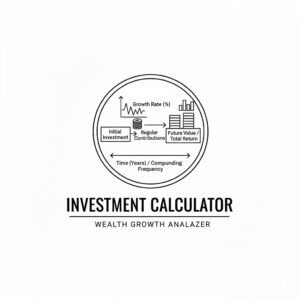
An Investment Calculator uses mathematical formulas to estimate the future value of an investment. The most commonly used formula is:
FV = PV × (1 + r/n)^(nt) + PMT × [((1 + r/n)^(nt) - 1) / (r/n)]
Where:
-
FV= Future Value of the investment -
PV= Present Value or initial investment -
PMT= Periodic contribution -
r= Annual interest rate (decimal) -
n= Compounding frequency per year -
t= Time in years
This formula assumes contributions are made at the end of each period and the interest rate remains constant. It can calculate future value for a one-time investment or recurring contributions.
Benefits of Using an Investment Calculator
Investors gain multiple advantages when using an Calculator, including:
-
Clarity on Future Growth: Understand how contributions and interest rates affect long-term returns.
-
Strategic Planning: Evaluate different scenarios and adjust investment strategies accordingly.
-
Time Efficiency: Quickly calculate complex projections without manual formulas.
-
Risk Awareness: Estimate potential outcomes and make informed risk-adjusted decisions.
Experts often combine these calculations with a Trailing Twelve Months Calculator to analyze past performance and project future gains more accurately.
Key Features of a Modern Investment Calculator
A high-quality Investment Calculator typically includes the following features:
-
Initial Investment Input: Allows users to enter their starting capital.
-
Periodic Contribution Options: Accepts monthly, quarterly, or annual contributions.
-
Interest Rate Flexibility: Users can input expected annual rates of return.
-
Compounding Frequency: Choose how often the interest compounds (daily, monthly, quarterly, yearly).
-
Result Analysis: Provides future value, total contributions, total return, and annualized growth.
-
Expert Advice or Tips: Suggests strategies based on calculated returns.
These calculators are often integrated with tools like an Investment Fee Calculator to account for management fees and optimize net returns.
Practical Example: Projecting Portfolio Growth
Consider an investor planning to start with $10,000 and contribute $500 monthly at an annual return of 7% for 10 years. Using the formula:
-
Initial Investment FV:
FV_Initial = 10000 × (1 + 0.07/12)^(12×10)≈$20,072.57 -
Contributions FV:
FV_Contributions = 500 × [((1 + 0.07/12)^(12×10) - 1) / (0.07/12)]≈$93,200.45
Total Future Value:FV = 20,072.57 + 93,200.45 ≈ $113,273.02
The total contributions were $10,000 + 500×120 = $70,000, and total return ≈ $43,273.02.
This example shows the significant impact of consistent contributions and compounding over time.
How to Use an Investment Calculator Effectively
-
Set realistic return rates: Historical stock market returns average
7-10%annually, but adjust for inflation and risk tolerance. -
Include all contributions: Factor in every monthly or yearly addition to see the true growth potential.
-
Consider compounding frequency: Monthly or quarterly compounding accelerates growth compared to annual compounding.
-
Use multiple calculators: Compare results with a Wealth Growth Calculator for diversified portfolio planning.
Case Study: Long-Term Wealth Planning
A real investor, Sarah, started investing $5,000 and added $300 monthly for 15 years at a conservative 6% return. Her projected future value using an Investment Calculator was:
FV ≈ 5000 × (1 + 0.06/12)^(12×15) + 300 × [((1 + 0.06/12)^(12×15) - 1) / (0.06/12)]
≈ $98,500
Without the calculator, Sarah could not have easily visualized the impact of consistent contributions over time. By adjusting contributions or return assumptions, she could create multiple scenarios and make informed decisions.
Understanding Different Types of Investment Calculators
Investors can choose from a variety of calculators depending on goals:
-
Investment Return Calculator: Focuses on estimating the profit or return percentage over a period.
-
Portfolio Growth Calculator: Evaluates overall growth of a diversified portfolio including multiple asset classes.
-
Wealth Growth Calculator: Tracks total wealth accumulation including investments, savings, and dividends.
-
Investment Planning Tool: Helps create actionable plans and allocate funds effectively for short and long-term goals.
Integrating these calculators with professional advice allows for a holistic investment strategy.
Common Mistakes to Avoid
-
Ignoring fees and taxes: Use calculators that allow fee adjustments to see net returns.
-
Overestimating returns: Historical averages are better benchmarks than optimistic projections.
-
Neglecting inflation: Ensure your projections consider inflation-adjusted growth.
-
Inconsistent contributions: Skipping periods reduces the impact of compounding dramatically.
Expert Tips for Maximizing Investment Growth
Financial advisors recommend:
-
Starting early to leverage the power of compounding.
-
Diversifying portfolios across stocks, bonds, and ETFs.
-
Regularly reviewing and adjusting contributions based on life events or market changes.
-
Tracking performance using tools like Investment Planning Calculators for accurate decision-making.
FAQs
What is the difference between an Investment and an Investment Return Calculator?
An Investment Calculator projects the future value considering contributions, compounding, and time, while an Investment Return Calculator mainly estimates profit percentage or return on investment.
Can I rely solely on an Investment Calculator for planning?
Calculators are excellent planning tools but should be complemented with financial advice, market analysis, and risk assessment.
How does compounding frequency affect investment growth?
The more frequent the compounding (e.g., monthly vs annually), the greater the impact on total returns due to interest accruing on previously earned interest.
Conclusion
Using an Investment Calculator provides clear insights into the growth of your investments. It removes uncertainty, empowers strategic planning, and helps investors make data-driven decisions. Regularly updating inputs, considering fees, inflation, and market conditions ensures your projections are realistic and reliable. For advanced planning, combine these calculators with resources like Trailing Twelve Months Calculator and Investment Fee Calculator for comprehensive insights.