Debt Service Coverage Ratio Calculator
Debt Service Coverage Ratio (DSCR) Calculator
Measures ability to pay all debt obligations (principal + interest) from operating income — critical for lenders.
Debt Service Coverage Ratio Calculator: Assess Your Business Loan Repayment Capacity Accurately
Understanding a company’s ability to meet its debt obligations is critical for lenders, investors, and business owners alike. The Debt Service Coverage Ratio Calculator offers a precise, easy-to-use solution to determine whether a business generates enough income to cover its debt obligations. By leveraging this calculator, entrepreneurs and financial analysts can make informed decisions, reduce risk, and ensure sustainable growth.
This tool is especially important when planning loans, managing cash flow, or evaluating investment opportunities. Alongside, related tools such as the Maturity Value Calculator and Beta Stock Calculator provide complementary insights into financial health and investment risk.
What is the Debt Service Coverage Ratio?
The Debt Service Coverage Ratio (DSCR) is a financial metric that measures a company’s ability to pay all debt obligations, including both principal and interest, from its operating income. It is expressed as:
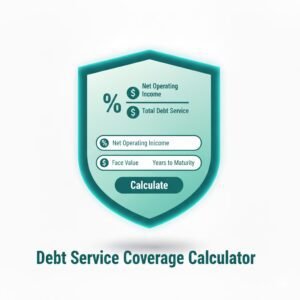
DSCR = Net Operating Income (NOI) ÷ Total Annual Debt Service
Where:
-
Net Operating Income (NOI)is the revenue generated from operations minus operating expenses. -
Total Annual Debt Serviceis the sum of all principal and interest payments due in a year.
A DSCR greater than 1 indicates that a company can cover its debt obligations, whereas a DSCR below 1 signals potential financial strain. For example, a DSCR of 1.5 means the company generates 1.5 times the cash required to pay its debt.
Why Using a DSCR Calculator is Important
Manual calculations can be time-consuming and prone to errors. A DSCR Calculation Tool simplifies this process, offering:
-
Accuracy: Automatically calculates ratios with precision.
-
Speed: Instant results with minimal input.
-
Visualization: Clear output with interpretations and risk levels.
-
Scenario Analysis: Test different income or debt levels to plan strategically.
Financial institutions frequently use DSCR to evaluate loan repayment capacity, making it a critical metric for both lenders and borrowers. Entrepreneurs can also leverage it for internal financial planning, ensuring their business remains financially healthy.
How to Use a Debt Service Coverage Ratio Calculator
Using a DSCR calculator is straightforward:
-
Input Net Operating Income (NOI) – This is often your EBITDA (Earnings Before Interest, Taxes, Depreciation, and Amortization).
-
Enter Total Annual Debt Service – Include all scheduled principal and interest payments for the year.
-
Click Calculate – The calculator instantly computes your DSCR and categorizes your financial health.
-
Interpret Results – Most calculators offer an advisory section with professional insights.
For instance, a business with NOI = $500,000 and annual debt service = $300,000 will have:
DSCR = 500,000 ÷ 300,000 = 1.67
This indicates strong debt coverage and financial stability.
Practical Examples of DSCR
Example 1: Small Retail Business
A local retailer earns an annual NOI of $120,000 and has a debt service of $100,000. Using the DSCR formula:
DSCR = 120,000 ÷ 100,000 = 1.2
The DSCR suggests adequate coverage but limited buffer. Lenders may require a higher ratio, especially for growth loans.
Example 2: Commercial Real Estate Investment
A commercial property generates $450,000 NOI with $250,000 annual debt service:
DSCR = 450,000 ÷ 250,000 = 1.8
This strong ratio indicates lower risk, potentially qualifying the investor for favorable loan terms.
Example 3: Startup Scenario
A startup with $60,000 NOI and $80,000 debt service will have:
DSCR = 60,000 ÷ 80,000 = 0.75
This is below 1.0, indicating the company cannot service its debt from current operations, signaling high default risk.
These examples illustrate why accurate calculations are crucial for decision-making. Using a Business DSCR Analyzer helps identify risks and make timely adjustments.
Typical DSCR Requirements by Lenders
Lender expectations vary by industry and loan type:
-
Commercial Real Estate Loans: ≥
1.25× -
Banks & CMBS Loans: Typically
1.35–1.50× -
SBA Loans: ≥
1.15–1.25× -
Investment-Grade Businesses: ≥
2.0×
Meeting or exceeding these thresholds increases approval chances, improves interest rates, and reduces default risk.
DSCR in Financial Planning
Businesses can leverage DSCR insights to:
-
Plan expansion without over-leveraging
-
Schedule loan repayments more effectively
-
Negotiate better terms with lenders
-
Identify operational inefficiencies that reduce NOI
Financial analysts often use the Loan Repayment Capacity Calculator to simulate multiple scenarios, ensuring business stability during revenue fluctuations.
Advantages of Using an Online DSCR Calculator
-
Real-time Results: No manual computation needed.
-
Professional Analysis: Automated interpretation provides actionable insights.
-
Scenario Testing: Adjust NOI or debt to evaluate different business situations.
-
Integrated with Other Tools: Works in tandem with finance calculators to analyze comprehensive financial health.
Expert Insights on DSCR
Financial experts emphasize that a consistent DSCR above 1.5 is ideal for sustainable growth. According to industry data, businesses with a DSCR between 1.25–1.5 often face liquidity constraints during economic downturns. Investors and lenders also use DSCR as a primary filter for risk assessment.
Tips for Improving DSCR
-
Increase NOI: Reduce operating costs or boost revenue streams.
-
Refinance Debt: Lower interest rates or extend maturities to reduce annual debt service.
-
Strategic Investments: Avoid over-leveraging on low ROI projects.
-
Monitor Regularly: Regular use of a Debt Coverage Ratio Calculator ensures you maintain a healthy ratio.
FAQs About DSCR
What is a good DSCR for a small business?
A DSCR of 1.25× or higher is usually considered acceptable for small businesses, though stronger ratios are preferred by lenders.
Can DSCR be negative?
Yes. If NOI is negative or debt service exceeds operating income, DSCR will be below 1.0, indicating a high default risk.
How often should a business calculate DSCR?
Monthly or quarterly calculations are recommended, especially when considering loans, refinancing, or expansions.
Case Studies
Case Study 1: Retail Chain Expansion
A retail chain planning to open five new stores used a DSCR Calculation Tool to simulate debt scenarios. By increasing NOI through operational efficiencies, they improved DSCR from 1.1 to 1.6, securing a $2M expansion loan at a lower interest rate.
Case Study 2: Commercial Property Investment
An investor purchased a commercial property generating $400,000 NOI with $280,000 debt service. Using the DSCR calculator, they projected a DSCR of 1.43, justifying the loan approval and potential for additional property investments.
These real-world applications demonstrate how crucial accurate DSCR calculations are for lenders, investors, and business owners.
Key Takeaways
-
DSCR measures loan repayment ability and indicates financial stability.
-
Using a Debt Coverage Ratio Calculator ensures accurate and fast assessments.
-
Ratios above 1.25× are generally acceptable; above 2.0× is excellent.
-
Scenario analysis with a Loan Repayment Capacity Calculator helps plan for growth or crises.
-
Integrating DSCR insights with tools like the Maturity Value Calculator supports comprehensive financial planning.
A healthy DSCR ensures that businesses can cover debt obligations, optimize operations, and build credibility with lenders.
Conclusion
The Debt Service Coverage Ratio Calculator is a critical tool for understanding financial health, planning loans, and making informed business decisions. Accurate DSCR calculations reduce risk, improve lender confidence, and support sustainable growth. Whether you are a small business owner, investor, or financial analyst, incorporating this calculator into your toolkit ensures informed decision-making.
Regularly monitoring DSCR with tools like the Business DSCR Analyzer and cross-referencing with other finance calculators allows for better cash flow management, investment planning, and operational efficiency. Maintaining a strong DSCR secures better loan terms, reduces financial stress, and positions your business for long-term success.