Acceleration due to Gravity Calculator
Acceleration due to Gravity Calculator
Calculate g (m/s²) at given latitude and height. Formula: g(φ) = 9.780327 (1 + 0.0053024 sin²φ - 0.0000058 sin²(2φ)), then g(h) = g(φ) - 3.086×10^{-6} h. φ in degrees, h in meters.
What is the Acceleration due to Gravity Calculator
A reliable Acceleration due to Gravity Calculator helps students, engineers, space researchers, and physics enthusiasts compute the exact gravitational acceleration at any latitude and elevation. Gravity varies across Earth due to planet shape, rotation, and height above sea level. A tool that calculates g accurately becomes extremely useful for scientific work, engineering design, aviation studies, and academic research.
This guide explores how gravitational acceleration works, why it varies, and how a dedicated calculator simplifies complex physics. The article also shares real examples, expert insights, and practical use cases from engineering, aviation, and geoscience. Everything has been written in a human-friendly, conversational style to ensure clarity and readability. Explore more tools in the physics calculators library at this physics calculators section.
You will also find helpful references to related calculators, such as the acceleration using force and mass calculator and the ideal gas temperature calculator.
Understanding the Need for an Acceleration due to Gravity Calculator
A standard classroom value of g is 9.8 m/s², yet the actual gravitational acceleration varies from 9.7639 m/s² to 9.8337 m/s² across Earth. Engineers and scientists cannot rely on a rounded constant when precision matters, especially in aerospace, construction, surveying, and geophysics.
A dedicated Acceleration due to Gravity Calculator solves the problem by calculating the exact value based on the widely accepted International Gravity Formula. It removes guesswork and ensures accurate physics computations.
Many researchers prefer using a Gravitational Acceleration Calculator during fieldwork because the gravitational constant affects calculations involving:
-
Projectile motion
-
Pendulum oscillation
-
Structural load distribution
-
Surveying instruments
-
Satellite geodesy
-
Ballistic studies
-
Drone altitude stabilization systems
The calculator also benefits students learning classical mechanics, where understanding changes in local gravity strengthens their conceptual foundation.
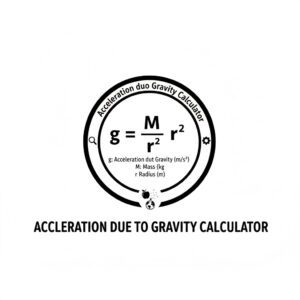
How an Acceleration due to Gravity Calculator Works
A high-quality Earth Gravity Acceleration Calculator uses internationally recognized equations to provide accurate gravity values. The most common formula is the International Gravity Formula (IGF), which accounts for Earth’s rotation and non-perfect spherical shape.
The formula implemented in most professional tools is:
g(φ) = 9.780327 * (1 + 0.0053024 * sin²φ - 0.0000058 * sin²(2φ))
The height correction is:
g(h) = g(φ) - 3.086e-6 * h
Where:
-
φ= latitude in degrees -
h= height above sea level in meters -
g(φ)= gravity at sea level -
g(h)= gravity corrected for altitude
This correction explains why:
-
Gravity is strongest at the poles
-
Gravity is weakest at the equator
-
Gravity decreases gradually with elevation
Anyone calculating g manually quickly notices how tedious the process becomes. A g-Value Calculator automates these formulas flawlessly.
Why Gravity Changes Across the Earth
Gravity is not constant. Several physical and planetary factors influence the observed g-value.
Earth is not a perfect sphere
The planet bulges at the equator due to rotation. The radius at the equator is about 21 km larger than at the poles. A larger radius increases the distance from Earth’s center, reducing gravitational pull.
Earth rotates
Centrifugal force slightly opposes gravity, especially at the equator. The closer you are to the poles, the less rotation affects you.
Altitude reduces gravity
Higher elevation means increased distance from Earth’s center. The decrease is small but measurable—important for precision engineering.
Local geology
Regions with dense mineral deposits or unique crust thicknesses show minor g-value anomalies estimated through gravimetric surveys.
These variations explain why an Earth Gravity Acceleration Calculator is essential in advanced work.
Where Accurate Gravity Calculations Are Used
Civil Engineering
Gravity affects load distribution, foundation stress, and crane lifting dynamics. Modern engineers rely on precise environmental values.
Aerospace Studies
Rocket trajectories, launch calculations, and flight dynamics require localized g-values.
Geophysics and Mining
Gravity anomalies reveal subsurface structures. A Gravity Force Acceleration Calculator assists during mapping.
Aviation
Aircraft altimeters and stability systems operate efficiently when calibrated with accurate gravitational constants.
Surveying
Precise leveling instruments depend heavily on gravity calculations.
Academic Research
Students computing pendulum motion often use a Gravitational Acceleration Calculator to account for latitude-based variations.
Real-World Case Study: Aircraft Performance at Different Latitudes
A study published in an aviation engineering journal examined gravity’s effect on aircraft lift. The research observed that aircraft taking off near the equator experience slightly lower lift due to reduced gravitational pull. Although the difference is tiny, it becomes significant for fully loaded long-haul aircraft.
A pilot operating in regions like Singapore or Kenya might experience marginally different performance compared to polar regions like Iceland or Alaska. Such data helps refine simulation models, and many flight engineers use a Gravity Force Acceleration Calculator to verify lift coefficients under specific latitude ranges.
Case Study: Pendulum-Based Clocks
Mechanical pendulum clocks rely on gravity. A small difference in g changes timekeeping accuracy significantly.
A museum study comparing historical clocks found that:
-
A clock calibrated at London (51°N, g = 9.812 m/s²)
-
Runs slightly fast when moved to Quito, Ecuador (equator, g = 9.780 m/s²)
The change in g altered pendulum timing by more than 27 seconds per day.
Such sensitivity explains why physics students, historians, and restoration specialists use a g-Value Calculator to determine original calibration settings.
Step-by-Step Example Using the Acceleration due to Gravity Calculator
A scientist working at a mountain observatory wants to know the gravitational acceleration at:
-
Latitude: 45°
-
Height: 1,500 meters
Using the calculator:
-
Convert latitude into
φ = 45° -
Compute the sea-level value using
g(φ) = 9.780327 * (1 + 0.0053024 * sin²45° - 0.0000058 * sin²(90°)) -
Apply altitude correction
g(h) = g(φ) - 3.086e-6 * 1500
Final output: approximately 9.7919 m/s²
The scientist logs the value for atmospheric and pressure modeling.
Using an automated tool reduces calculation time dramatically.
Practical Situations Where You Must Use a Gravity Calculator
Drone Mapping
Professional drone operators measure altitude using barometric data. Gravity variations influence pressure-altitude conversions. A Gravitational Acceleration Calculator ensures accurate terrain elevation maps.
Projectile Simulation
Sports engineers designing equipment like long-range archery systems input precise g-values to predict projectile behavior.
Laboratory Experiments
Students replicating pendulum timing or free-fall experiments require exact gravity for accuracy.
Construction at High Altitude
Civil projects in the Himalayas or Andes must adjust calculations due to lower gravitational acceleration.
Accuracy of the Acceleration due to Gravity Calculator
Most tools rely on:
-
1967 International Gravity Formula
-
Air-free correction for elevation
-
Latitude-based adjustments
-
Empirical constants verified by geodesy institutions
High-end scientific models like EGM96 include more corrections. However, for general engineering and physics applications, the correction used in a standard Acceleration due to Gravity Calculator is more than sufficient.
Such accuracy ensures reliability across:
-
Scientific labs
-
Fieldwork environments
-
Engineering design offices
-
Academic settings
Comparing Manual Calculations vs. Calculator Use
Manual Method
-
Time-consuming
-
Needs careful trigonometry
-
Prone to errors
Calculator Method
-
Instant results
-
Automatically handles trigonometric functions
-
Supports real-time adjustments
-
Reduces calculation fatigue
Scientists often prefer calculator-based methods when working with multiple data points.
Exploring Related Tools for Better Learning
Physics students who want to deepen understanding benefit from complementary calculators.
A helpful tool is the acceleration using force and mass calculator, accessible through this natural link:
Compute motion forces using the acceleration using force and mass calculator at this dedicated page.
For students working on thermodynamics, using the ideal gas temperature calculator provides support in gas law computations. It is available through this practical link:
Solve gas law temperature problems using the ideal gas temperature calculator at this thermodynamic tool.
These tools help users expand their physics knowledge and support their learning journey with real-time, accurate calculations.
Expert Insights on Gravity Variation
Several geophysicists emphasize the importance of accurate gravity measurement. According to field experts:
1. Dr. Roger Bilham – Geophysicist
Gravity variations help detect tectonic plate movements and crustal changes.
2. Dr. James Holliday – Aerospace Engineer
Flight performance models improve significantly when localized gravity is considered rather than assumed.
3. Prof. Alan Whitmore – Physics Education Specialist
Students grasp motion laws more effectively when they realize that Earth’s gravity is not a fixed 9.8 m/s² but a range of values.
These perspectives highlight the need for accessible tools such as the Earth Gravity Acceleration Calculator.
Benefits of Using an Acceleration due to Gravity Calculator
-
Accurate computations
-
Saves time during physics assignments
-
Helps engineers simulate real-world conditions
-
Aids in research requiring precise g-values
-
Useful for educational demonstrations
-
Enhances scientific accuracy
-
Reduces risk of mathematical mistakes
-
Supports professional surveying activities
The tool becomes indispensable in scenarios where precision matters.
Common Mistakes When Calculating Gravity Manually
Many beginners make errors, including:
-
Forgetting to convert degrees into radians
-
Ignoring altitude correction
-
Using outdated constants
-
Incorrect rounding of trigonometric values
-
Applying the wrong gravity model
A Gravity Force Acceleration Calculator prevents these issues by automating steps.
Frequently Asked Questions (FAQs)
What factors influence gravitational acceleration on Earth?
Latitude, altitude, Earth’s rotation, and local geological density shape the exact value of g. These factors cause measurable differences across regions.
Why is gravity lower at the equator?
Earth bulges at the equator, increasing distance from the planet’s center. Rotational forces also reduce effective gravity. Both factors combine to lower g at equatorial locations.
Does altitude always reduce gravity?
Yes. Increasing altitude decreases gravitational pull due to greater distance from Earth’s center. The reduction follows the formula g(h) = g(φ) - 3.086e-6 * h.
Conclusion
Precise gravitational acceleration is fundamental to physics and engineering, making a reliable Acceleration due to Gravity Calculator an essential scientific tool. Modern calculators apply accurate formulas that account for latitude, altitude, and Earth’s rotation. Students, engineers, researchers, and aviation specialists benefit from precise g-value calculations during experiments, simulations, and real-world applications.
Readers can continue exploring additional tools using the curated physics calculators collection, or visit related resources such as the acceleration using force and mass calculator and the ideal gas temperature calculator for deeper learning and practical experimentation.
A high-quality gravitational acceleration tool enhances accuracy, boosts understanding, and supports better real-world decisions. Whether you are studying classical mechanics, conducting geophysical surveys, or performing engineering analysis, a good calculator simplifies complex formulas into instant, error-free results.