Angle of Depression Calculator
Angle of Depression Calculator
Calculate the angle of depression (or elevation) using height and horizontal distance – widely used in surveying, navigation, physics, and trigonometry worldwide.
What is the Angle of Depression Calculator
The Angle of Depression Calculator is an essential tool for anyone involved in surveying, navigation, construction, or physics. It allows users to determine the angle at which an observer looks downward from a higher point toward a target on lower ground. This calculation is crucial in designing safe structures, planning sightlines, and understanding slope measurements in real-life scenarios.
By entering the vertical height and horizontal distance, the calculator instantly provides the angle in degrees, ensuring accuracy and saving time compared to manual calculations. This tool also doubles as a downward angle estimator, making it versatile for professionals and students alike.
How the Angle of Depression Works
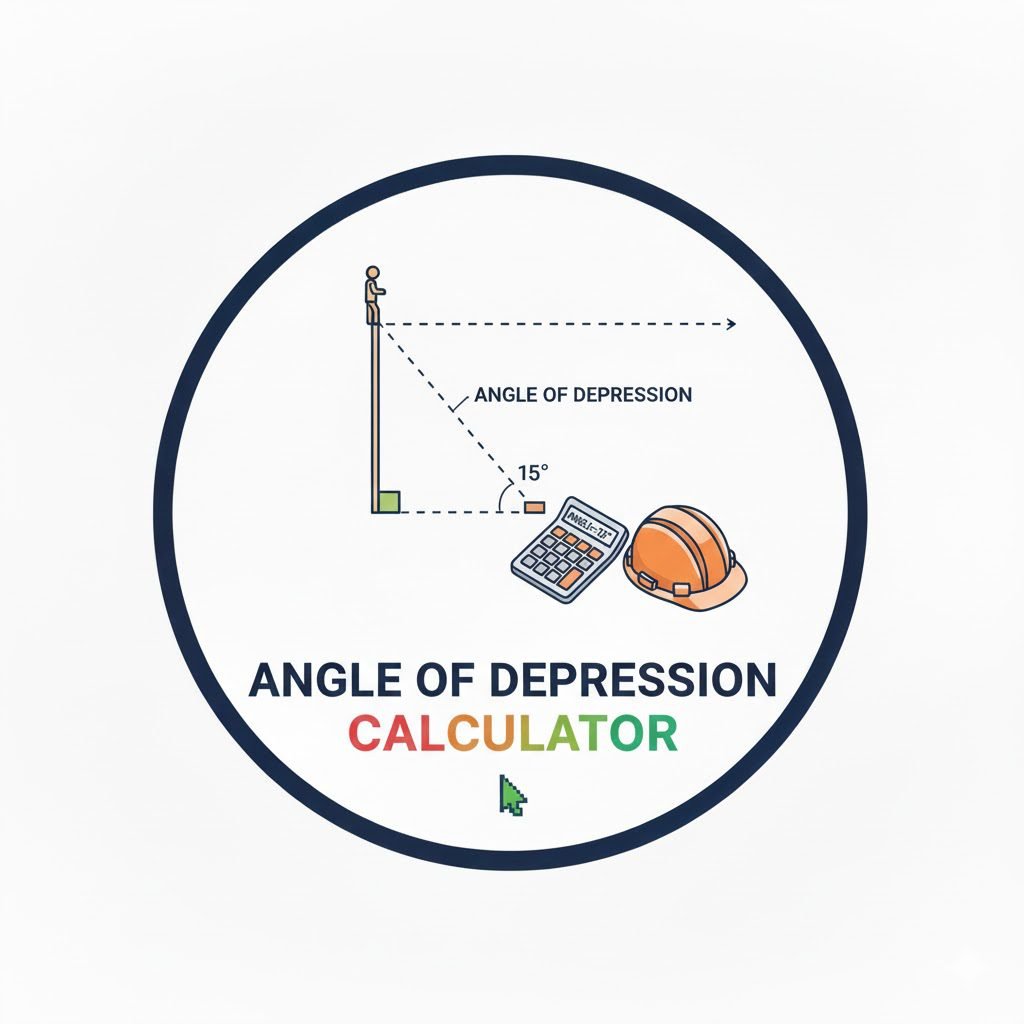
The angle of depression refers to the angle formed between the horizontal line from an observer’s eye and the line connecting the observer to an object below. Mathematically, it is expressed as:
Where:
-
θis the angle of depression in degrees. -
heightis the vertical difference between the observer and the object. -
horizontal distanceis the straight-line distance along the ground.
Understanding this angle helps in designing sightlines, ensuring safety in construction, and even calculating artillery trajectories in military contexts. It is often paired with an observation angle calculator to analyze both upward and downward lines of sight.
Practical Applications
The Angle of Depression Calculator is widely used across different fields. Some practical examples include:
-
Architecture and Construction: Engineers use it to design staircases, ramps, or viewing platforms, ensuring safe slopes and proper sightlines.
-
Surveying: Surveyors determine the gradient of land and plan for accurate drainage and building placements.
-
Aviation and Navigation: Pilots and ship captains calculate descent angles to maintain safe approaches or sight distances.
Example 1: A surveyor is on a 30-meter-high cliff, observing a point 120 meters away horizontally. Using the formula θ = arctan(30 / 120), the angle of depression is 14.04°. This ensures precise placement of observation markers.
Example 2: An architect plans a balcony 10 meters above the ground with a garden 25 meters away. The downward viewing angle is θ = arctan(10 / 25) = 21.8°. This helps design the railing for optimal visibility and safety.
Example 3: In sports stadium design, a spectator 15 meters above the field and 40 meters away horizontally has a line of sight angle of θ = arctan(15 / 40) ≈ 20.56°. This ensures all spectators have a clear view of the action.
Benefits of Using an Angle of Depression Calculator
Using a dedicated tool rather than manual calculations provides multiple advantages:
-
Speed: Instant results save time compared to manual trigonometry.
-
Accuracy: Reduces errors caused by rounding or miscalculations.
-
Versatility: Works for multiple units including meters, feet, yards, kilometers, or miles.
-
Ease of Use: Suitable for students, professionals, and everyday users without advanced math knowledge.
Additionally, this calculator often links to other useful tools like the Bowl Segment Calculator for volume measurement, or the Bolt Circle Calculator for mechanical designs, creating a seamless workflow for engineers and designers.
Tips for Accurate Calculations
-
Ensure the horizontal distance and height are measured accurately.
-
Use consistent units to avoid miscalculations.
-
For long distances, consider environmental factors such as terrain slope or curvature in professional surveying.
-
Combine with a line of sight angle calculator to cross-check observations.
FAQs
What is the difference between the angle of depression and angle of elevation?
Both angles are measured from a horizontal line. The angle of depression looks downward from the observer, while the angle of elevation looks upward toward the target. They are equal in magnitude when measured between the same points.
Can this calculator be used for irregular terrains?
Yes, but for uneven or curved terrain, the calculated angle is an approximation. For highly precise measurements, adjustments for slope or obstacles may be necessary.
Which units can I use in this calculator?
It supports meters, feet, yards, kilometers, and miles, making it versatile for both academic and professional use.
Conclusion
The Angle of Depression Calculator is an invaluable tool for anyone needing accurate downward angle measurements. From surveying to architecture and navigation, it provides precise results quickly and effortlessly. By understanding this angle and using tools like the observation angle calculator, users can make informed decisions in construction, safety, and design projects.
Explore more practical tools to simplify calculations on construction calculators, and enhance efficiency in your workflow with seamless, accurate calculations.