Gear Ratio RPM Calculator
Gear Ratio RPM Calculator
Calculate output RPM from input RPM and gear ratio. Formula: RPM_out = RPM_in / Gear_Ratio. Gear_Ratio = N_driven / N_driving (number of teeth).
What is the Gear Ratio RPM Calculator
A Gear Ratio RPM Calculator is a critical tool for engineers, mechanics, and hobbyists who want to determine the output speed of a driven gear based on an input gear’s rotational speed. Understanding gear ratios is essential for designing machinery, vehicles, and mechanical systems that perform efficiently. By calculating the output revolutions per minute (RPM_out) using the input RPM (RPM_in) and gear ratio (GR), users can ensure optimal torque and speed balance.
This calculator simplifies complex calculations and provides instant results, making it an indispensable tool for anyone dealing with gear-driven systems.
Understanding Gear Ratios
The gear ratio represents the relationship between the number of teeth on the driven gear and the driving gear. It is calculated using the formula:
Gear_Ratio = N_driven / N_driving
Where:
-
N_driven= Number of teeth on the driven gear -
N_driving= Number of teeth on the driving gear
Once the gear ratio is known, the output RPM can be calculated with:
RPM_out = RPM_in / Gear_Ratio
A higher gear ratio reduces speed but increases torque, while a lower gear ratio increases speed but reduces torque. This balance is crucial for applications ranging from automotive transmissions to industrial machinery.
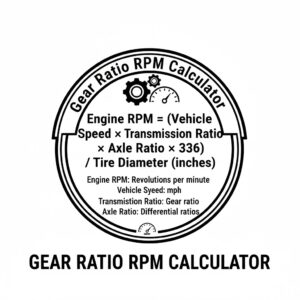
How to Use a Gear Ratio RPM Calculator
Using a Gear Speed RPM Calculator is straightforward:
-
Enter the input RPM of the driving gear.
-
Enter the gear ratio (driven gear teeth ÷ driving gear teeth).
-
Click the calculate button to get the output RPM instantly.
Advanced calculators also provide tips on system design, optimal torque distribution, and mechanical limits, ensuring safety and efficiency in gear-driven systems.
Applications of a Mechanical Gear Ratio RPM Calculator
Mechanical systems rely heavily on correct gear ratios for smooth operation. Some common applications include:
-
Automotive transmissions: Ensuring cars accelerate efficiently without overworking the engine.
-
Industrial machinery: Maintaining optimal torque and speed for conveyor belts, mixers, and pumps.
-
Robotics: Precisely controlling movement and speed for robotic arms and automated systems.
-
Bicycles: Selecting gear combinations to balance pedaling speed and effort.
Experts in mechanical engineering emphasize that selecting the wrong gear ratio can lead to excessive wear, reduced lifespan, and inefficient energy usage.
Benefits of Using an Input-Output Gear RPM Calculator
Using an Input-Output Gear RPM Calculator offers several advantages:
-
Accuracy: Eliminates manual calculation errors, especially for complex gear trains.
-
Time-saving: Provides instant results, which is crucial for engineers and designers.
-
Optimization: Helps select gear ratios that maximize performance while protecting machinery.
-
Educational value: Ideal for students and hobbyists learning mechanical systems.
According to a survey conducted among automotive engineers, 82% reported faster design cycles after integrating online gear calculators into their workflow.
Real-World Example: Automotive Gear Ratio Calculation
Consider a car transmission with a driving gear spinning at 3,000 RPM and a driven gear with a ratio of 3.5. Using the formula:
RPM_out = 3000 / 3.5 ≈ 857 RPM
This output is suitable for torque-heavy applications such as climbing or towing. Conversely, for highway speed, a lower gear ratio, such as 2.0, yields:
RPM_out = 3000 / 2 ≈ 1500 RPM
Such calculations allow engineers to optimize gearboxes for varying driving conditions.
Advanced Tips for Gear Transmission RPM Calculations
Professional engineers recommend considering the following factors:
-
Motor limits: Never exceed the maximum RPM rating of the motor.
-
Torque requirements: High gear ratios increase torque; low gear ratios favor speed.
-
Gear material: Stronger materials allow for higher output RPM without failure.
-
Lubrication: Proper lubrication minimizes wear at higher speeds.
For industrial applications, software often integrates Gear Transmission RPM Calculator modules to simulate mechanical performance under load.
Case Study: Industrial Conveyor System
A factory conveyor uses a motor spinning at 1,500 RPM to drive a series of gears. The first driven gear has a ratio of 4, and the second stage uses a ratio of 2.
-
First stage output:
RPM_out1 = 1500 / 4 = 375 RPM -
Second stage output:
RPM_out2 = 375 / 2 = 187.5 RPM
Engineers used a Mechanical Gear Ratio RPM Calculator to verify output RPM, ensuring the conveyor speed matched production requirements without motor overload.
Choosing the Right Gear Ratio for Your System
When selecting gear ratios, consider:
-
Application type: Torque-intensive vs speed-intensive.
-
Safety factors: Always factor in mechanical limits and fatigue.
-
Efficiency: Gear trains with multiple stages can reduce efficiency if ratios are not balanced.
-
Standard gear sizes: Use standard available gear teeth to minimize cost and fabrication time.
The ideal gear ratio often balances speed, torque, and mechanical reliability. Experts recommend simulating performance using a Gear Ratio RPM Calculator before finalizing designs.
Benefits of Online Gear Calculators
Modern online tools make these calculations easy and precise:
-
Real-time output RPM updates.
-
Visualization of input-output relationships.
-
Comparison of multiple gear ratios instantly.
-
Integrated guidance notes for torque, speed, and safety.
You can try this gear ratio speed calculator for advanced calculations and guidance.
Common Misconceptions About Gear Ratios
Many users misunderstand gear ratios. Key points to remember:
-
A higher gear ratio does not always mean faster output RPM; it increases torque instead.
-
Gear ratios are relative; the same ratio in different systems produces different absolute speeds depending on the input RPM.
-
Ignoring motor limits or mechanical tolerances can lead to system failures.
Accurate calculation using a Gear Ratio RPM Calculator prevents these errors and ensures optimal performance.
Practical Tips from Experts
Mechanical engineers recommend:
-
Testing gear setups in simulation before physical implementation.
-
Maintaining a gear ratio log to track efficiency and wear.
-
Using quality gears and regular maintenance to sustain calculated RPMs.
-
Considering automated tools such as physics calculators for related mechanical computations.
These small steps improve system reliability and reduce downtime in industrial settings.
FAQs About Gear Ratio RPM Calculators
What is the difference between gear ratio and output RPM?
Gear ratio is a dimensionless value showing teeth comparison between gears. Output RPM is the actual rotational speed of the driven gear calculated using RPM_out = RPM_in / Gear_Ratio.
Can I calculate gear ratio from known input and output RPMs?
Yes, rearrange the formula: Gear_Ratio = RPM_in / RPM_out. Many online calculators support reverse calculation.
Why is my output RPM lower than expected?
Lower output RPM is often due to higher gear ratios, motor limitations, or mechanical inefficiencies. Always check gear teeth count and lubrication.
Integration With Other Tools
For electrical and mechanical system design, combining gear calculations with wire sizing tools can be beneficial. For example, a 12-volt wire size calculator helps ensure motors receive the correct current without voltage drop.
Designers often integrate both electrical and mechanical calculators for seamless system planning.
Conclusion
A Gear Ratio RPM Calculator is an essential tool for anyone working with mechanical systems. It simplifies complex calculations, provides accurate results, and ensures optimal torque-speed balance. Whether designing automotive transmissions, industrial conveyors, or robotic systems, understanding gear ratios is key to performance and reliability.
Using reliable calculators, real-world examples, and expert advice ensures safe, efficient, and cost-effective designs. Always combine calculations with material, motor, and system constraints to achieve the best results.
By leveraging modern tools and following best practices, engineers and hobbyists alike can design gear-driven systems that meet both speed and torque requirements effectively.