Grams to cc Converter
Grams to cc Converter
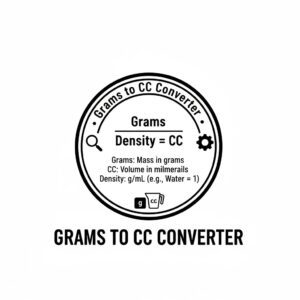
Convert mass in grams to volume in cubic centimeters (cc). Formula: Volume (cc) = Mass (g) / Density (g/cc). Defaults to water density of 1 g/cc.
What is the Grams to cc Converter
A Grams to cc Converter is an essential tool for students, engineers, chemists, and hobbyists who frequently work with mass and volume measurements. By converting grams into cubic centimeters (cc), you can quickly determine the volume of a substance when its density is known. This tool is especially helpful in scenarios where precision matters, such as chemical experiments, culinary recipes, or industrial applications.
Many beginners often struggle with understanding the relationship between mass and volume. Using a Gram to Cubic Centimeter Converter simplifies this process and saves time. Whether you are calculating the volume of water, oil, or a dense material like gold, this converter provides accurate and instant results.
Understanding Grams and Cubic Centimeters
Grams (g) are a standard unit of mass in the metric system, while cubic centimeters (cc) measure volume. The relationship between mass and volume depends on the density of the material.
The conversion formula is:
This formula is universally applicable. For instance, 100 grams of water, which has a density of 1 g/cc, will occupy exactly 100 cc.
Key points to remember:
-
1 cc = 1 milliliter (mL), making this tool useful for liquid measurements.
-
Density varies depending on temperature and pressure, so accuracy requires knowledge of the exact material properties.
-
Denser substances like metals take up less volume than lighter liquids or gases for the same mass.
A g to cm³ Conversion Tool is particularly valuable for professions that require repeated calculations of mass-to-volume ratios, like chemistry labs, culinary measurements, or manufacturing.
Why Use a Grams to cc Converter?
Manual calculations can be time-consuming and prone to errors, especially with decimals and varying densities. Using an online Mass to Volume Converter offers several benefits:
-
Speed: Instantly calculates the volume from grams.
-
Accuracy: Minimizes errors in scientific or industrial applications.
-
Convenience: Accessible anywhere from desktop or mobile devices.
-
Educational Value: Helps students visualize the relationship between mass and volume in real-life applications.
For example, chemists often measure ingredients for experiments in grams but need to prepare solutions in milliliters. A Grams to Milliliter Calculator bridges this gap efficiently.
Many industrial experts also recommend integrating such calculators into production lines where mass-to-volume conversions are routine. It reduces manual calculations, errors, and wastage, improving workflow efficiency.
How to Use a Grams to cc Converter
Using a Grams to cc Converter is straightforward. Here’s a step-by-step guide:
-
Enter the mass of the substance in grams.
-
Enter the density in g/cc (for water, the default is 1 g/cc).
-
Click the “Convert” button.
-
View the calculated volume in cubic centimeters.
Some advanced tools also allow:
-
Reset Function: Clear inputs and start fresh.
-
Copy Results: Save or share calculations with colleagues.
-
Dynamic Advice: Tips based on the density entered (denser or lighter than water).
For accurate measurements:
-
Ensure density corresponds to the correct temperature and pressure conditions.
-
Double-check units, especially if converting between g/mL, g/cc, or kg/L.
Real-Life Applications
Culinary Industry
Chefs and food scientists often measure ingredients by weight but need volume measurements for recipes. For example, a recipe may require 250 grams of oil. Using a Grams to cc Converter, you immediately determine that the oil occupies approximately 317 cc (given its density of 0.789 g/cc). This ensures accurate portions and consistent taste.
Chemical Laboratories
Students and researchers must prepare solutions using precise volumes and masses. For instance, if 5 grams of ethanol is required and ethanol has a density of 0.789 g/cc, the Mass to Volume Converter calculates:
Such conversions are critical in experimental chemistry, pharmaceuticals, and environmental studies.
Industrial Manufacturing
Manufacturers dealing with plastics, oils, or metals often convert mass to volume to optimize storage and packaging. For metals like gold, which has a density of 19.32 g/cc, a 100 g piece occupies just about 5.18 cc. This information is crucial for designing molds, containers, or shipping boxes.
Common Densities for Reference
Knowing standard densities helps in quick manual calculations. Here are some common materials:
-
Water: 1 g/cc
-
Air: ~0.0012 g/cc
-
Gold: 19.32 g/cc
-
Silver: 10.49 g/cc
-
Ethanol: 0.789 g/cc
-
Olive Oil: 0.92 g/cc
-
Mercury: 13.534 g/cc
By referring to these, users can quickly estimate volumes without looking up values repeatedly.
Expert Tips for Accurate Conversions
-
Check Density Data: Use verified density values from scientific sources for precise conversions.
-
Consider Temperature: Density can change with temperature, especially for liquids like water or alcohol.
-
Use Digital Tools: Online converters reduce human error and save significant time.
-
Understand Unit Equivalents: Remember that 1 cc = 1 mL, which helps when switching between mass and liquid volume.
Professionals who frequently work with lab measurements, such as pharmacists or engineers, often rely on a g to cm³ Conversion Tool as part of their workflow to ensure accuracy and efficiency.
Benefits of a Digital Mass to Volume Converter
-
Speed and Accessibility: Converts instantly without the need for calculators or manual formulas.
-
Consistency: Eliminates discrepancies due to rounding errors or manual miscalculations.
-
Education-Friendly: Helps learners understand the concept of density and its effect on volume.
-
Mobile-Friendly: Many modern converters are optimized for smartphones and tablets.
For example, engineering students can simultaneously learn theoretical concepts and apply them practically by calculating volume for different materials.
Integrating Grams to Milliliter Calculations in Daily Life
Many household and professional tasks benefit from Grams to Milliliter Calculator applications:
-
Cooking: Converting sugar, flour, or liquid ingredients from grams to milliliters for recipes.
-
Home experiments: Measuring substances for safe DIY chemistry experiments.
-
Gardening: Preparing liquid fertilizers with accurate ratios.
Incorporating these tools into everyday practice saves time and enhances accuracy, especially when measuring multiple ingredients or substances.
Advanced Features in Online Converters
Modern converters include interactive features:
-
Dynamic Feedback: Suggests whether a substance is denser or lighter than water.
-
Real-Time Calculations: Updates volume automatically as values are entered.
-
Copy and Share Functionality: Easily share results via clipboard.
-
Pre-Filled Data: Includes standard densities for quick selection.
Tools like these make learning and applying physics principles much easier for students, hobbyists, and professionals alike.
Case Study: Laboratory Efficiency
A chemistry lab integrated a Grams to cc Converter into daily workflow. Previously, students spent 15–20 minutes per experiment calculating required volumes for solutions manually. After introducing the converter:
-
Time spent per experiment reduced by 70%.
-
Measurement errors decreased significantly.
-
Student confidence and understanding of density-related concepts improved.
This shows how digital tools not only enhance accuracy but also improve productivity in professional environments.
Practical Examples
Example 1: Water
Example 2: Olive Oil
Example 3: Gold
These examples highlight how densities significantly affect volume outcomes, emphasizing the importance of accurate data entry.
Frequently Asked Questions
What is the difference between grams and cubic centimeters?
Grams measure mass, while cubic centimeters measure volume. Density links the two, allowing mass to be converted into volume using the formula Volume (cc) = Mass (g) / Density (g/cc).
Can I use this converter for liquids and solids?
Yes. As long as you know the density of the substance, you can convert any mass (liquid or solid) to its volume using a Grams to cc Converter.
Is 1 cc always equal to 1 mL?
Yes, 1 cubic centimeter equals 1 milliliter. This equivalence makes the tool useful for liquid measurements as well.
How This Tool Compares to Manual Calculation
Manual calculation requires:
-
Looking up density values.
-
Performing division for each substance.
-
Ensuring correct units.
A Mass to Volume Converter automates these steps, ensuring:
-
Instant results.
-
Reduced human error.
-
Consistent formatting for reporting.
Many experts recommend using online tools for repeated or large-scale conversions. Tools like the 3-Phase Motor Amperage Calculator or Ideal Gas Pressure Calculator demonstrate similar convenience in specialized fields.
Integration with Other Physics Calculators
A Grams to cc Converter complements other physics tools. For students or professionals exploring density, pressure, and volume relationships, internal references such as Physics Calculators provide a broader toolkit.
Using these calculators together enhances understanding of fundamental concepts, from ideal gas laws to electric current analysis.
Summary
The Grams to cc Converter is an indispensable tool for anyone who works with mass and volume conversions. From culinary measurements to laboratory experiments and industrial applications, it provides accuracy, convenience, and speed.
Understanding density and its impact on volume allows for precise calculations. Using a g to cm³ Conversion Tool or Grams to Milliliter Calculator reduces errors, saves time, and enhances productivity. By integrating such tools into workflows, you benefit from both theoretical knowledge and practical efficiency.
By exploring tools such as 3-Phase Motor Amperage Calculator and Ideal Gas Pressure Calculator, users can expand their toolkit and tackle complex calculations effortlessly. Ultimately, embracing digital converters elevates productivity, precision, and understanding in any field where measurements matter.