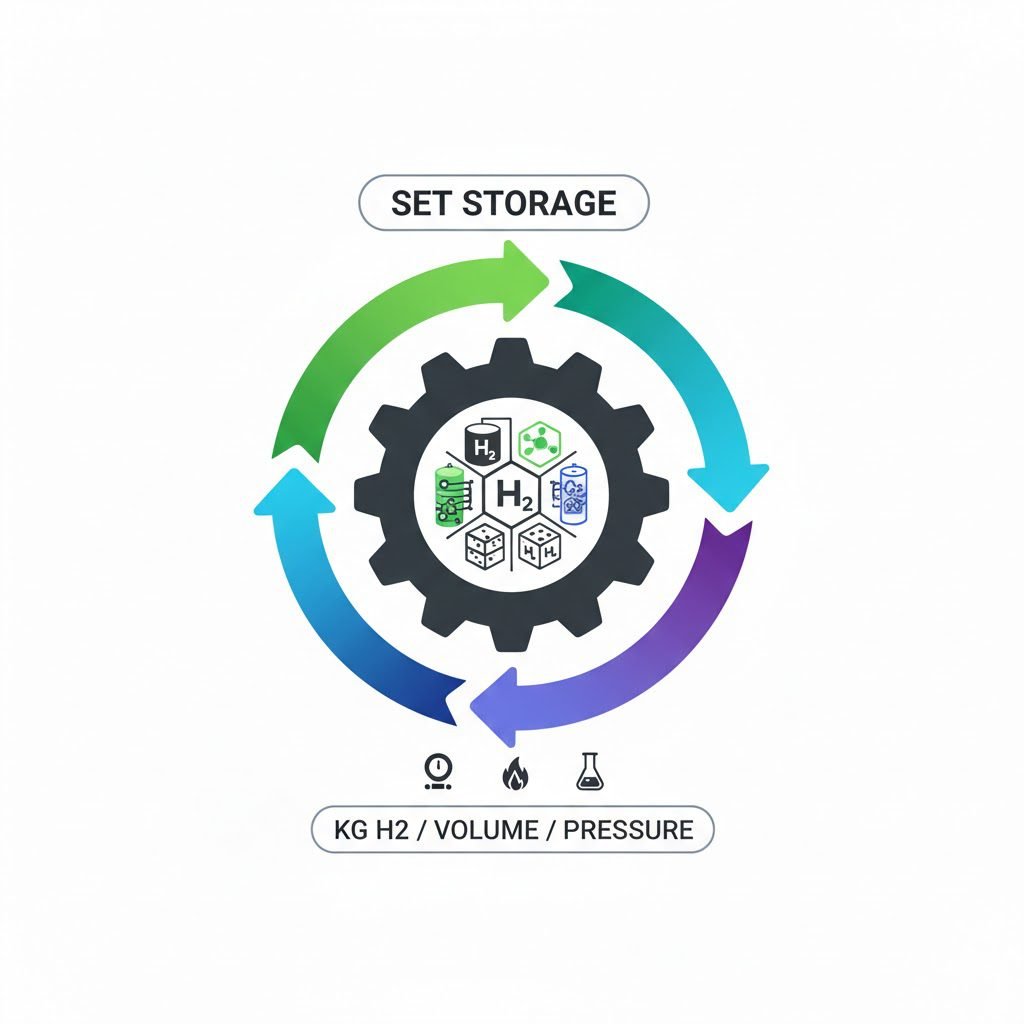
Calculate gravimetric and volumetric hydrogen storage capacity of materials and compare with global targets (e.g., DOE, IEA).
Hydrogen Storage Material Calculator: Practical Insights for Real-World Hydrogen Systems
Hydrogen Storage Material Calculator tools exist because hydrogen storage is rarely a simple lab equation. In the real world, engineers, researchers, and energy planners constantly ask the same question: How much usable hydrogen can this material actually store once it’s inside a real system? Whether you are designing a fuel cell vehicle tank, evaluating a new metal hydride, or comparing MOFs for stationary storage, guessing is not an option. This calculator bridges that gap by translating material properties into system-level performance you can actually trust.
Hydrogen storage decisions affect safety, cost, system weight, and range. A material that looks great on paper can fail once density, tank mass, or operating conditions are considered. This tool was built to solve that exact problem in a clear, transparent way.
Why Hydrogen Storage Performance Is Hard to Compare
Hydrogen storage materials are often reported using ideal laboratory values, not system reality. Two materials may both claim 6 wt% hydrogen capacity, but behave very differently once packaged into a tank.
Common challenges include:
Confusing material-level vs system-level gravimetric capacity
Ignoring volumetric limits that affect tank size
Missing how density impacts total hydrogen stored
Comparing results without global benchmarks like DOE targets
The Hydrogen Storage Material Calculator solves this by applying consistent assumptions and presenting results in a format that mirrors real engineering decisions.
Hydrogen Storage Material Calculator
How the Hydrogen Storage Material Calculator Works
Key Inputs Explained
The calculator focuses on the most important parameters that influence hydrogen storage:
Hydrogen Capacity (wt%): Weight percent of hydrogen in the material.
Material Density (g/cm³): Used to calculate volumetric storage.
System Mass (kg): Includes tank, balance of plant, and structure.
Operating Temperature & Pressure: Inform context, even if not directly computed.
Core Calculations (Simple and Transparent)
System Gravimetric Capacity
The tool assumes ~70% of system mass is active material.
Inline formula: System wt% = Material wt% × 0.7
Volumetric Hydrogen Capacity
Expressed as kilograms of hydrogen per liter: Volumetric capacity (kg/L) = (wt% ÷ 100) × density
Total Hydrogen Stored
How much hydrogen your full system can hold: H₂ stored (kg) = (System wt% ÷ 100) × system mass
These calculations match exactly what the tool displays, ensuring full trust and reproducibility.
Step-by-Step Practical Examples
Example 1: Metal Hydride for Stationary Storage
wt% = 5.5
Density = 1.5 g/cm³
System mass = 100 kg
Results:
System gravimetric ≈ 3.85 wt%
Volumetric ≈ 0.083 kg H₂/L
Total hydrogen ≈ 3.85 kg
This shows why metal hydrides excel in volumetric efficiency, even when gravimetric performance is moderate.
Example 2: MOF Material Comparison
wt% = 7.0
Density = 0.6 g/cm³
Despite higher wt%, volumetric storage drops significantly. This explains why MOFs often require cryogenic conditions to compete at scale.
Example 3: Vehicle Range Check
Fuel cell vehicles typically need 5–6 kg of hydrogen for ~500 km range. By adjusting system mass and wt%, you can instantly see if a material is realistically viable.
Try changing inputs yourself to see how close your design gets.
Performance Benchmarking Against Global Targets
The calculator compares your results with widely referenced goals:
DOE gravimetric target: ~6.5 wt%
DOE volumetric target: ~0.050 kg H₂/L
Results are rated from Developmental to Excellent, giving instant context instead of raw numbers.
Related Tools You May Find Useful
If you work in materials or chemical engineering, these tools pair naturally with hydrogen storage analysis:
Is this calculator suitable for academic research?
Yes. It uses transparent assumptions and matches common system-level approximations used in early-stage research and feasibility studies.
Does higher wt% always mean better storage?
No. Density and system mass matter. Volumetric performance often limits real designs.
Can I use this for custom or experimental materials?
Absolutely. Select Custom Material and input measured or predicted values.
Conclusion
The Hydrogen Storage Material Calculator is designed for people who need answers, not marketing numbers. It translates material properties into usable system performance, helping you make better decisions faster.
Test different scenarios, compare materials honestly, and explore related tools to deepen your analysis. This is how hydrogen storage moves from theory to reality.
Ahmad Ali Is The Founder Of Ahmad Free Tools, Creating Free Online Tools That Help Users Complete Everyday Tasks Quickly And Efficiently. With 6000+ Online Tools Developed, He Is Recognized As An Expert In Building Practical, User-Friendly Digital Solutions.