Indoor Air Ionization Impact Calculator
Indoor Air Ionization Impact Calculator
Estimate the potential impact of negative ion generation on indoor air quality based on ion concentration and room characteristics.
Indoor Air Ionization Impact Calculator: Measure & Improve Your Indoor Air Quality
Indoor air quality is no longer a luxury—it’s essential for health, focus, and overall well-being. The Indoor Air Ionization Impact Calculator empowers you to understand how negative ions can influence the air you breathe, whether at home, in offices, or public spaces. Imagine sitting in a room with cleaner, fresher air without constantly opening windows or relying solely on filters. This calculator gives you a tangible way to measure and optimize indoor air ionization, improving comfort and potentially enhancing your mood, alertness, and sleep quality.
Why Indoor Air Ionization Matters
Indoor air often contains pollutants like dust, allergens, and volatile organic compounds (VOCs), which can accumulate unnoticed. Negative ionization is a proven method to reduce airborne particles by charging them so they cluster and settle, effectively “cleaning” the air.
Key benefits of indoor air ionization include:
-
Reduction of airborne dust and allergens
-
Potential improvement in mood and alertness
-
Enhanced perception of freshness in indoor environments
-
Support for HVAC systems in pathogen reduction
Studies indicate that natural environments like forests and waterfalls contain 10,000–50,000+ ions/cm³, which is often much higher than unfiltered indoor air levels (<1,000 ions/cm³). Using a dedicated ionizer can help replicate some of these benefits indoors.
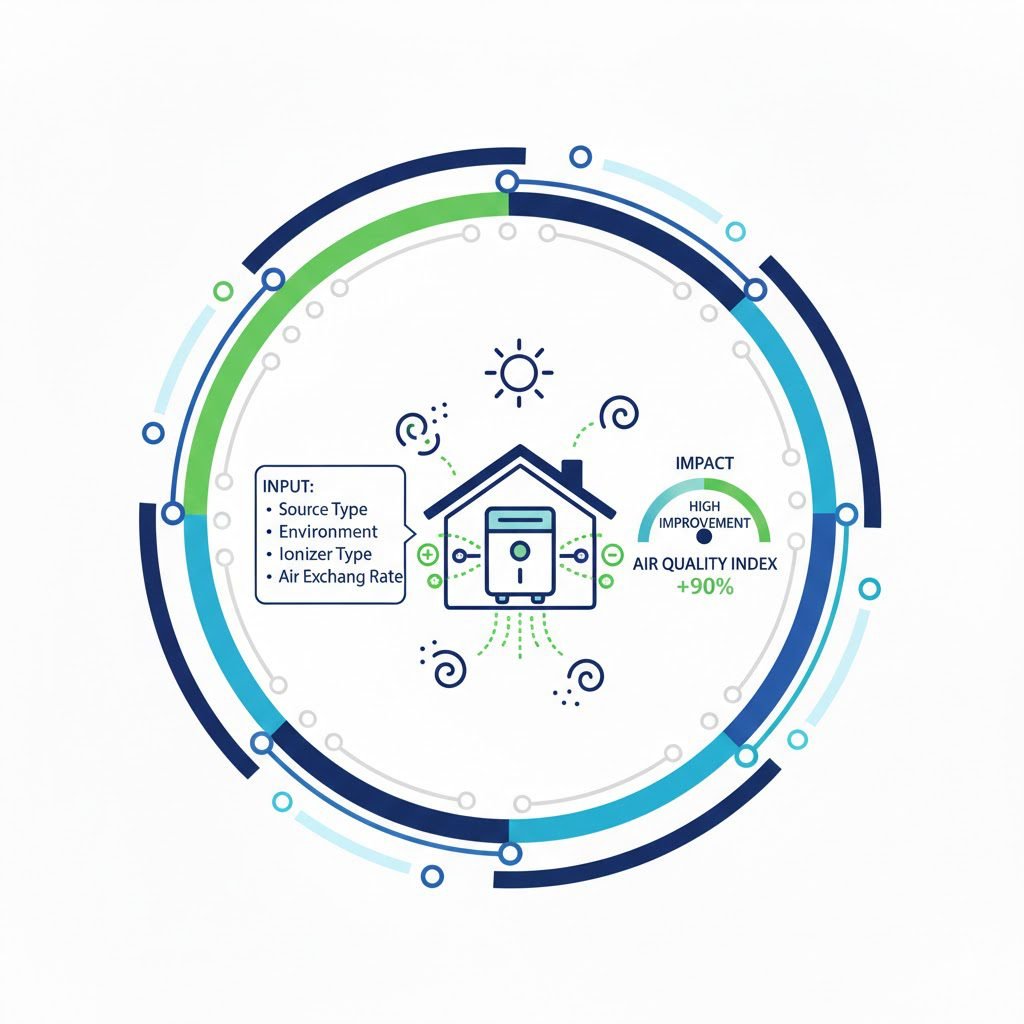
How the Indoor Air Ionization Impact Calculator Works
The tool estimates the effect of negative ion generation on indoor air quality based on three primary inputs:
-
Negative Ion Concentration (ions/cm³): Number of ions generated in the room.
-
Room Size (m³): Larger rooms require higher ion generation to achieve similar benefits.
-
Ionizer Type / Usage: From no device to high-output bipolar ionizers.
Calculation Logic
The calculator uses benchmarks based on global research:
Impact status is determined as:
-
Positive Impact: Ion concentration meets or exceeds the recommended level for that device type.
-
Neutral / Minimal Impact: Concentration is moderate; minor improvement is possible.
-
Limited / Concern Level: Too low to provide meaningful benefit.
The tool also estimates benefit levels:
-
High: >20,000 ions/cm³ — comparable to natural outdoor air
-
Good: 10,000–20,000 ions/cm³ — supports mood, alertness, particle reduction
-
Moderate: 5,000–10,000 ions/cm³ — slight air freshening effect
-
Low: <5,000 ions/cm³ — minimal noticeable effect
Finally, it calculates ions per cubic meter for perspective:
This helps users understand concentration relative to their room size.
Step-by-Step Examples
Example 1: Small Bedroom, Basic Ionizer
-
Negative Ion Concentration: 10,000 ions/cm³
-
Room Size: 25 m³
-
Ionizer Type: Basic Air Purifier with Ionizer
Calculation:
Example 2: Office Space, Dedicated Ion Generator
-
Negative Ion Concentration: 50,000 ions/cm³
-
Room Size: 100 m³
-
Ionizer Type: Dedicated Negative Ion Generator
Calculation:
Example 3: Living Room, No Ionizer
-
Negative Ion Concentration: 800 ions/cm³
-
Room Size: 50 m³
-
Ionizer Type: None
Calculation:
These examples demonstrate how ion concentration and room volume directly influence air quality impact. Users can experiment with different ionizer types and room sizes to optimize results.
Practical Tips for Maximizing Indoor Ionization
-
Combine ionization with ventilation: Fresh air intake enhances overall air quality.
-
Use HEPA filters: Negative ions complement particle removal but do not replace filtration.
-
Avoid excessive ionization: Very high levels (>1 million ions/cm³) may produce ozone; choose CARB-certified devices.
-
Test different placements: Position ionizers near airflow sources for even distribution.
For related calculators and environmental tools, you can explore:
FAQs
Q1: How do I know if my room has enough negative ions?
A: Use the Indoor Air Ionization Impact Calculator. Enter your room size, ion concentration, and device type to see the impact and benefit level.
Q2: Can negative ions replace air filters?
A: No. Negative ions reduce airborne particles but should be combined with HEPA filters or ventilation for optimal indoor air quality.
Q3: Are high-output ionizers safe?
A: Certified devices (CARB-tested) are generally safe. Avoid devices producing ozone above recommended levels, and always follow manufacturer guidelines.
Conclusion
The Indoor Air Ionization Impact Calculator is an essential tool for anyone serious about improving indoor air quality. By understanding how negative ion concentration interacts with room volume and ionizer type, you can make informed decisions that improve comfort, health, and environmental wellness.
Practical takeaway: Test different ionizer types, adjust room placement, and monitor air quality to achieve the most effective and safe outcomes. For a deeper dive into environmental chemistry and related calculators, explore our full suite of tools.