Noise Pollution Impact Calculator
Noise Pollution Impact Calculator
Estimate the potential health, productivity, and well-being impact of noise pollution in your daily environment – globally applicable approximation.
Noise Pollution Impact Calculator: Assess Your Daily Noise Risk Easily
Noise pollution is an invisible hazard that affects millions worldwide every day. From traffic hum in busy cities to aircraft overhead, the impact on our health, sleep, and productivity is often underestimated. That’s where the Noise Pollution Impact Calculator becomes invaluable. This tool provides a clear, practical estimate of your personal risk from environmental noise, helping you make informed decisions to protect your well-being.
Whether you live in a bustling urban center or a quieter suburb, understanding how noise affects your daily life can prevent long-term health issues such as sleep disturbances, stress, and cardiovascular strain.
Why Measuring Noise Pollution Matters
Noise pollution is not just a nuisance—it is a documented health risk. Research shows that chronic exposure to sound levels above 55 dB during the day or 40 dB at night can contribute to:
-
Increased stress levels and irritability
-
Sleep disruption, affecting overall recovery and productivity
-
Cardiovascular strain including hypertension and heart disease
-
Cognitive impairment in children, affecting learning and attention
-
Gradual hearing loss, especially in adults without hearing protection
By quantifying these risks, the Noise Pollution Impact Calculator allows individuals, urban planners, and environmental health professionals to take preventive action.
How the Noise Pollution Impact Calculator Works
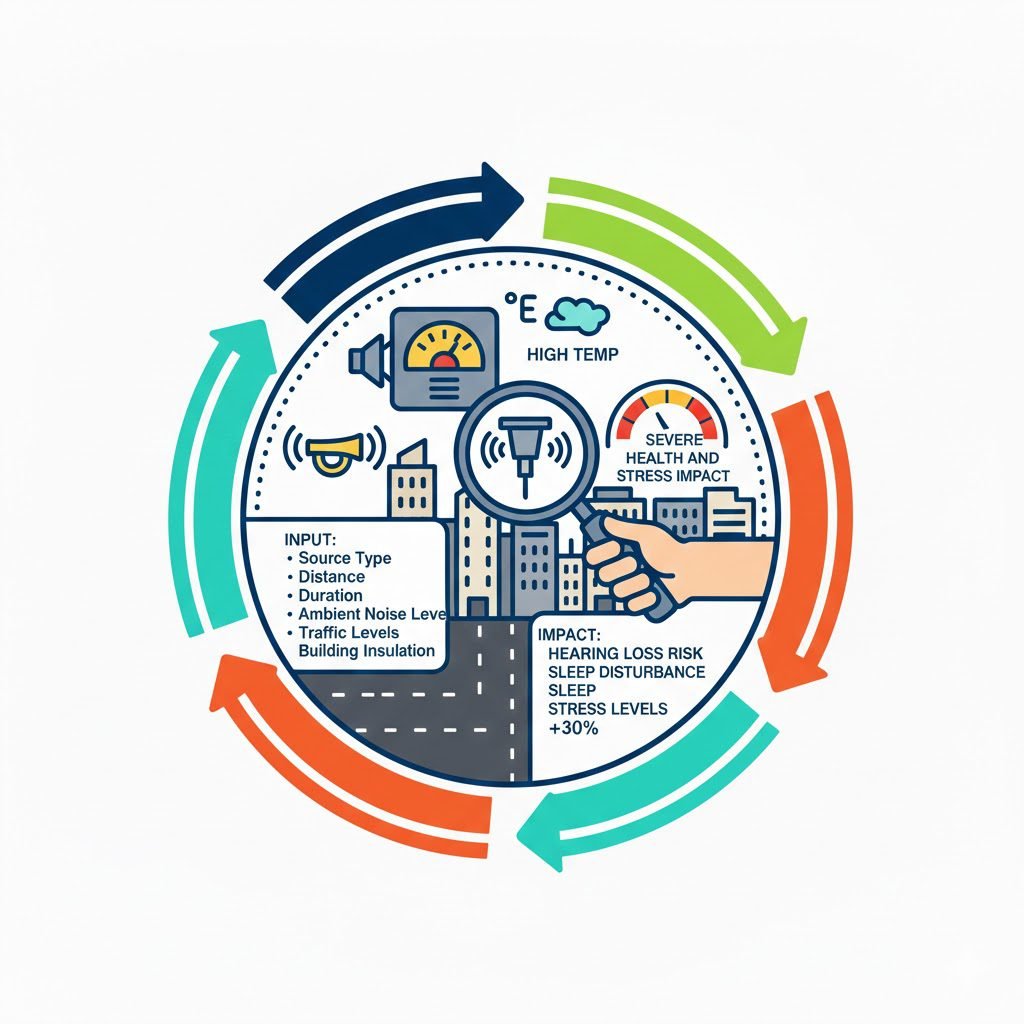
This calculator combines real-world science with practical algorithms to produce a personalized Noise Impact Score. Here’s a breakdown of the process:
Inputs Required
-
Average Daytime Noise Level (dB) – Typical city streets may reach 65 dB, while quiet suburban areas can be 45 dB.
-
Average Nighttime Noise Level (dB) – Nighttime exposure is crucial for sleep quality; city nights may reach 50 dB.
-
Daily Exposure Duration (hours) – How long you’re exposed to noise each day (e.g., 16 hours of waking activity).
-
Primary Noise Source – Traffic, aircraft, construction, neighbors, or other environmental sounds.
-
Age Group – Children, adults, or seniors, as sensitivity varies by age.
-
Hearing Protection Usage – Whether you use earplugs or protective devices.
How Calculations Are Made
The calculator uses a combination of threshold-based risk scoring and multipliers:
-
Daytime Noise Risk
-
Threshold: 55 dB
-
Example: If daytimeDb = 65 → (65 – 55) × 3 = 30 points
-
Nighttime Noise Risk
-
Threshold: 40 dB
-
Example: If nighttimeDb = 50 → (50 – 40) × 5 = 50 points
-
Total Weighted Risk
-
Adjusts for hours of exposure, giving more weight to time spent in noisy environments.
-
Modifiers for Source, Age, and Protection
-
Source: Aircraft (×1.5), Construction (×1.4), Traffic (×1.2), Others (×1.0)
-
Age: Children (×1.4), Seniors (×1.3), Adults (×1.0)
-
Protection: Always (×0.4), Sometimes (×0.7), Never (×1.0)
-
Final Impact Score
-
Max score capped at 300 for relative comparison
-
Categorized as Low, Moderate, High, Very High, or Severe
Step-by-Step Examples
Example 1: Urban Office Worker
-
Daytime: 65 dB (city traffic)
-
Nighttime: 50 dB
-
Exposure: 16 hours
-
Source: Traffic
-
Age: Adult
-
Protection: Rarely
Calculation:
-
Daytime risk = (65-55)×3 = 30
-
Nighttime risk = (50-40)×5 = 50
-
Total weighted risk = (30×16/24 + 50×8/24) × 1.2 ≈ 52 points
-
Source modifier ×1.2 → 62.4
-
Age modifier ×1.0 → 62.4
-
Protection ×1.0 → 62.4
Result: 62 points → Moderate noise impact
Example 2: Airport Resident Child
-
Daytime: 70 dB
-
Nighttime: 60 dB
-
Exposure: 18 hours
-
Source: Aircraft
-
Age: Child
-
Protection: Sometimes
Result: ~180 points → High impact; highlights vulnerability in children
Example 3: Senior in Suburban Home
-
Daytime: 50 dB
-
Nighttime: 35 dB
-
Exposure: 14 hours
-
Source: Neighbors
-
Age: Senior
-
Protection: Always
Result: ~20 points → Low impact; protective measures significantly reduce risk
These examples show how age, protection, and noise source drastically influence overall impact, reinforcing the importance of personalized assessments.
Practical Tips to Reduce Noise Impact
-
Install soundproof windows or doors
-
Use earplugs or noise-canceling headphones
-
Introduce plants or vegetation barriers around your home
-
Limit time near loud sources, especially at night
-
Advocate for quieter urban planning and traffic management
For urban professionals, combining multiple strategies is often most effective.
Related Tools for Environmental Awareness
-
Deforestation Carbon Loss Calculator – assess environmental impact of deforestation
-
Greenhouse Gas Equivalent Calculator – convert emissions into relatable terms
-
Plastic Waste Microfiber Release Calculator – understand household microplastic pollution
-
Environmental Chemistry Calculators – explore additional eco-impact calculations
FAQs
1. Can short-term exposure affect my health?
Even brief exposure above safe dB levels can cause temporary stress or sleep disruption. Chronic exposure is more concerning.
2. How accurate is this calculator?
It provides a global approximation based on WHO/EU noise guidelines. Individual sensitivity may vary.
3. How can I test scenarios?
Adjust daytime/nighttime dB, exposure hours, and protection levels to simulate different living conditions or workplaces.
Conclusion
The Noise Pollution Impact Calculator empowers you to understand your daily noise exposure in a tangible way. By combining scientific thresholds with practical modifiers like age and protection, it provides actionable insights into your health risks.
Test different scenarios, explore mitigation strategies, and pair this tool with other environmental calculators to take control of your personal and community noise environment.