Storage Container Material Safety Calculator
Storage Container Material Safety Calculator
Quick assessment of relative chemical compatibility & material safety risk when storing substances in common industrial containers (approximation – always verify with manufacturer data sheets & regulations).
Storage Container Material Safety Calculator: Assess Chemical Storage Risks Accurately
When storing chemicals or industrial liquids, choosing the right container material is more than a convenience—it’s a critical safety decision. The Storage Container Material Safety Calculator helps professionals, lab technicians, and industrial operators quickly evaluate the risk of storing substances in common materials like HDPE, polypropylene, stainless steel, or fiberglass.
Imagine a warehouse storing various cleaning agents or oils: one container may seem fine at room temperature, but after a few months in summer heat, chemical reactions could compromise the material, leading to leaks or contamination. This calculator provides a practical, data-driven way to anticipate such risks, saving time, money, and ensuring safety compliance.
Why Material Compatibility Matters
Chemical compatibility refers to how safely a substance can interact with the material of its container. Using the wrong container can cause:
-
Corrosion or degradation of the container material
-
Leaching of harmful substances into the stored chemical
-
Pressure build-up or leaks, creating hazards for staff
-
Shortened shelf-life for sensitive substances
Key factors influencing compatibility include:
-
Chemical type and concentration
-
Container material properties (resistance to acids, bases, solvents)
-
Temperature of storage
-
Storage duration
By analyzing these factors together, our calculator estimates a risk score that helps guide safe storage practices.
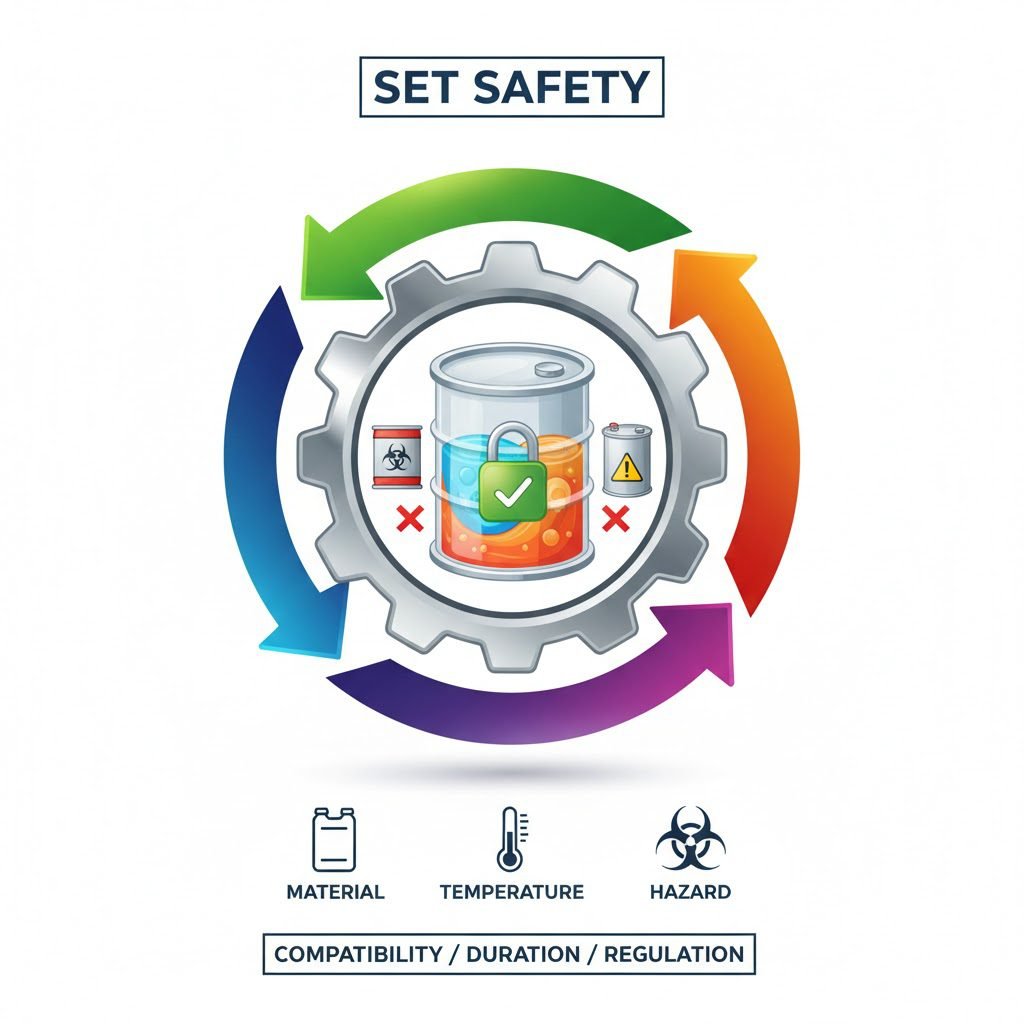
How the Storage Container Material Safety Calculator Works
This tool combines expert knowledge of materials chemistry with practical safety standards. Here’s how it evaluates risk:
Inputs:
-
Stored Substance Category: e.g., water, oils, mild acids, strong oxidizers, or solvents.
-
Container Material: HDPE, LDPE, PP, PVC, stainless steel, aluminum, or fiberglass-reinforced plastic.
-
Temperature (°C): Affects reaction rates—the tool models the general principle that every 10 °C increase roughly doubles reaction rate.
-
Storage Duration: Short-term (<1 month) to very long-term (>5 years), reflecting cumulative exposure.
Calculation Logic:
The tool uses a simple but effective formula:
-
Base Compatibility Factor =
substance × material
Higher numbers indicate more aggressive interactions. -
Temperature Acceleration Factor =
2^((temp - 25)/10)
Adjusted between 0.7–4.5 to reflect practical extremes. -
Duration Multiplier = ranges 0.6–2.3 depending on storage length.
Output:
-
Risk Score: Numeric estimate (0–40+)
-
Risk Level: Very Low, Low–Moderate, Moderate–High, High/Very High
-
Practical Advice: Whether the material is safe, requires monitoring, or should be replaced
This transparent, step-by-step calculation ensures users understand why a container may be unsafe, not just the score.
Step-by-Step Examples
Example 1: Storing Neutral Oils in HDPE
Inputs:
-
Substance: Neutral oils → factor 2
-
Material: HDPE → factor 1
-
Temperature: 25 °C
-
Duration: Medium-term (1–12 months) → multiplier 1
Calculation:
Result: Very Low Risk — Excellent compatibility.
✅ Suitable for medium-term storage without monitoring.
Example 2: Storing Acetic Acid in PP at 40 °C
Inputs:
-
Substance: Mild acids → factor 4
-
Material: PP → factor 3
-
Temperature: 40 °C
-
Duration: Long-term (>1 year) → multiplier 1.7
Calculation:
Result: High/Very High Risk — NOT RECOMMENDED.
⚠️ Alternative container like stainless steel or FRP suggested.
Example 3: Storing Gasoline Blends in HDPE at 30 °C
Inputs:
-
Substance: Gasoline/Ethanol blend → factor 7.5
-
Material: HDPE → factor 1
-
Temperature: 30 °C
-
Duration: Short-term (<1 month) → multiplier 0.6
Calculation:
Result: Low–Moderate Risk — Acceptable for short-term storage.
⚠️ Avoid long-term storage; consider specialized fuel containers.
Practical Recommendations
-
Always consult SDS/MSDS sheets for precise chemical handling.
-
Monitor temperature and duration for stored substances.
-
Use secondary containment for high-risk chemicals.
-
Regularly inspect containers for cracks, discoloration, or leakage.
-
Consider upgrading to certified IBCs, stainless steel, or lined containers for aggressive chemicals.
Internal links for reference:
-
Explore Chemical Container Pressure Calculator to assess storage pressure risks.
-
Check Emergency Chemical Response Calculator for safety planning.
-
Review Daily-Use Plastic Chemical Safety Calculator for routine material checks.
Frequently Asked Questions (FAQs)
1. Can this tool replace chemical compatibility charts?
No. It provides an approximate risk assessment. Always verify with manufacturer charts, SDS, and regulatory standards for hazardous chemicals.
2. How does temperature affect risk?
Reaction rates generally double every 10 °C above 25 °C. Higher temperatures accelerate material degradation, increasing the risk score.
3. Which materials are safest for long-term storage?
Stainless steel (304/316) and FRP are highly resistant to most acids, alkalis, and solvents. Plastics like HDPE or PP are generally safe for neutral liquids or short-term storage.
Conclusion
The Storage Container Material Safety Calculator is a practical, expert-designed tool for industrial, laboratory, and warehouse professionals. By combining chemical type, container material, temperature, and duration, it provides actionable insights for safe storage.
Testing different inputs, like more aggressive chemicals or extended storage periods, helps you preemptively identify risks and select the best containers. For more guidance, explore related tools on materials chemistry calculators for comprehensive safety planning.