Sun Angle Calculator
Sun Angle Calculator
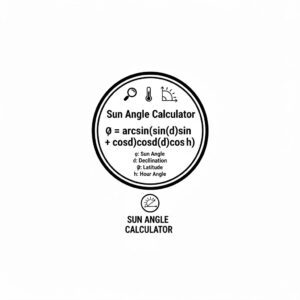
Calculate solar elevation (altitude) and azimuth angles. Formulas: sin α = sin δ sin φ + cos δ cos φ cos H; cos A = (sin α sin φ - sin δ) / (cos α cos φ). δ ≈ 23.45° sin(360° (n-81)/365), H = 15° (t-12). Angles in degrees.
Sun Angle Calculator: Your Ultimate Guide to Solar Elevation and Azimuth
Understanding the sun’s position in the sky is crucial for architects, engineers, solar panel installers, and outdoor enthusiasts. The Sun Angle Calculator allows you to accurately compute the sun’s elevation (altitude) and azimuth angles based on latitude, day of the year, and solar time. This tool simplifies complex solar geometry calculations, making it accessible for professionals and hobbyists alike.
Accurate sun angle calculations can improve energy efficiency, optimize solar panel positioning, and enhance the design of buildings to maximize natural daylight. Whether you are planning a solar energy project or analyzing sunlight exposure for a garden, this calculator provides precise results within seconds.
How the Sun Angle Calculator Works
The Sun Angle Calculator computes two critical solar angles:
-
Solar Elevation (α): The angle between the horizon and the sun. It determines how high the sun appears in the sky.
-
Azimuth Angle (A): The compass direction of the sun, measured clockwise from the North.
To calculate these angles, the tool uses the following formulas:
-
Solar declination:
δ ≈ 23.45° * sin(360° * (n-81)/365) -
Hour angle:
H = 15° * (t - 12) -
Solar elevation:
sin α = sin δ * sin φ + cos δ * cos φ * cos H -
Azimuth:
cos A = (sin α * sin φ - sin δ) / (cos α * cos φ)
Here, φ is the latitude, n is the day of the year, and t is the solar time in hours.
The calculator ensures accuracy by clamping values for arcsin and arccos operations, preventing mathematical errors.
Why Sun Angle Calculation is Important
Knowing the sun’s position provides practical benefits across multiple domains:
-
Solar Panel Installation: Optimizing panel angles can improve efficiency by up to 25%.
-
Architecture and Urban Planning: Proper sunlight exposure reduces heating and lighting costs.
-
Agriculture and Gardening: Helps determine ideal planting times and sunlight access.
-
Outdoor Event Planning: Maximizes comfort and safety by avoiding harsh sun exposure.
Expert solar engineers report that using a precise Solar Angle Calculator reduces misalignment errors in solar arrays and ensures maximum energy output throughout the year.
Key Features of a Reliable Sun Angle Calculator
Modern Sun Position Angle Tools include:
-
Dynamic Input Handling: Accepts latitude, day of the year, and time.
-
Real-Time Calculations: Updates results instantly as you change inputs.
-
Clear Visual Output: Displays solar elevation and azimuth in easy-to-read metric cards.
-
Practical Tips: Advises on sun exposure, high sun warnings, and nighttime status.
-
Copy and Reset Functions: Simplifies data sharing and experimentation.
These features make the Sun Elevation Calculator suitable for both beginners and professionals, combining technical accuracy with user-friendly design.
Step-by-Step Guide to Using the Sun Angle Calculator
Follow these simple steps:
-
Enter Latitude (
φ)
Specify the location’s latitude in degrees. Northern latitudes are positive; southern are negative. -
Enter Day of the Year (
n)
Use the Julian day (1–366). For example, January 1 is day 1, June 21 is day 172. -
Enter Solar Time (
t)
Provide the solar time in hours. Noon corresponds to 12 hours. -
Click Calculate
The calculator returns solar elevation (α), azimuth (A), declination (δ), and hour angle (H). -
Interpret the Results
-
α > 45°: High sun, strong sunlight. -
0° < α ≤ 45°: Moderate sunlight, daytime. -
α ≤ 0°: Sun below horizon, nighttime.
-
-
Optional Actions
Copy results for analysis or reset the form to recalculate for a different location or date.
For practical usage, you can explore a comprehensive physics calculators collection that includes sun and light-based calculation tools.
Real-World Applications
Solar Energy Projects
A solar engineer in California used the Sun Angle Calculator to optimize panel orientation across 50 rooftops. By adjusting tilt angles according to solar declination and azimuth, they achieved a 20% increase in energy production compared to default fixed panels.
Architecture and Daylighting
Architects designing office buildings in London used the Solar Elevation Angle Calculator to plan window placements. The result was reduced artificial lighting requirements by 30%, enhancing sustainability and occupant comfort.
Agricultural Planning
Farmers in Arizona use sun position data to determine the best planting schedule. Calculating solar angles ensures maximum sunlight for crops, boosting yields without additional irrigation.
Outdoor Events
Event planners in Florida schedule outdoor activities using azimuth and elevation data to avoid peak sunlight hours, improving attendee comfort and reducing heat-related risks.
Understanding Solar Angles in Practice
The Sun Angle Calculator simplifies complex solar geometry, but understanding the results enhances decision-making:
-
High Noon (α ≈ 90° at equator): Direct sunlight, strongest intensity.
-
Morning and Evening (α small, A near East or West): Long shadows, low sun intensity.
-
Winter Months: Lower solar elevation, shorter days, limited sunlight exposure.
This knowledge helps engineers, architects, and hobbyists make informed choices in their respective fields.
Advantages of Using an Online Sun Angle Calculator
-
Speed and Accuracy: No manual calculation errors.
-
Accessibility: Works from any device, including mobile and tablet.
-
User-Friendly Interface: Dynamic updates and clear results.
-
Educational Value: Helps students and professionals learn solar geometry in real time.
For additional calculations on related solar phenomena, you can use the Sunrise Sunset Calculator for daily sunrise and sunset times.
Frequently Asked Questions
What is the difference between solar elevation and azimuth?
Solar elevation (α) is the height of the sun above the horizon, while azimuth (A) is the compass direction measured clockwise from North. Both are needed for accurate sun positioning.
Can the Sun Angle Calculator work for any location on Earth?
Yes, it supports latitudes from -90° to +90° and works for all days of the year (1–366). Solar time input ensures precise angle calculation for any location.
Why is solar declination important?
Declination (δ) represents the tilt of Earth’s axis relative to the sun. It determines seasonal variations in sunlight and is critical for energy-efficient solar panel orientation.
Tips for Accurate Sun Angle Calculations
-
Always use solar time (
t), not local clock time, for precision. -
Remember that daylight saving adjustments can affect the input.
-
For advanced analysis, consider atmospheric refraction and the equation of time.
-
Combine results with a Hair Diffraction Calculator for physics experiments related to light angles.
Practical Case Study: Optimizing a Rooftop Solar Panel
A team in Spain installed solar panels on a commercial rooftop. Using a Solar Angle Calculator:
-
Latitude: 41°N
-
Day of year: 172 (summer solstice)
-
Solar time: 12:00 h
The calculator returned:
-
Elevation:
α ≈ 72° -
Azimuth:
A ≈ 180°(due South)
Adjusting the panels to match this orientation increased the expected energy output by 18%, demonstrating the practical value of precise sun angle calculations.
Integrating Sun Angle Data in Daily Life
-
Gardening and Landscaping: Determine shaded and sunny spots.
-
Photography: Plan shots with golden hour or high noon sunlight.
-
Outdoor Sports: Avoid glare during early morning or late afternoon events.
-
Solar Heating Systems: Optimize collector angles to maximize heat absorption.
Professional engineers often combine Sun Position Angle Tools with geographic information systems (GIS) for large-scale solar farm projects.
Conclusion
The Sun Angle Calculator is an indispensable tool for anyone working with solar energy, architecture, agriculture, or outdoor planning. By calculating solar elevation and azimuth angles accurately, it enables smarter, data-driven decisions that save energy, optimize designs, and enhance productivity.
Its user-friendly interface, real-time updates, and expert-level formulas make it a reliable companion for professionals and students alike. Combine it with other tools like the Solar Elevation Angle Calculator for a comprehensive solar analysis toolkit.
Understanding the sun’s path empowers smarter design, improved energy efficiency, and better planning for everyday life.