Traffic Congestion Impact Calculator
Traffic Congestion Impact Calculator
Estimate time lost, extra fuel used, and financial cost due to traffic congestion on your regular trips – globally applicable for daily commuters.
Traffic Congestion Impact Calculator: Measure Time and Fuel Costs Effectively
Traffic congestion is a daily reality for millions of commuters worldwide. Whether you’re driving to work, delivering goods, or managing a fleet of vehicles, the hidden costs of traffic can add up quickly. The Traffic Congestion Impact Calculator is designed to provide precise estimates of extra time lost, additional fuel consumption, and financial impact due to congested roads, giving commuters and fleet managers a clear picture of the real cost of traffic delays.
This tool not only quantifies your losses but also helps identify practical solutions, making it a valuable resource for personal and professional planning.
Why Understanding Traffic Congestion Impact Matters
Traffic congestion doesn’t just delay your commute; it has significant economic and environmental consequences:
-
Time Loss: Stop-and-go traffic can increase commuting time by 50–200%, translating to lost work hours and reduced productivity.
-
Fuel Wastage: Vehicles are less fuel-efficient in traffic, consuming 20–50% more fuel than during steady driving.
-
Financial Costs: Extra fuel usage, vehicle wear, and the opportunity cost of lost time combine to form a significant annual burden.
-
Environmental Impact: Higher fuel consumption leads to increased greenhouse gas emissions, contributing to urban air pollution.
For instance, studies show that drivers in Bangalore, Moscow, and Istanbul can lose over 200 hours per year in traffic—equivalent to almost 9 full days.
By using this calculator, you can quantify these costs accurately and explore strategies to reduce them.
How the Traffic Congestion Impact Calculator Works
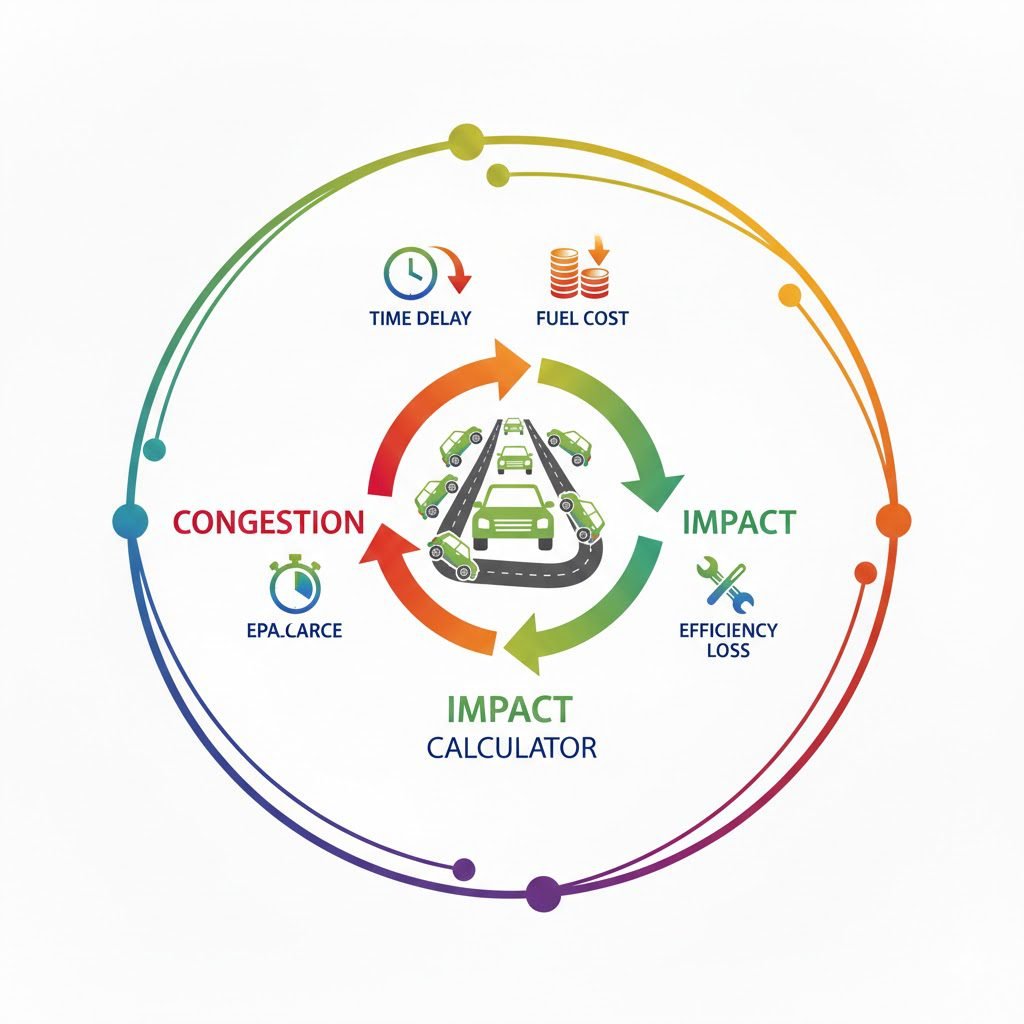
The calculator estimates time lost, extra fuel used, and financial impact using realistic traffic models. It considers both free-flow and congested speeds, monthly workdays, and your vehicle’s efficiency.
Key Inputs
-
Trip Distance (km) – Distance of your one-way commute.
-
Free-Flow Speed (km/h) – Average speed under uncongested conditions.
-
Congested Speed (km/h) – Average speed during traffic jams.
-
Work Days per Month – Number of commuting days per month.
-
Fuel/Electricity Efficiency (km/L or km/kWh) – Vehicle consumption rate.
-
Fuel/Electricity Price – Current cost per liter or kWh.
-
Currency Symbol – For display purposes.
Calculation Logic
-
Round-Trip Distance:
roundTrip = distance * 2 -
Time Lost Per Round Trip:
-
Monthly and Annual Time Loss:
-
Fuel Impact (30% increase in stop-and-go traffic):
This formula accounts for both time and cost, providing a complete picture of congestion impact.
Step-by-Step Examples
Example 1: Daily Commuter
-
Distance: 30 km one-way
-
Free-Flow Speed: 80 km/h
-
Congested Speed: 30 km/h
-
Fuel Efficiency: 15 km/L
-
Fuel Price: $1.50/L
-
Work Days: 22
Calculations:
-
Extra Time per Trip:
(60 km / 30 km/h) - (60 km / 80 km/h) = 2 - 0.75 = 1.25 hours (~75 minutes) -
Monthly Time Lost:
1.25 * 22 ≈ 27.5 hours -
Annual Time Lost:
27.5 * 12 ≈ 330 hours (~13.75 days) -
Monthly Extra Fuel Cost:
(60 / 15 * 0.3) * 22 * 1.5 ≈ $66 -
Annual Extra Cost:
$66 * 12 ≈ $792
This shows that a seemingly small daily slowdown can lead to hundreds of lost hours and substantial fuel costs annually.
Example 2: Fleet Vehicle Scenario
-
Distance: 50 km one-way
-
Free-Flow Speed: 100 km/h
-
Congested Speed: 40 km/h
-
Fuel Efficiency: 12 km/L
-
Fuel Price: $1.20/L
-
Work Days: 25
The calculator instantly estimates total fleet time loss and extra fuel costs, helping managers plan routes or shifts to optimize efficiency.
Example 3: Electric Vehicle Commuter
-
Distance: 25 km one-way
-
Free-Flow Speed: 70 km/h
-
Congested Speed: 25 km/h
-
Efficiency: 6 km/kWh
-
Electricity Price: $0.20/kWh
Even with EVs, stop-and-go traffic reduces efficiency, increasing monthly electricity costs, which the calculator accurately estimates.
Practical Tips to Reduce Traffic Impact
-
Use Traffic Apps: Google Maps, Waze, or local traffic feeds to avoid peak congestion.
-
Carpool or Public Transit: Sharing rides reduces cost, fuel usage, and congestion.
-
Flexible Hours or Remote Work: Shift commute times or work from home to save hours.
-
Fleet Management: Use route optimization for delivery vehicles to reduce fuel and time losses.
For deeper insights into vehicle costs, you can explore related calculators:
Frequently Asked Questions (FAQs)
Q1: Can this calculator be used for electric vehicles?
Yes. Simply input your EV’s efficiency in km/kWh and the electricity price per kWh. The calculator accounts for stop-and-go efficiency reduction.
Q2: How accurate are the time and fuel estimates?
Estimates are based on typical traffic patterns and real-world efficiency reductions. While individual results may vary slightly, they provide a reliable approximation for planning purposes.
Q3: Does it include vehicle maintenance or wear costs?
No, the calculator focuses on time and fuel/electricity costs. For total vehicle cost, consider using our Multi-Year Fleet Cost Simulator.
Conclusion
The Traffic Congestion Impact Calculator empowers commuters and fleet managers to quantify the hidden costs of traffic. By measuring lost time, extra fuel, and financial impact, users gain actionable insights for improving commuting efficiency, reducing costs, and lowering environmental impact.
Whether you are a daily commuter, a fleet operator, or simply curious about the cost of congestion, this tool provides real, expert-backed calculations. Test different routes, speeds, and vehicles to explore how small changes can save hours and money each year.