Unlevered Free Cash Flow Calculator
Unlevered Free Cash Flow Calculator
Calculate UFCF (FCFF) – cash flow available to all investors before debt effects. Core metric for DCF valuation worldwide
What is the Unlevered Free Cash Flow Calculator
The Unlevered Free Cash Flow Calculator is an essential tool for finance professionals, business owners, and investors who want to understand a company’s cash generation capacity without the impact of debt. By calculating unlevered free cash flow (UFCF), one can assess the real operating performance of a business, making it easier to project future cash flows, determine enterprise value, and make informed investment decisions. Unlike net cash flow metrics, UFCF focuses purely on operational efficiency, ignoring interest payments and financing structures.
Understanding Unlevered Free Cash Flow
Unlevered free cash flow represents the cash available to all capital providers – debt holders and equity holders alike – before any interest payments are deducted. It’s the cornerstone metric used in discounted cash flow (DCF) valuations and serves as a benchmark for assessing a firm’s financial health.
The standard formula for UFCF is:
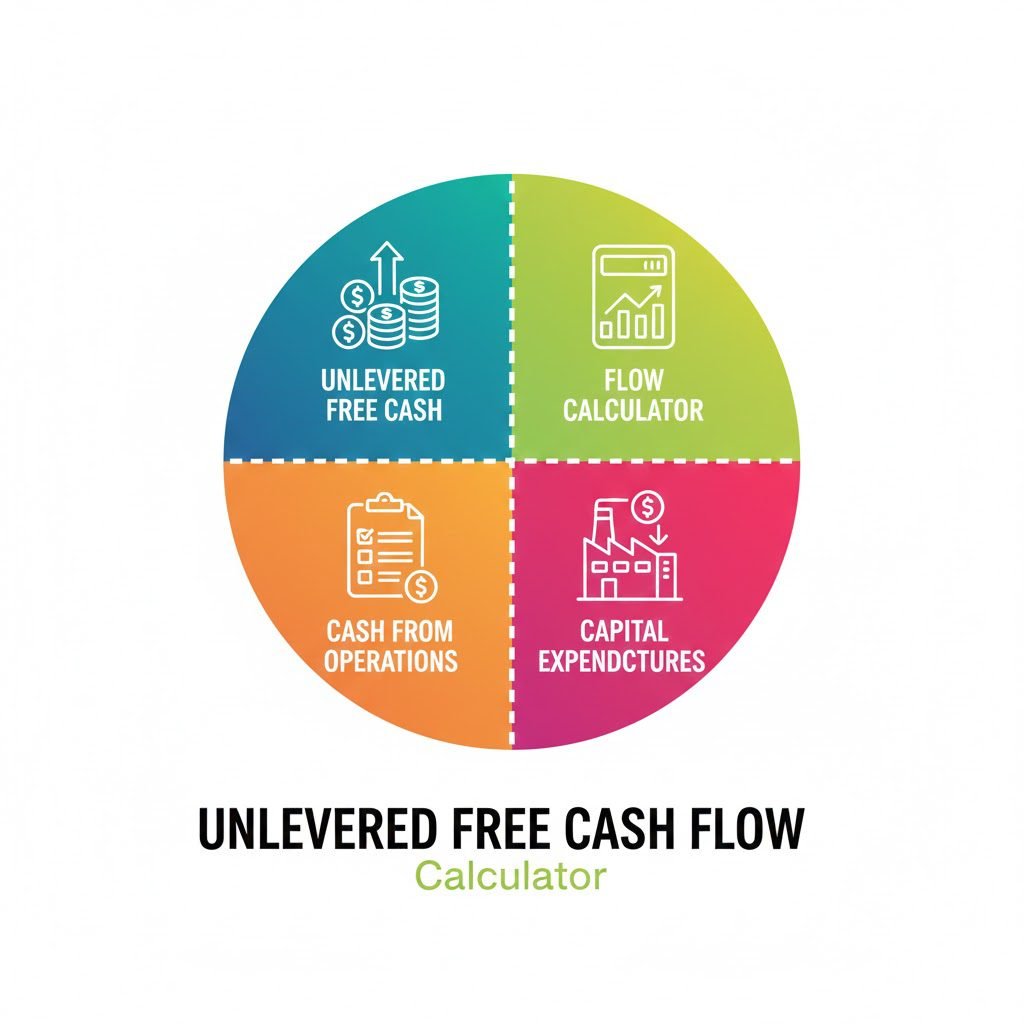
UFCF = EBIT × (1 − Tax Rate) + Depreciation − CapEx − ΔNWC
Where:
-
EBIT= Earnings Before Interest and Taxes -
Tax Rate= Applicable corporate tax percentage -
Depreciation= Non-cash charges reducing taxable income -
CapEx= Capital expenditures for assets -
ΔNWC= Change in net working capital
By focusing on operational performance and ignoring debt, this metric gives a clear picture of a company’s capacity to generate cash for reinvestment, dividends, or debt repayment.
Why Use an Unlevered Free Cash Flow Calculator
An unlevered free cash flow estimator provides several advantages:
-
Accuracy in Valuation: Ensures unbiased cash flow projections for enterprise value calculations.
-
Decision-Making Tool: Helps investors and executives make strategic financial decisions.
-
Comparative Analysis: Allows comparison of companies regardless of their capital structure.
-
Forecasting: Useful for long-term financial planning and scenario analysis.
Finance professionals often combine UFCF with other tools like a sales calculator to project revenue growth and operational efficiency simultaneously. Similarly, integrating UFCF with a revenue growth calculator helps model future cash inflows more accurately.
How to Calculate Unlevered Free Cash Flow
Step-by-step calculation of UFCF is straightforward using a free cash flow calculator:
-
Determine EBIT: Start with operating profit, which represents earnings before interest and taxes.
-
Apply Tax Rate: Calculate net operating profit after tax (NOPAT) using
NOPAT = EBIT × (1 − Tax Rate). -
Add Depreciation and Amortization: Non-cash charges are added back to reflect true cash flow.
-
Subtract Capital Expenditures (CapEx): Deduct funds spent on property, plant, equipment, or other assets.
-
Adjust for Net Working Capital: Subtract any increase in working capital or add if it decreases.
For example, consider a company with:
-
EBIT = $18,000,000 -
Tax Rate = 30% -
Depreciation = $6,000,000 -
CapEx = $8,000,000 -
ΔNWC = $2,000,000
The UFCF calculation would be:
NOPAT = 18,000,000 × (1 − 0.30) = 12,600,000UFCF = 12,600,000 + 6,000,000 − 8,000,000 − 2,000,000 = 8,600,000
This value indicates strong operational cash generation, making the business a promising investment opportunity.
Key Benefits of an Unlevered FCF Calculator
Using an unlevered fcf calculator brings multiple advantages:
-
Simplifies Complex Calculations: Eliminates manual errors and speeds up financial analysis.
-
Scenario Planning: Allows finance teams to test assumptions like growth rates, tax variations, and CapEx adjustments.
-
Investor Confidence: Provides transparent, debt-independent insights to potential investors.
-
Benchmarking: Compares UFCF trends across periods, highlighting operational efficiency improvements.
Many professionals rely on a cash flow projection calculator to integrate UFCF forecasts with multi-year financial planning, which ensures realistic and actionable financial strategies.
Real-Life Case Study: Tech Industry Example
A mid-sized tech company planning international expansion used UFCF to evaluate its funding needs. After calculating unlevered free cash flow:
-
Year 1 UFCF: $5M
-
Year 2 UFCF: $7M
-
Year 3 UFCF: $9.5M
Investors used this data to assess debt capacity, make capital allocation decisions, and forecast returns. By focusing on UFCF rather than net income, the company highlighted its operational strength without the distortion of financing choices.
Common Misconceptions About UFCF
-
UFCF is not Net Income: UFCF excludes debt payments and interest, providing a pure operational perspective.
-
Positive UFCF doesn’t mean instant profitability: A company can have positive UFCF but still report accounting losses due to non-cash expenses.
-
CapEx heavily influences UFCF: Significant investments reduce UFCF in the short term but may drive long-term growth.
Using a unlevered free cash flow estimator can clarify these misconceptions, offering a more objective view of cash generation.
Advanced Applications
Finance experts often combine UFCF with other tools for deeper analysis:
-
DCF Valuation: UFCF is discounted using WACC to determine enterprise value.
-
Growth Analysis: Multi-year cash flow projections help identify trends.
-
Scenario Modeling: Adjusting CapEx or NWC to simulate best-case and worst-case outcomes.
-
Investment Screening: Comparing UFCF across companies to prioritize investment opportunities.
For professionals seeking integrated calculations, linking a UFCF model with a finance calculators directory allows seamless access to related tools like debt calculators, ROI estimators, and profitability metrics.
Tips for Accurate UFCF Calculation
-
Ensure EBIT is adjusted for non-recurring items.
-
Use realistic tax rates reflective of local laws.
-
Include all major capital expenditures to avoid overestimating cash flow.
-
Account for seasonal fluctuations in net working capital.
-
Consider using a digital unlevered free cash flow calculator to reduce errors and save time.
FAQs About Unlevered Free Cash Flow
Q1: Can UFCF be negative, and what does it mean?
Yes. Negative UFCF typically indicates high CapEx or rising working capital. It may reflect investment in growth rather than poor performance.
Q2: How is UFCF different from levered free cash flow?
UFCF ignores debt payments, showing cash available to all investors. Levered free cash flow subtracts interest, reflecting cash available only to equity holders.
Q3: How frequently should I calculate UFCF?
Quarterly calculation is standard for internal management, while annual figures are common for valuation and investor reporting.
Conclusion
The Unlevered Free Cash Flow Calculator is a critical financial tool for anyone seeking to understand a company’s cash generation independent of its capital structure. From DCF valuations to scenario modeling and investment decision-making, UFCF offers unparalleled insights into operational efficiency and financial health.
Using this tool, combined with resources like a sales calculator or a revenue growth calculator, professionals can make accurate forecasts, plan growth strategies, and communicate confidently with stakeholders. Whether for a tech startup or a multinational corporation, mastering UFCF ensures smarter investments and stronger financial planning.