Toxic Chemical Dose Calculator
Toxic Chemical Dose Calculator
Estimate potential health risk from acute exposure to a toxic chemical by comparing the ingested/absorbed dose to international reference values (e.g., Acute Reference Dose or Lethal Dose estimates).
Toxic Chemical Dose Calculator: Assess Acute Chemical Exposure Risks Accurately
Accidental exposure to chemicals, whether at home, in the lab, or in industrial settings, can pose serious health risks. Understanding the potential impact of a chemical requires knowing the dose absorbed relative to your body weight. That’s where the Toxic Chemical Dose Calculator comes in — a practical tool designed to help you estimate acute exposure risks, compare them with international reference values like Acute Reference Dose (ARfD) and LD50, and make informed safety decisions.
Imagine a scenario: you accidentally ingest a pesticide-contaminated fruit. How do you know whether the amount you ingested is dangerous? By entering your body weight, exposure amount, and the chemical’s toxicity, this calculator instantly provides a clear assessment. No guesswork, just actionable insight.
How the Toxic Chemical Dose Calculator Works
The calculator simplifies complex toxicology concepts into an easy-to-use tool. Here’s a breakdown:
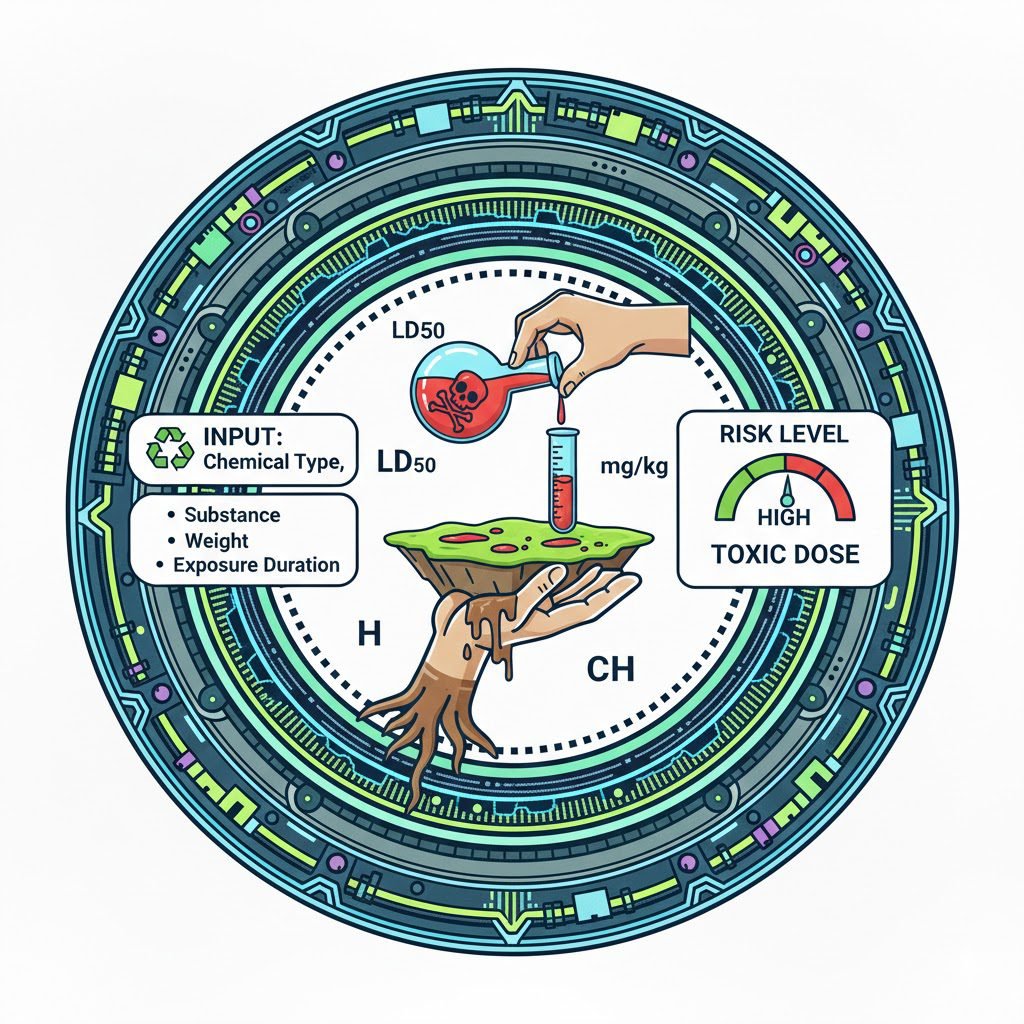
Inputs
-
Body Weight (kg): The user’s weight in kilograms; critical because dose is calculated relative to weight.
-
Amount Exposed (mg): The quantity of chemical contacted or ingested.
-
Exposure Route:
-
Oral (Ingestion)
-
Dermal (Skin Contact)
-
Inhalation
-
-
Chemical Toxicity Level: Categorized as:
-
Low (e.g., ethanol, sodium chloride)
-
Moderate (e.g., aspirin, caffeine)
-
High (e.g., pesticides, cyanide)
-
Very High (e.g., nerve agents, dioxins)
-
Calculation Logic
The dose (mg/kg) is computed using:
Then, the dose is compared against toxicity benchmarks:
| Toxicity Level | ARfD (mg/kg) | LD50 (mg/kg) | Interpretation |
|---|---|---|---|
| Low | 500 | 5000 | Generally safe |
| Moderate | 50 | 500 | Caution advised |
| High | 2 | 50 | Risk of acute effects |
| Very High | 0.01 | 5 | Severe or fatal potential |
Risk Assessment Logic:
-
Low Risk: Dose < 50% of ARfD
-
Moderate Risk: Dose between 50–100% of ARfD
-
High Risk: Dose > ARfD
This visual and numerical feedback helps users immediately gauge whether immediate action, such as seeking medical attention, is necessary.
Step-by-Step Examples
Example 1: Household Chemical Exposure
-
Body Weight: 70 kg
-
Exposed Amount: 500 mg
-
Toxicity: Moderate (e.g., caffeine)
Calculation:
Assessment:
-
ARfD for moderate toxicity = 50 mg/kg
-
Dose is < ARfD → Low Risk
Practical Insight: Minor exposure; monitor symptoms but generally safe.
Example 2: Pesticide Spill
-
Body Weight: 60 kg
-
Exposed Amount: 120 mg
-
Toxicity: High (e.g., organophosphate pesticide)
Calculation:
Assessment:
-
ARfD for high toxicity = 2 mg/kg
-
Dose = ARfD → Moderate Risk
Practical Insight: Risk approaching safe limits; follow safety protocols and consult medical services.
Example 3: Nerve Agent Accidental Contact
-
Body Weight: 80 kg
-
Exposed Amount: 1 mg
-
Toxicity: Very High
Calculation:
Assessment:
-
ARfD for very high toxicity = 0.01 mg/kg
-
Dose > ARfD → High Risk
Practical Insight: Immediate emergency intervention required. This demonstrates how even a tiny amount of extremely toxic substances can be fatal.
Why This Calculator Matters
-
Provides instant risk estimation without deep toxicology expertise.
-
Supports multiple exposure routes: ingestion, skin contact, inhalation.
-
Uses internationally recognized benchmark values (ARfD, LD50).
-
Helps workers, students, and households understand safety in real-life chemical scenarios.
-
Encourages proactive behavior: consulting Safety Data Sheets (SDS), contacting poison control, or seeking medical care.
Related Tools You May Find Useful
-
Hazardous Gas Diffusion Calculator – Estimate airborne chemical spread.
-
UV Radiation Risk Calculator – Assess skin exposure to UV radiation.
-
Heavy Metal Bioaccumulation Calculator – Track toxic metals in water or food.
-
Explore Environmental Chemistry Calculators for more safety tools.
FAQs
1. Can I rely solely on this calculator for safety decisions?
No. This tool provides approximate risk estimates. Always consult official toxicological data, SDS, or medical professionals for precise guidance.
2. Does body weight significantly affect toxicity risk?
Yes. Since dose is calculated in mg/kg, individuals with lower body weight may experience higher relative exposure even if the absolute amount is small.
3. Can I use this for chronic exposure assessment?
No. This calculator is designed for acute exposure. Chronic effects require long-term monitoring and different benchmark values.
Key Tips for Users
-
Always enter accurate body weight and exposure values for meaningful results.
-
Test different scenarios to understand potential risk ranges.
-
Use the copy result feature to document exposures for workplace safety records.
-
Combine with related calculators like Hazardous Gas Diffusion Calculator for comprehensive chemical risk management.
Conclusion
The Toxic Chemical Dose Calculator empowers users to quickly understand the acute risk of chemical exposure, bridging the gap between complex toxicology data and practical safety decisions. By entering a few simple values, anyone can assess whether a chemical exposure is low-risk, moderate, or potentially dangerous.
Use the tool regularly, experiment with different chemicals, and combine insights from related calculators to maintain a safe, informed environment, whether at home, school, or work. Safety starts with knowledge — and this tool puts that knowledge at your fingertips.