pH Neutralization Calculator
pH Neutralization Calculator
Calculate the amount of acid or base needed to neutralize a solution and achieve a target pH (typically 7 for neutral). Uses strong acid/base approximation for common laboratory and industrial scenarios.
pH Neutralization Calculator: Accurately Adjust Solution pH for Lab & Industrial Use
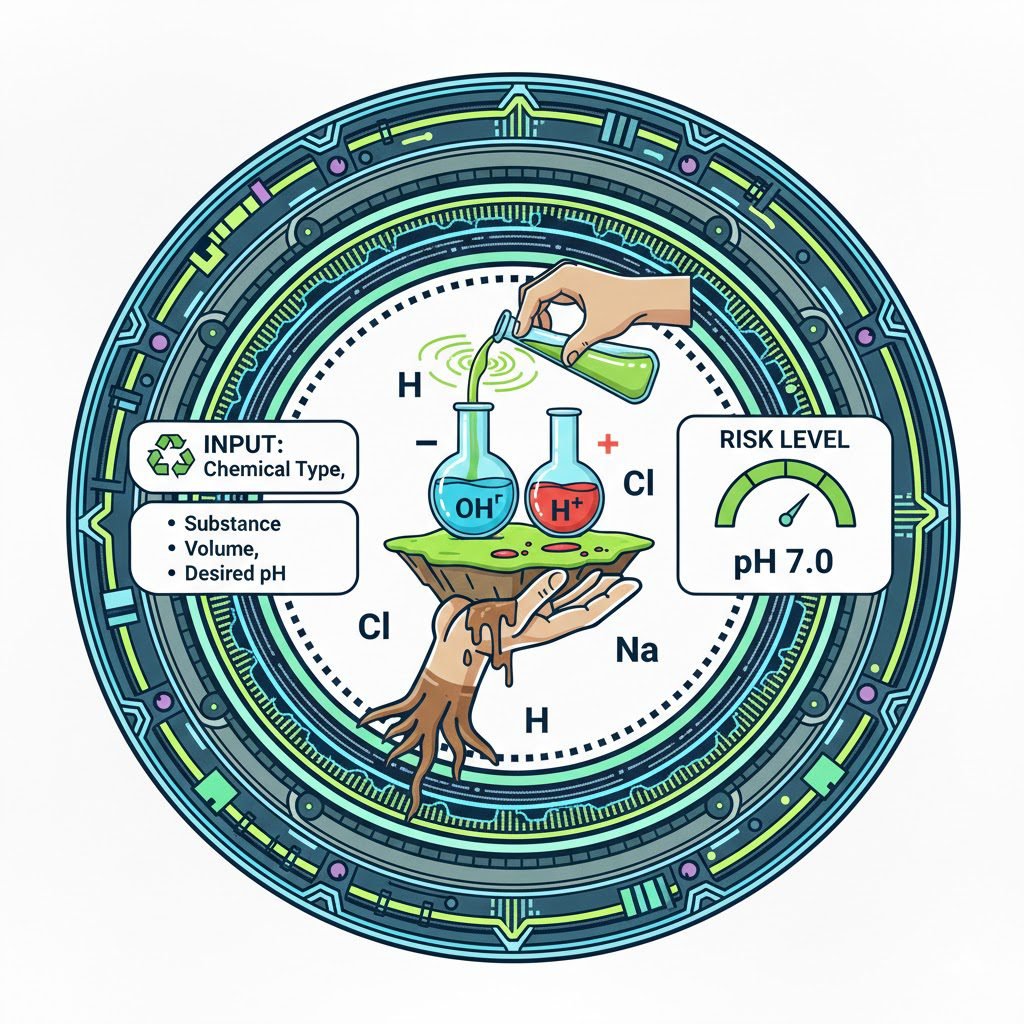
Maintaining the correct pH in chemical solutions, wastewater, or industrial processes is crucial for safety, compliance, and efficiency. The pH Neutralization Calculator is a practical tool designed to help you determine exactly how much acid or base is required to bring a solution to a desired pH level. Whether you are a chemist in a laboratory, an environmental engineer managing effluent, or an industrial operator monitoring chemical processes, this calculator simplifies complex calculations into precise, actionable results.
Imagine a small-scale chemical experiment where a solution has an initial pH of 2.0, but you need to neutralize it to 7.0 for safe handling. Manually calculating the moles and volume of neutralizing agent can be tedious and error-prone. With this calculator, you get accurate moles required, volume of neutralizer, and practical guidance, all within seconds.
How the pH Neutralization Calculator Works
This tool uses fundamental chemistry principles and strong acid/base approximations. Here’s a breakdown:
Inputs
-
Solution Volume (L) – Total volume of the solution you want to neutralize.
-
Initial pH – The current acidity or basicity level of your solution.
-
Target pH – The desired pH after neutralization (commonly 7 for neutral solutions).
-
Neutralizing Agent Concentration (M) – Molarity of your acid or base (e.g., 1 M NaOH or HCl).
-
Neutralizing Agent Type – Choose whether you are adding a base to an acidic solution or acid to a basic solution.
Calculation Logic
The calculator performs these steps:
-
Converts pH to hydrogen ion concentration:
-
Determines the moles needed to reach the target pH:
-
Calculates volume of neutralizer:
-
Converts the result to milliliters for practical use.
The result highlights the solution’s initial pH status (acidic, neutral, or basic) and provides step-by-step guidance for safe neutralization.
Practical Applications
The pH Neutralization Calculator is not just a lab tool—it has widespread relevance in industry and environmental management:
-
Wastewater treatment: Ensure effluent meets regulatory pH standards (typically 6–9).
-
Chemical manufacturing: Adjust pH safely during reactions or product preparation.
-
Educational labs: Teach students how acid-base neutralization works in a hands-on scenario.
-
Environmental monitoring: Safely handle acidic or basic spills and prevent ecological damage.
Step-by-Step Examples
Example 1: Neutralizing an Acidic Solution
-
Volume: 10 L
-
Initial pH: 2.0
-
Target pH: 7.0
-
Neutralizer: 1 M NaOH
Step 1: Calculate initial [H⁺]
Step 2: Calculate target [H⁺]
Step 3: Moles of base required
Step 4: Volume of NaOH (1 M) required
✅ Result: Add 100 mL of 1 M NaOH to reach pH 7.
Example 2: Neutralizing a Basic Solution
-
Volume: 5 L
-
Initial pH: 12
-
Target pH: 7
-
Neutralizer: 2 M HCl
Step 1:
Step 2: Moles of acid required
Step 3: Volume of HCl
🔹 Tiny volume needed, highlighting how strong acids or bases work in high-pH adjustments.
Example 3: Real-World Wastewater Adjustment
-
Volume: 1000 L
-
Initial pH: 4.5
-
Target pH: 7.0
-
Neutralizer: 0.5 M NaOH
Step 1: Convert pH to [H⁺]
Step 2: Calculate moles needed
Step 3: Volume of NaOH required
✅ This demonstrates how industrial-scale adjustments require careful planning.
Why This Tool is Reliable
-
Strong acid/base assumption: Perfect for most lab and industrial scenarios.
-
Quick, accurate calculations: Eliminates manual errors.
-
Safety and environmental guidance: Highlights PPE, pH monitoring, and effluent standards.
-
Interactive learning: Encourages experimenting with different volumes, concentrations, and target pH values.
Related Tools to Explore
-
Hazardous Gas Diffusion Calculator – For workplace chemical safety.
-
UV Radiation Risk Calculator – Understand environmental exposure effects.
-
Heavy Metal Bioaccumulation Calculator – Track contaminants in water and soil.
-
Environmental Chemistry Calculators – Explore more chemistry tools.
FAQs
1. Can this calculator handle weak acids or buffers?
Yes, but results are approximate. Strong acid/base calculations are exact; weak acids or buffers require more advanced modeling.
2. Why is the required neutralizer volume sometimes very small?
At extreme pH levels or high concentrations, strong acids/bases are highly reactive. Only tiny amounts are needed to shift the pH.
3. How do I safely neutralize a solution in practice?
-
Add neutralizer slowly with stirring.
-
Monitor pH continuously.
-
Wear PPE and work in a controlled environment.
Conclusion
The pH Neutralization Calculator makes neutralizing acidic or basic solutions effortless and accurate. By entering volume, initial pH, target pH, and neutralizer concentration, you instantly receive moles and volume required, along with practical guidance for safe, compliant handling. Whether you’re in a lab, managing wastewater, or teaching chemistry, this tool provides reliability, safety, and convenience.
💡 Try different scenarios, test various concentrations, and ensure your processes always meet environmental and safety standards. Explore our environmental chemistry calculators for more helpful tools.