Deforestation Carbon Loss Calculator
Deforestation Carbon Loss Calculator
Estimate the amount of CO₂ released into the atmosphere due to deforestation – globally applicable using average forest carbon stock values.
Deforestation Carbon Loss Calculator: Measure the True Climate Impact of Forest Clearing
Deforestation is not just the loss of trees—it’s the release of millions of tonnes of carbon dioxide (CO₂) into the atmosphere every year. With the Deforestation Carbon Loss Calculator, you can quickly estimate how much CO₂ is released when a forest area is cleared, helping you understand the environmental consequences of logging, land conversion, or natural forest degradation. Whether you’re an environmental researcher, policymaker, or concerned citizen, this tool turns complex carbon calculations into actionable insights.
Why Understanding Carbon Loss Matters
Every hectare of forest stores significant amounts of carbon—both above and below ground. When forests are cut, burned, or left to decompose, that carbon is released as CO₂, contributing to global warming and climate instability.
Some real-world context:
-
Tropical forests alone store an average of 250 tonnes of carbon per hectare. Clearing just 10 hectares releases over 9,000 tonnes of CO₂e.
-
Globally, deforestation accounts for ~10–15% of annual greenhouse gas emissions, making it a critical factor in climate change mitigation.
By using the calculator, you can estimate emissions based on forest type, area cleared, and biomass burn percentage, making your assessments precise and actionable.
How the Deforestation Carbon Loss Calculator Works
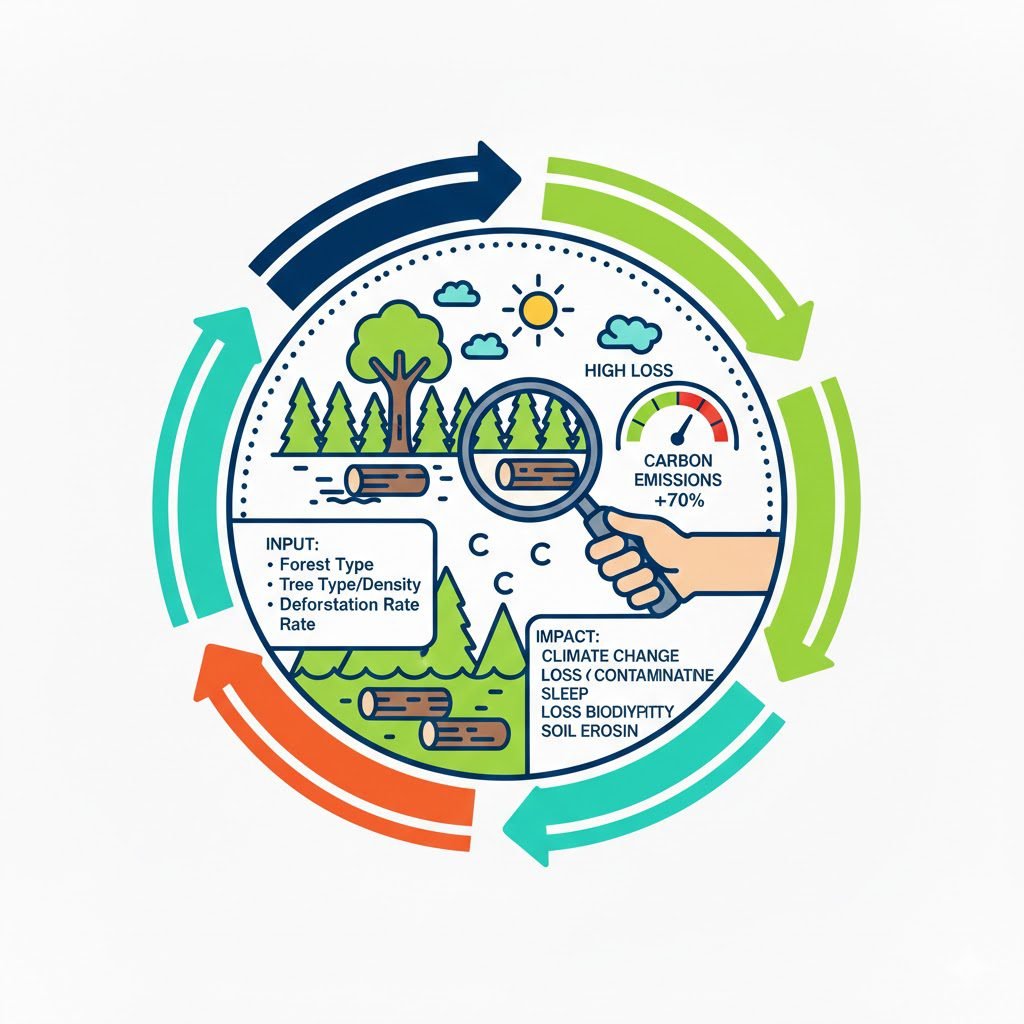
This calculator is designed to provide instant carbon loss estimates using scientifically backed averages. Here’s a breakdown:
1. Inputs You Provide:
-
Area of Forest Cleared (hectares): Enter the size of the forest cleared.
-
Forest Type: Choose from tropical, temperate, boreal, mangrove, or global average.
-
Carbon Density Assumption: High, medium, or low density depending on forest age or degradation.
-
Percentage of Biomass Burned/Decomposed: Specify how much of the forest carbon is released immediately.
2. The Calculation Logic:
The calculator follows these steps:
-
Determine Carbon Stock per Hectare (tonnes C/ha):
-
Tropical: 250, Temperate: 150, Boreal: 90, Mangrove: 350, Average: 180
-
Density Factor: High=1.3, Medium=1.0, Low=0.7
-
Calculate Total Carbon:
-
Convert Carbon to CO₂ (C → CO₂):
-
Apply Burn/Decomposition Fraction:
-
Estimate CO₂ per Hectare:
-
Provide Real-World Equivalents:
-
Passenger cars: ~4.2 tonnes CO₂/year per car
-
Long-haul flights: ~1 tonne CO₂ per flight
Practical Examples
Let’s explore some realistic scenarios to see the calculator in action.
Example 1: Tropical Forest Slash-and-Burn
-
Area: 10 hectares
-
Forest Type: Tropical Rainforest
-
Density: High
-
Burned Biomass: 80%
Calculation:
-
Carbon per hectare = 250 × 1.3 = 325 tonnes C/ha
-
Total Carbon = 10 × 325 = 3,250 tonnes C
-
CO₂ Release = 3,250 × 3.67 × 0.8 ≈ 9,538 tonnes CO₂e
-
Equivalent to ~2,271 cars driving for a year.
Example 2: Temperate Forest, Moderate Density
-
Area: 25 hectares
-
Forest Type: Temperate
-
Density: Medium
-
Burned Biomass: 60%
Calculation:
-
Carbon per hectare = 150 × 1.0 = 150 tonnes C/ha
-
Total Carbon = 25 × 150 = 3,750 tonnes C
-
CO₂ Release = 3,750 × 3.67 × 0.6 ≈ 8,253 tonnes CO₂e
-
Equivalent to ~1,965 cars.
Example 3: Mangrove Forest Conservation Check
-
Area: 5 hectares
-
Forest Type: Mangrove
-
Density: Low
-
Burned Biomass: 50%
Calculation:
-
Carbon per hectare = 350 × 0.7 = 245 tonnes C/ha
-
Total Carbon = 5 × 245 = 1,225 tonnes C
-
CO₂ Release = 1,225 × 3.67 × 0.5 ≈ 2,246 tonnes CO₂e
-
Equivalent to ~535 cars.
🔹 Tip: Test different burn percentages or forest densities to understand how management practices affect carbon emissions.
Related Tools for Environmental Impact Analysis
-
Vehicle Noise vs Air Pollution Calculator – Explore transport emissions.
-
Industrial Odor Index Calculator – Evaluate industrial environmental effects.
-
Heavy Rain Runoff Contaminant Calculator – Measure water contamination from urban runoff.
-
Environmental Chemistry Calculators – A collection of chemistry-based sustainability tools.
These tools complement the Deforestation Carbon Loss Calculator, helping you assess broader environmental impacts.
FAQs
Q1: Does the calculator account for soil carbon losses?
A1: The primary focus is on aboveground and belowground biomass carbon. Soil carbon losses are partially included but can vary regionally.
Q2: Can this tool predict future emissions from forest regrowth?
A2: No, the calculator estimates immediate CO₂ release. For regrowth and sequestration predictions, specialized forestry models are recommended.
Q3: Why do different forests emit different amounts of CO₂ per hectare?
A3: Carbon stock varies with forest type, age, density, and biomass composition. Tropical forests store more carbon than boreal or temperate forests.
Why Use This Calculator
-
Accurate and Practical: Uses global averages and real-world carbon stock data.
-
Interactive Learning: Allows users to test scenarios, improving understanding of deforestation impacts.
-
Supports Decision-Making: Ideal for educators, policymakers, NGOs, or students evaluating environmental policies.
By entering a few simple inputs, you can instantly quantify CO₂ emissions and relate them to tangible equivalents like cars or flights—making abstract carbon data easy to understand.
Conclusion
The Deforestation Carbon Loss Calculator transforms complex carbon emission calculations into a clear, actionable, and interactive experience. Understanding the carbon impact of forest clearing is essential for mitigating climate change and promoting sustainable forest management.
Take a few minutes to experiment with different forest types, areas, and burn percentages to see how your choices affect CO₂ emissions. Then explore related tools to broaden your environmental analysis and strengthen decision-making. Every calculation is a step toward understanding and protecting our forests.