
How to Troubleshoot Common Errors in Chromatography
How to Troubleshoot Common Errors in Chromatography
Chromatography is a cornerstone technique in chemical analysis, widely used in pharmaceuticals, environmental testing, and food quality control. But even experienced chemists encounter errors during experiments. Learning how to troubleshoot common errors in chromatography can save you time, reduce waste, and improve your results’ accuracy. Imagine running a crucial HPLC analysis only to find unexpected peaks or inconsistent retention times—that’s frustrating and costly. Understanding the root causes and solutions is key to maintaining reliable chromatography data.
Understanding Chromatography Errors
Chromatography separates chemical components based on their interactions with a stationary phase and a mobile phase. Errors typically arise due to instrument issues, sample preparation problems, or procedural mistakes. Recognizing the error type is the first step to troubleshooting effectively.
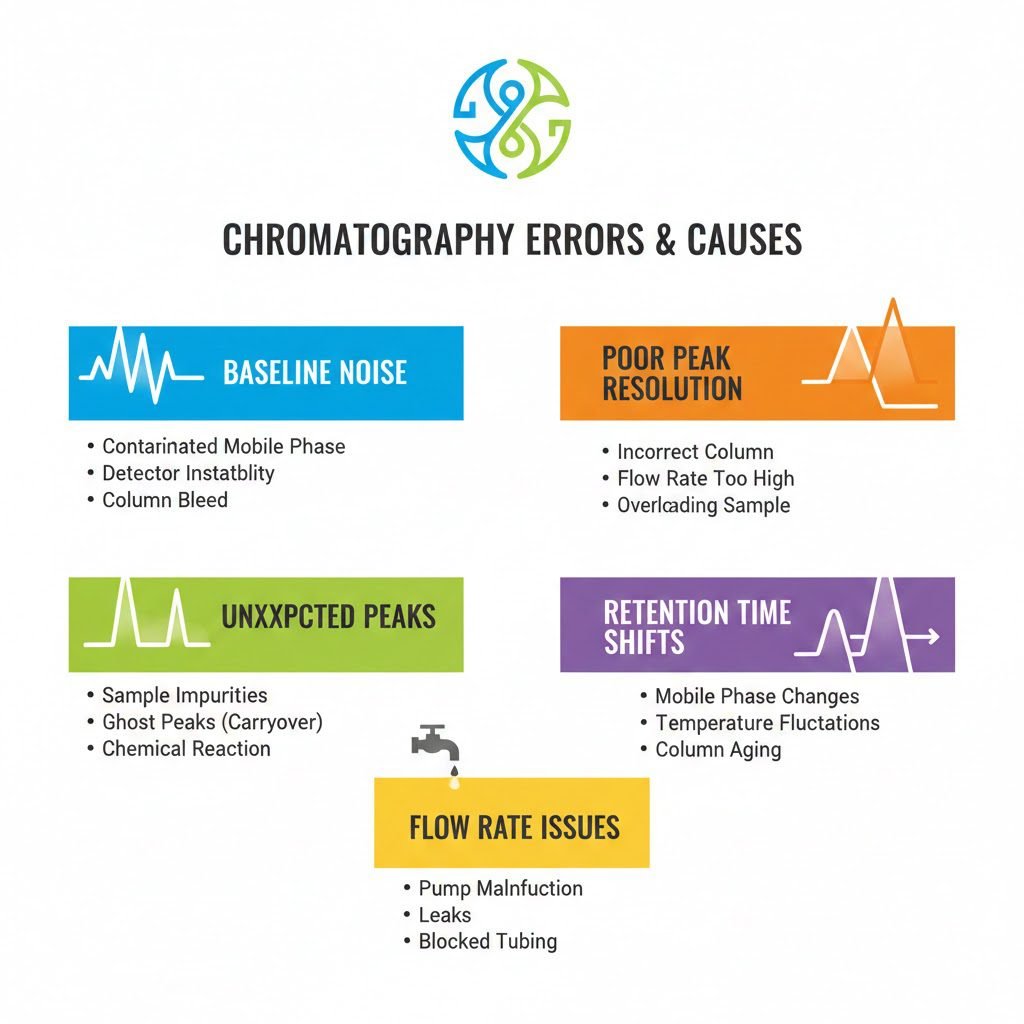
Common types of errors include:
-
Baseline noise or drift
-
Poor peak resolution
-
Unexpected peaks
-
Retention time shifts
-
Flow rate inconsistencies
Each error can stem from multiple sources, which we’ll explore in detail.
How the Chromatography Process Works
Before diving into troubleshooting, it helps to understand the basic workflow:
-
Sample Preparation – Proper dilution, filtration, or derivatization ensures accurate separation.
-
Instrument Setup – Columns, pumps, detectors, and mobile phases must be calibrated and compatible.
-
Injection and Separation – Samples interact with the stationary phase, producing distinct peaks.
-
Data Analysis – Software interprets the chromatogram for qualitative and quantitative results.
Errors often appear in step 2 or 3, making systematic checks essential.
Step-by-Step Troubleshooting Guide
1. Baseline Noise or Drift
Symptoms: The baseline fluctuates, rises, or shows spikes unrelated to sample peaks.
Possible Causes & Fixes:
-
Detector instability: Warm up the detector for recommended periods; replace worn lamps.
-
Mobile phase contamination: Filter solvents and degas before use.
-
Column issues: Check for blockages or contamination; flush the column as needed.
Example: If an HPLC baseline drifts after 10 minutes, check mobile phase composition first. A small air bubble or improper solvent degassing often causes this problem.
2. Poor Peak Resolution
Symptoms: Peaks are broad, overlapping, or indistinct.
Possible Causes & Fixes:
-
Incorrect flow rate: Verify pump calibration and adjust flow.
-
Column degradation: Replace columns after repeated use; use guard columns.
-
Inadequate sample preparation: Ensure samples are fully dissolved and filtered (0.22–0.45 μm).
Example Calculation:
Peak resolution RsR_s is calculated as:
Where:t_R = retention time of each peakW = peak width at baseline
Aim for R_s ≥ 1.5 for baseline separation.
3. Unexpected Peaks
Symptoms: Extra peaks appear, not corresponding to the expected analytes.
Possible Causes & Fixes:
-
Impurities in the sample or solvents: Use high-purity reagents.
-
Column contamination: Run a blank and clean the column if needed.
-
Carryover from previous samples: Flush the injection system thoroughly.
Practical Tip: Running a solvent blank before each batch can identify contamination early.
4. Retention Time Shifts
Symptoms: Peaks appear earlier or later than expected.
Possible Causes & Fixes:
-
Temperature fluctuations: Use column ovens or maintain consistent lab temperature.
-
Mobile phase variation: Prepare fresh mobile phase with precise solvent ratios.
-
Pump inconsistencies: Regularly calibrate pumps and check for leaks.

5. Flow Rate Inconsistencies
Symptoms: Uneven or erratic peaks.
Possible Causes & Fixes:
-
Air bubbles in the system: Degas solvents and prime pumps.
-
Pump malfunctions: Service or replace pump seals and pistons.
-
Clogged injector or column: Inspect and replace if necessary.
Real-Life Examples
-
Example 1: HPLC Quantification of Caffeine
-
Problem: Peak tailing observed.
-
Solution: Replaced column guard, filtered mobile phase. Peak symmetry improved, R_s = 1.8.
-
-
Example 2: Gas Chromatography of Environmental Pollutants
-
Problem: Extra peaks appeared.
-
Solution: Checked solvents; detected contamination from old vial caps. Cleaned vials, reran sample—extra peaks disappeared.
-
-
Example 3: Thin-Layer Chromatography (TLC) for Drug Purity
-
Problem: Poor separation.
-
Solution: Adjusted solvent polarity and ensured plates were activated properly. Separation improved with baseline resolution of R_f differences >0.2.
-
Practical Tips for Reliable Chromatography
-
Always run a blank before sample analysis.
-
Label solvents and reagents to prevent contamination.
-
Document instrument settings for reproducibility.
-
Perform regular preventive maintenance on pumps, columns, and detectors.
-
Train all lab personnel to recognize early signs of errors.
FAQs
Q1: How do I know if a peak is real or noise?
Check by running a blank and comparing. Real peaks consistently appear in replicates, while noise is irregular.
Q2: Can temperature affect GC or HPLC results?
Yes, temperature fluctuations can shift retention times and alter resolution. Use thermostatted columns when precision is critical.
Q3: How often should chromatography equipment be maintained?
Preventive maintenance is recommended every 3–6 months, depending on usage and column type.
Conclusion
Troubleshooting chromatography errors may seem daunting, but understanding common causes and systematic solutions ensures consistent, accurate results. By monitoring baselines, resolving peaks correctly, controlling temperature, and maintaining equipment, you can prevent most errors before they affect your data. Experiment with different solvents, columns, and sample preparations to optimize your process—practical experience is the best teacher.
Explore related guides to expand your expertise in analytical techniques: Flame Photometry for Sodium Detection, Plotting Standard Curves in Excel, Mass Spectrometry Analysis Basics.



