
24V Wire Size Calculator
24V Wire Size Calculator
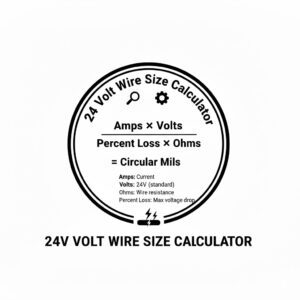
Calculate minimum AWG wire size for 24V DC to limit voltage drop. Formula: CM = (2 × I × L × ρ) / V_d where V_d = (%VD/100) × 24V, ρ_Cu=10.371 Ω·cmil/ft, ρ_Al=17.004. Select AWG with CM ≥ required.
24V Wire Size Calculator: The Complete Guide for Safe Low Voltage Wiring
Electrical wiring is the backbone of any low-voltage 24V DC system. Choosing the correct wire size ensures efficiency, prevents overheating, and reduces voltage drop. A 24V Wire Size Calculator simplifies this process by recommending the appropriate AWG wire based on current, length, and material. This article will guide you through the calculations, practical applications, and expert tips for selecting the right wire for your projects.
Understanding 24V Electrical Systems
A 24V DC system is common in solar power setups, automotive electronics, industrial controls, and low-voltage lighting. These systems are safer than high-voltage alternatives, but incorrect wire sizing can lead to:
-
Excessive heat generation
-
Voltage drop causing equipment malfunction
-
Energy inefficiency and power loss
A 24V Electrical Wire Gauge Calculator helps avoid these problems by calculating the minimum circular mils (CM) required for the wire.
Voltage Drop Formula:
Where:
-
I= Current in amperes (A) -
L= One-way length in feet (ft) -
ρ= Resistivity of the material (ρ_Cu = 10.371 Ω·cmil/ftfor copper,ρ_Al = 17.004 Ω·cmil/ftfor aluminum) -
V_d= Maximum allowed voltage drop (V), calculated asV_d = (%VD / 100) × 24V
Understanding this formula helps users manually verify results and gives insight into the engineering behind wire sizing.
Why Wire Size Matters in Low Voltage 24V Systems
Correct wire sizing is crucial for safety, performance, and longevity of your electrical system. Key reasons include:
-
Preventing Overheating: Undersized wires carry more resistance, generating heat that can melt insulation or cause fires.
-
Minimizing Voltage Drop: Too much voltage drop reduces the efficiency of motors, lights, and sensors.
-
Ensuring Compliance: Electrical codes and standards often dictate minimum wire sizes for safety.
-
Cost-Effectiveness: Oversized wires are more expensive and harder to handle, while undersized wires are unsafe.
Experts recommend using a 24V Ampacity to Wire Size Calculator for all critical circuits to avoid guesswork and ensure compliance with best practices. For additional calculations and related tools, explore physics calculators that can help with a wide range of electrical engineering and physics projects.
How to Use a 24V Wire Size Calculator
Using a 24V Current to Wire Gauge Calculator is straightforward and involves four main inputs:
-
Current (I in amperes): The total load current that the wire must carry.
-
Length (L in feet or meters): One-way distance from the power source to the load.
-
Maximum Voltage Drop (%): Usually 2-3% for sensitive electronics.
-
Material: Copper or aluminum.
Step-by-Step Example:
Suppose you have a 24V LED strip requiring 12A over 50 feet. Maximum voltage drop allowed is 3%, and you are using copper.
-
Calculate voltage drop:
-
Calculate required circular mils (CM):
-
Select the nearest AWG wire with CM ≥ 17,280. In this case, 10 AWG copper wire meets the requirement.
This step-by-step method ensures safety and efficiency for low-voltage circuits.
Comparing Copper vs Aluminum Wires
Choosing between copper and aluminum affects wire size and cost. Key differences:
-
Copper: Higher conductivity, smaller size for same current, more expensive.
-
Aluminum: Lower cost, but requires a larger size due to higher resistivity.
For example, the same 12A, 50-ft run at 3% voltage drop would require:
-
Copper: 10 AWG (CM = 17,280)
-
Aluminum: 8 AWG (CM = 26,240)
Using a Low Voltage 24V Wire Size Calculator helps instantly determine the correct choice for your system.
Real-World Applications and Case Studies
Case Study 1: Solar Power System
A solar-powered off-grid home uses 24V battery banks. The system designer needed to connect a 20A charge controller to a battery bank 30 feet away. Using the 24V Wire Size Calculator, the correct wire size was determined to prevent more than 2% voltage drop. The result: 8 AWG copper wire, ensuring minimal loss and safe operation.
Case Study 2: Industrial Automation
An industrial robot required 24V control signals over 60 feet. Using copper wiring without calculation led to voltage drop issues, causing sensors to malfunction. After recalculating with a wire size calculator, the solution was 6 AWG copper wire, resolving voltage drop problems.
Case Study 3: Automotive Applications
In a 24V truck lighting system, designers initially used 12 AWG copper wire for a 15-foot run. Voltage drop caused headlights to dim. Using a 24V Current to Wire Gauge Calculator, engineers upgraded to 10 AWG, restoring full brightness.
These examples demonstrate how proper sizing improves performance and prevents costly mistakes.
Voltage Drop Considerations
Voltage drop is the most critical factor in low-voltage systems. It depends on:
-
Wire Length: Longer runs increase drop.
-
Current: Higher current increases drop proportionally.
-
Wire Material: Aluminum has higher resistance, causing more drop.
-
Voltage Drop Limit: Sensitive devices need stricter limits.
Rule of Thumb: Keep voltage drop under 3% for low-voltage 24V systems. For longer runs, consider upsizing the wire or reducing current by splitting loads.
Tips from Electrical Experts
Electrical engineers recommend the following:
-
Always round up to the next standard AWG size.
-
Use stranded wire for flexibility and reduced skin effect in DC.
-
Check temperature ratings; derate wires if ambient temperature exceeds 30°C.
-
Avoid long daisy-chained connections; use busbars where possible.
-
Consult a professional for critical or high-current circuits.
For additional engineering calculations, you can explore tools like the 3-Phase Motor Amperage Calculator for complementary insights.
Using Online Wire Size Calculators Effectively
Online calculators simplify the process:
-
Input precise values for current, length, voltage drop, and material.
-
Check recommended AWG against local electrical codes.
-
Verify results manually if possible using
CM = (2 × I × L × ρ) / V_d.
For learning and conversion purposes, you can also use related tools like the Grams to CC Converter when calculating material volumes for electrical enclosures.
Frequently Asked Questions
What is the recommended wire size for a 24V LED strip at 10A over 50 feet?
Using copper and a 3% voltage drop limit, the 10 AWG wire is recommended. Aluminum would require 8 AWG.
Can I use aluminum wire for 24V systems?
Yes, but you must increase the wire size due to higher resistivity. Aluminum requires roughly 1.6× the CM of copper for the same voltage drop.
How do I minimize voltage drop in long 24V runs?
Options include increasing wire size, reducing current per run, splitting loads, or using a higher system voltage. Using a 24V Ampacity to Wire Size Calculator is essential for accurate recommendations.
Benefits of Using a 24V Wire Size Calculator
-
Time-Saving: Eliminates manual calculations.
-
Accuracy: Ensures voltage drop stays within limits.
-
Safety: Prevents overheating and fire hazards.
-
Cost Efficiency: Avoids over-specifying wires unnecessarily.
-
Ease of Use: Ideal for engineers, electricians, and DIY enthusiasts.
By adopting a Low Voltage 24V Wire Size Calculator, professionals can make precise decisions quickly.
Advanced Tips for Complex Systems
-
For multiple loads on a single bus, calculate the combined current before sizing wires.
-
When wiring in parallel, ensure each wire carries equal current to avoid imbalance.
-
Use temperature correction factors for ambient temperatures over 30°C.
-
For outdoor or underground applications, consider insulation type and environmental derating.
Using an accurate 24V Current to Wire Gauge Calculator helps factor in these advanced considerations without errors.
Practical Example: Wiring a 24V Solar Pump
A 24V DC water pump draws 15A and is located 40 feet from the battery. Using a copper wire and 3% voltage drop limit:
Recommended wire size: 10 AWG copper, which ensures safe operation and optimal pump performance.
For longer runs, switching to 8 AWG may be more efficient. Calculations like this are simplified using an online 24V Wire Size Calculator.
Conclusion
A 24V Wire Size Calculator is an indispensable tool for anyone working with low-voltage DC systems. Correct wire sizing prevents voltage drop, improves efficiency, and enhances safety. Whether for solar panels, automotive systems, or industrial applications, accurate calculations save time, money, and headaches.
Using tools like a 24V Electrical Wire Gauge Calculator or a 24V Ampacity to Wire Size Calculator ensures your designs comply with electrical standards while maintaining reliability. Always cross-check results and consult professionals for critical systems. Proper wire sizing translates directly into long-term system performance and safety.



