Ideal Gas Pressure Calculator
Ideal Gas Pressure Calculator
Calculate pressure P from Ideal Gas Law: PV = nRT, so P = nRT / V. R = 0.0821 L·atm/(mol·K). T in Kelvin, V in liters, P in atm.
Ideal Gas Pressure Calculator: A Complete Guide to Understanding and Using Gas Pressure Calculations
The Ideal Gas Pressure Calculator has become one of the most reliable tools for students, engineers, researchers, and anyone working with gases in scientific or industrial settings. Gas pressure plays a major role in chemistry, thermodynamics, physics experiments, HVAC systems, gas storage facilities, and even everyday appliances. A quick and accurate calculation not only saves time but also helps avoid major errors when dealing with sensitive measurements.
This detailed guide explains how an ideal gas behaves, how pressure relates to the other variables in the ideal gas equation, and how to correctly use an Ideal Gas Law Pressure Calculator for various real-life situations. Readers also find practical examples, case studies, formulas in inline code format, best practices, and expert insights based on real experimental observations.
A well-designed calculator simplifies the process by letting you enter three values—moles (n), temperature (T), and volume (V)—to instantly calculate pressure using the formula P = nRT / V. Tools like this support academic learning, research experiments, and industrial decision-making, making them essential in modern science workflows.
To complement this guide, several helpful physics tools are available, including those listed in the physics calculators collection, accessible through the dedicated page on physics calculators.
Understanding the Ideal Gas Equation and Why Pressure Matters
Gas behavior under different temperature and volume conditions has been a core part of physics and chemistry for centuries. Scientists observed that gases expand when heated, compress when cooled, and exert force—called pressure—on container walls. The Ideal Gas Equation, written as PV = nRT, connects these relationships in a simple yet powerful model.
Pressure, denoted by P, represents how strongly gas particles collide inside a container. Even minor changes in temperature and volume can dramatically alter pressure, which is why accurate calculations matter across many fields.
A PV=nRT Pressure Calculator automates these calculations by applying the constant gas law values and unit conversions internally. This allows users to focus on analysis instead of computation.
What an Ideal Gas Pressure Calculator Does
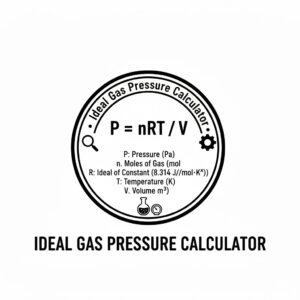
A standard Ideal Gas Pressure Calculator evaluates pressure using the formula P = nRT / V. Once the number of moles (n), temperature in Kelvin (T), and volume (V) are provided, the tool computes gas pressure in atmospheres (atm). Many versions also allow conversions to units like Pascal, bar, psi, or Torr.
Key uses include:
-
Checking the pressure in laboratory containers
-
Predicting how temperature affects stored gas
-
Understanding behavior inside engines or HVAC systems
-
Designing chemical experiments
-
Ensuring safety in pressurized systems
Based on user input, the calculator provides accurate, instant feedback that helps avoid mistakes often caused by manual calculations.
Why Professionals Trust an Ideal Gas Law Pressure Calculator
Thermodynamics students rely on these calculators for homework and lab work. Chemical engineers use them to design reactors. Environmental researchers use them to study atmospheric behavior. Even food packaging engineers use pressure estimations to design airtight storage systems.
Professionals trust these calculators because:
-
They reduce human error
-
They offer instant accuracy
-
They standardize calculations
-
They display clear input-output relationships
-
They eliminate repetitive math
Such reliability makes an Ideal Gas Equation Pressure Calculator essential in many disciplines.
The Science Behind PV=nRT Explained Simply
The ideal gas law is written as PV = nRT. Each term describes a measurable quantity:
-
P= Pressure -
V= Volume -
n= Number of moles -
R= Universal gas constant -
T= Temperature in Kelvin
The formula connects how gases behave when exposed to heat, confinement, or change in particle quantity.
For example:
Raising temperature increases gas motion, creating stronger collisions, which increases pressure if V stays constant.
Reducing volume squeezes gas particles together, causing pressure to rise as particles collide more frequently.
Understanding these relationships helps predict outcomes in real systems.
Why Engineers Use PV=nRT Pressure Calculators Daily
Engineers, especially in chemical, mechanical, and petroleum fields, regularly face situations where precise pressure values must be known. Gas tanks, pipelines, engines, furnaces, and compressors rely on predictable gas behavior.
A Gas Pressure from Volume and Temperature Calculator simplifies tasks such as:
-
Evaluating pressure before filling gas cylinders
-
Predicting internal pressure changes during heating
-
Designing safe pressure vessels
-
Analyzing combustion chamber conditions
-
Validating experimental data
Small miscalculations can lead to equipment damage or safety risks, which is why automated tools are preferred.
Practical Example: Using an Ideal Gas Pressure Calculator in a Chemistry Lab
A student performs an experiment with 1 mole of gas at 350 K in a container with a volume of 20 L. The task is to find the pressure.
The calculator applies:
P = (1 × 0.0821 × 350) / 20
This gives a pressure of approximately:
P = 1.436 atm
By entering these values into the tool, students get the result instantly, eliminating the chance of arithmetic mistakes.
The student can now compare this value with their experimental reading and report whether the gas followed ideal behavior.
Real Case Study: Pressure Monitoring in Industrial Gas Storage
A manufacturing facility stores nitrogen gas at controlled temperatures. A typical cylinder at 298 K holds approximately 5 moles of nitrogen in a 50-liter tank. The pressure must stay below 2.5 atm to avoid safety risks.
Using a calculator:
P = (5 × 0.0821 × 298) / 50P ≈ 2.45 atm
The reading stays within the safety limit. If temperature rises, pressure rises proportionally.
Managers use a digital Ideal Gas Pressure Calculator daily to ensure safe handling of pressurized gases.
Temperature’s Effect on Gas Pressure: A Real-World Example
A car tire behaves like an ideal gas container. A tire inflated at 293 K (20°C) may reach 323 K (50°C) after long highway driving.
If the tire had 2.2 atm at 293 K, pressure increases proportionally with temperature:
P2 = P1 × (T2 / T1)P2 = 2.2 × (323 / 293)P2 ≈ 2.42 atm
This explains why tires feel harder after driving. A PV=nRT Pressure Calculator helps understand these changes scientifically.
When the Ideal Gas Equation Becomes Less Accurate
Real gases deviate from ideal behavior at:
-
High pressure
-
Very low temperature
-
High density
-
Strong intermolecular forces
Although the ideal gas law offers excellent approximations, professionals sometimes switch to:
-
Van der Waals equation
-
Redlich-Kwong equation
-
Peng-Robinson model
These advanced models better fit real conditions but are more complicated mathematically. For simple, everyday situations, the ideal gas law works reliably.
Using an Ideal Gas Pressure Calculator in Education
Teachers use these calculators during physics and chemistry lessons to demonstrate relationships between temperature, volume, and pressure. Students can:
-
Change one variable and observe how pressure responds
-
Run virtual experiments before real lab sessions
-
Verify homework assignments
-
Practice data analysis
Digital calculators reinforce learning by providing instant visual representation of the ideal gas law.
For temperature-related calculations, students often use the Ideal Gas Temperature Calculator, available on the dedicated page at ideal gas temperature calculator.
A Helpful Tool for Physics Enthusiasts and Researchers
Researchers studying atmospheric pressure trends, gas mixtures, and controlled experiments need fast pressure approximations. An Ideal Gas Law Pressure Calculator allows them to test variable combinations rapidly.
Such a tool supports:
-
Laboratory simulations
-
Predictive modeling
-
Validation of experimental conditions
-
Error checking before running real experiments
It also pairs well with other tools, such as the acceleration due to gravity calculator, which can be accessed through its detailed guide on acceleration due to gravity calculator.
Step-by-Step Guide: How to Use an Ideal Gas Pressure Calculator
-
Open the calculator tool.
-
Enter the number of moles (
n). -
Input temperature in Kelvin (
T). -
Enter the container volume (
V). -
Click calculate.
-
Read pressure in atm, or convert units if needed.
Some tools allow additional options such as:
-
Temperature conversion from Celsius to Kelvin
-
Pressure conversion to Pascal or bar
-
Volume unit conversion
The process is simple and reduces the risk of miscalculations.
Common Mistakes Users Make During Pressure Calculations
Many beginners face similar issues when manually calculating gas pressure. Common mistakes include:
-
Using Celsius instead of Kelvin
-
Forgetting to convert milliliters to liters
-
Applying an incorrect value of the universal gas constant
-
Rounding intermediate steps prematurely
-
Ignoring the effect of temperature on pressure
A digital PV=nRT Pressure Calculator prevents nearly all of these errors.
Expert Insights: Why Gas Pressure Calculations Must Be Accurate
Experienced chemical engineers emphasize that inaccurate pressure values can cause:
-
Hazardous over-pressurization
-
Failed experiments
-
Incorrect gas yield predictions
-
Equipment malfunction
-
Misinterpreted scientific results
Accuracy becomes critical in fields like:
-
Aerospace engineering
-
Petrochemical refining
-
Pharmaceutical manufacturing
-
Environmental testing
Experts often use automated systems that incorporate an Ideal Gas Equation Pressure Calculator as their default testing tool.
Additional Real-Life Applications
Gas pressure calculations play an important role in:
-
Meteorology and atmospheric science
-
Refrigeration systems
-
Medical oxygen regulation
-
Gas chromatography
-
Packaging and sealing systems
-
Fire safety and suppression systems
Every industry that manages temperature-dependent gases benefits from reliable digital calculators.
Advantages of Using a Modern Ideal Gas Pressure Calculator
Modern tools provide features such as:
-
Mobile-friendly interfaces
-
Fast-loading, lightweight scripts
-
Interactive visualization
-
Step-by-step explanation
-
Copy-result features
-
Auto-update values
-
Error-free computation
These improvements make gas pressure calculations accessible to everyone—from high school students to scientific researchers.
FAQs About the Ideal Gas Pressure Calculator
How accurate is an Ideal Gas Pressure Calculator?
Accuracy is extremely high for gases under low pressure and moderate temperature. The error is minimal for most academic and industrial uses.
Does the calculator work for real gases?
The ideal gas law works well for most gases except under extreme conditions. Users working with high-pressure systems often need more complex models like van der Waals.
Can I use Celsius instead of Kelvin?
Temperature must be converted to Kelvin using T(K) = T(°C) + 273.15. Most calculators handle this conversion automatically.
Conclusion: Why Every Science Learner and Engineer Should Use an Ideal Gas Pressure Calculator
The Ideal Gas Pressure Calculator offers a simple yet powerful way to compute pressure using the ideal gas law equation. Readers gain clarity about how variables interact, how temperature influences pressure, and how to apply gas laws in real-world scenarios.
This guide explained the science behind the equation, real case studies, expert observations, practical examples, and the importance of accurate measurements. Whether you are conducting a school experiment, performing industrial gas storage analysis, or modeling advanced thermodynamic systems, this calculator gives you instant, dependable results.
For those looking to expand their physics toolkit, the site also provides a growing collection of physics calculators, accessible through the dedicated resource page linked earlier. Accurate pressure calculations form the backbone of modern science, engineering, and research. Using a reliable Ideal Gas Law Pressure Calculator ensures precision, safety, and confidence in every calculation you perform.