Ideal Gas Temperature Calculator
Ideal Gas Temperature Calculator
Calculate temperature T from Ideal Gas Law: PV = nRT, so T = PV / (nR). R = 0.0821 L·atm/(mol·K). P in atm, V in liters, n in mol, T in Kelvin.
What is the Ideal Gas Temperature Calculator
Ideal Gas Temperature Calculator platforms are widely used because they simplify complex thermodynamic calculations into a single user-friendly step. Students often struggle to rearrange formulas, engineers must validate real-time pressure and volume measurements quickly, and researchers look for precise temperature estimates before running experiments. An Ideal Gas Temperature Calculator answers all these needs.
The formula behind this calculator is based on the Ideal Gas Law PV = nRT, and temperature is computed using T = PV / (nR). Although the formula looks simple, real-life scenarios can become challenging when dealing with unusual temperatures, gases under high pressure, or experimental limitations. That is why reliable tools like an Ideal Gas Temperature Calculator are essential for minimizing errors and helping users interpret results correctly.
This blog post provides a deeply detailed, highly readable, and SEO-optimized explanation of how the calculator works, what factors affect gas temperature, how engineers and scientists use it, and how to apply it in everyday educational and industrial settings. Readers will also find internal resources such as the full collection of physics tools on the physics calculators page at Ahmad Free Tools, along with supportive calculators for topics like acceleration and gas volume.
How an Ideal Gas Temperature Calculator Works
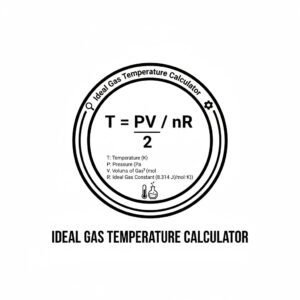
An Ideal Gas Temperature Calculator follows the rearranged ideal gas equation:
T = (P × V) / (n × R)
Where:
-
P= Pressure -
V= Volume -
n= Moles of gas -
R= Ideal gas constant -
T= Temperature in Kelvin
This calculation is the core of an Ideal Gas Law Temperature Calculator, but usability depends on how smoothly the tool converts the formula into a simple interface. Most people who use these calculators appreciate avoiding unnecessary algebra so they can focus on understanding results.
The calculator typically expects:
-
Pressure in atm
-
Volume in liters
-
Amount in moles
-
Output in Kelvin
Some advanced calculators also offer conversions into Celsius or Fahrenheit for easier interpretation.
Why Temperature Matters in Gas Behavior
Temperature plays a foundational role in understanding gas behavior. A small change in temperature can dramatically influence volume, pressure, density, and even reaction rates. This explains why laboratories rely heavily on temperature calculations during experiments.
A Gas Temperature from Pressure and Volume Calculator helps users:
-
Predict how gases will behave under different environmental conditions
-
Prepare accurate lab experiments
-
Perform engineering design work
-
Validate pressure and volume readings in quality control systems
-
Analyze container safety during thermal expansion
Temperature also determines the phase of many substances, so precise calculations can prevent costly errors during manufacturing or transport.
When to Use an Ideal Gas Equation Temperature Calculator
Students, teachers, researchers, and engineers use the calculator whenever temperature needs to be determined from known values of pressure, volume, and moles.
Common uses include:
-
Chemistry lab experiments
-
Physics problem-solving
-
Engineering design simulations
-
Environmental science research
-
Aviation and aerospace modeling
-
Chemical mixture analysis
-
Gas storage calculations
-
HVAC performance analysis
Working professionals rely on this calculator because manual calculations often lead to rounding errors, especially when dealing with unfamiliar units or extreme conditions.
Real-World Case Study: Laboratory Gas Expansion
A university chemistry lab conducted an experiment involving nitrogen gas to demonstrate thermal expansion. The instructor provided the following measured values:
-
Pressure: 1.20 atm
-
Volume: 30 L
-
Moles: 1.2
Using T = (P × V) / (n × R) results in:T = (1.20 × 30) / (1.2 × 0.0821)T = 365.29 K
This result allowed the students to compare theoretical predictions with real measurements. Such tasks become effortless when using an Ideal Gas Temperature Calculator instead of performing calculations manually.
Practical Example for Beginners
Assume a sealed container has:
-
Pressure: 0.8 atm
-
Volume: 12 L
-
Moles: 0.5
Use the formula:T = (0.8 × 12) / (0.5 × 0.0821) = 233.44 K
A beginner-friendly calculator ensures users understand both the math and the concepts without becoming overwhelmed.
Industry Example: Gas Storage Tank Inspection
A petroleum company uses a PV=nRT Temperature Calculator while inspecting gas tanks during seasonal changes. Pressure readings tend to vary as external temperatures rise. An accurate temperature calculation allows technicians to determine whether changes in pressure are normal or indicate a leak.
If pressure increases disproportionately, technicians can take corrective action immediately, preventing instability in storage systems.
Benefits of Using an Ideal Gas Temperature Calculator
Users often describe several advantages:
Accuracy
A tool removes the risk of miscalculating values, especially when multiple conversions or constants are involved.
Speed
Temperature results appear instantly, making the calculator suitable for fast-paced laboratory or industrial work.
Accessibility
Even beginners can perform advanced calculations without complex algebraic skills.
Reliability
Consistency is crucial in experiments and engineering design, and calculators ensure identical results every time.
Limitations of Ideal Gas Temperature Calculators
An Ideal Gas Equation Temperature Calculator is highly accurate under many conditions, but ideal gas assumptions fail at high pressure and low temperature.
Common causes of deviation:
-
Gas molecules interacting
-
Reduced molecular spacing
-
Phase-change proximity
-
Non-uniform temperature distributions
-
High-density gas conditions
For advanced systems, real gas models like the Van der Waals equation may be more suitable.
Understanding the Constant R
The ideal gas constant R = 0.0821 L·atm/(mol·K) is specifically chosen for calculations involving atmospheres and liters.
Other forms include:
-
R = 8.314 J/(mol·K) -
R = 62.36 L·mmHg/(mol·K)
An Ideal Gas Law Temperature Calculator typically uses the most common format unless unit conversions are integrated into the tool.
Tips for Getting Accurate Calculations
Accurate temperature results depend on the following best practices:
-
Measure pressure using calibrated devices
-
Use compatible units when entering values
-
Account for atmospheric pressure changes
-
Avoid rounding numbers too early
-
Check for gas purity
-
Avoid high-pressure or low-temperature deviations
Experienced researchers emphasize the importance of performing multiple measurements to reduce uncertainty.
Using the Ideal Gas Temperature Calculator for Education
Teachers use the tool to help students visualize relationships between pressure, volume, and temperature. Students can quickly change input values to observe how the temperature responds.
For example:
-
Increasing pressure increases temperature
-
Increasing volume increases temperature
-
Increasing moles decreases temperature
This dynamic understanding is more effective than theoretical textbook explanations alone.
How Engineers Depend on Gas Temperature Calculations
Engineering applications often require ultra-precise control of gas temperature. Fields that rely heavily on these calculations include:
-
Aerodynamics
-
Combustion engineering
-
HVAC system design
-
Chemical reactor design
-
Mechanical engineering
-
Environmental monitoring
Accurate temperature estimates can prevent malfunctions, improve efficiency, and enhance safety in pressurized systems.
Relationship Between Temperature and Gas Laws
Ideal gas calculations directly connect to other gas laws, such as:
-
Boyle’s Law
-
Charles’s Law
-
Gay-Lussac’s Law
-
Avogadro’s Law
Temperature is central to understanding each law. A PV=nRT Temperature Calculator helps unify these concepts into one coherent model.
Supportive Tools for Gas Calculations
You can explore helpful tools that complement Ideal Gas Temperature calculations. Many users also rely on tools like the Ideal Gas Volume Calculator during broader thermodynamic analysis. A complete list of related physics tools is available on the physics calculators page at Ahmad Free Tools. Users exploring motion and mechanics can also access the Acceleration Using Force and Mass Calculator, which supports classical mechanics studies.
These tools create a well-rounded learning experience, connecting gas laws, motion laws, and physical principles.
Choosing the Right Calculator
A high-quality Ideal Gas Temperature Calculator should include:
-
A clean interface
-
Automatic unit handling
-
Input validation
-
Instant results
-
Educational tooltips
-
Mobile-friendly layout
Several reviewers point out that responsive calculators perform better during fieldwork or lab experiments where mobile devices are used.
Expert Insights from Chemical Engineers
Chemical engineers frequently highlight three critical temperature calculation considerations:
Repeatability
Laboratory conditions require consistent measurement techniques for reliable temperature output.
Device Calibration
Pressure and volume sensors must be calibrated regularly to prevent inaccurate readings.
Gas Purity
Impurities in gas mixtures can distort temperature calculations, often causing slight but important deviations.
Professionals emphasize avoiding assumptions about gas purity when accuracy is essential.
Advanced Scenario: Multiple Gas Mixtures
Although PV=nRT applies to ideal gases, many gas mixtures behave ideally near room temperature. For example, air approximates an ideal gas under many conditions. This allows researchers to estimate temperature before switching to more advanced equations if needed.
A Gas Temperature from Pressure and Volume Calculator is a great starting point before applying more complex models.
Unit Conversions You Should Know
Temperature is reported in Kelvin, but many users prefer Celsius or Fahrenheit.
Conversions are simple:
-
T(°C) = T(K) − 273.15 -
T(°F) = (T(K) × 9/5) − 459.67
Pressure units commonly requiring conversion include:
-
atm
-
Pa
-
kPa
-
bar
-
mmHg
Volume units might require converting gallons, m³, or cm³ into liters.
A professional Ideal Gas Law Temperature Calculator handles these conversions automatically, reducing math workload.
Classroom Demonstration Idea
Teachers can demonstrate thermal changes visually. One effective experiment involves heating a sealed plastic bottle slightly and recording pressure before and after. Students then calculate temperature using an Ideal Gas Temperature Calculator and discuss why temperature rises with pressure.
Hands-on activities strengthen learning much more than theoretical instruction alone.
Comparing Ideal vs Real Gas Temperature
Real gases deviate due to intermolecular forces. Engineers often compare ideal and real gas temperatures to determine whether equipment tolerances remain safe.
For example, comparing T_ideal with T_real allows engineers to judge whether heat exchangers need recalibration.
Best Practices for Students
Students are encouraged to:
-
Understand the formula conceptually
-
Practice using multiple examples
-
Avoid skipping unit conversions
-
Review gas laws regularly
-
Use calculators to verify homework solutions
Many students report improved exam performance after consistent calculator practice.
FAQs
What is the ideal gas equation for temperature?
The temperature is calculated using T = PV / (nR).
Why calculate temperature from pressure and volume?
Temperature affects how gases compress, expand, react, and flow, making it crucial in labs and engineering systems.
Does the calculator work for all gases?
The calculator works best for ideal gases but provides good approximations for many real gases at moderate pressure and temperature.
Conclusion
An Ideal Gas Temperature Calculator is more than a convenience tool. It is an essential educational and industrial resource that supports accuracy, safety, and efficiency. Whether solving physics problems, conducting chemistry experiments, analyzing engineering systems, or validating environmental data, temperature calculations are foundational. A well-designed Ideal Gas Law Temperature Calculator eliminates calculation barriers, helps users make informed decisions, and reduces the risk of human error.
A complete set of physics and thermodynamics tools, including the Ideal Gas Temperature Calculator, the Ideal Gas Volume Calculator, and motion-related calculators like the Acceleration Using Force and Mass Calculator, support a deeper understanding of core scientific concepts. The more you use these tools, the more intuitive and rewarding your scientific and engineering work becomes.