
Angle of Incidence Calculator
Angle of Incidence Calculator
Calculate angle of refraction using Snell's Law. Formula: n₁ sin θ_i = n₂ sin θ_r, θ_r = arcsin((n₁/n₂) sin θ_i). Angles in degrees. Detects Total Internal Reflection (TIR).
Angle of Incidence Calculator: Accurate Light Refraction & Reflection Tool
The Angle of Incidence Calculator is an essential tool for students, engineers, physicists, and anyone working with light and optics. Whether designing lenses, studying refraction phenomena, or exploring total internal reflection, calculating the angle at which light hits a surface accurately is critical. This calculator simplifies complex trigonometric computations, providing precise results instantly.
Understanding the behavior of light at interfaces is crucial for optics, photography, fiber optics, and even daily observations. This guide will explore the science, applications, formulas, examples, and practical use cases of using an incidence angle calculator effectively.
What is the Angle of Incidence?
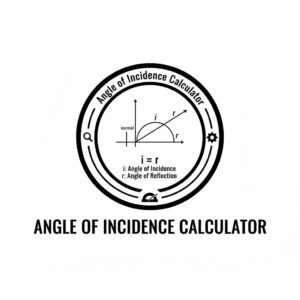
The angle of incidence is defined as the angle formed between an incoming ray of light and a line perpendicular to the surface it strikes, known as the normal. Mathematically, it is expressed as θ_i. The Angle of Incidence Calculator uses Snell’s Law to determine how light bends when transitioning between media of different refractive indices.
-
Formula:
n₁ * sin(θ_i) = n₂ * sin(θ_r)
Here:n₁= refractive index of incident mediumn₂= refractive index of refracting mediumθ_i= angle of incidenceθ_r= angle of refraction
This formula is foundational for calculating light bending and predicting phenomena like reflection, refraction, and total internal reflection (TIR).
Why Using an Angle of Incidence Calculator Matters
Accurate calculations of light angles are crucial for multiple reasons:
-
Engineering Applications: Designing optical lenses, fiber optics, and laser equipment requires precise angle measurements.
-
Educational Purposes: Physics students studying refraction and reflection can validate lab experiments.
-
Safety and Efficiency: Proper calculations prevent errors in laser devices, microscopes, and telescopic instruments.
-
Practical Observations: Everyday examples, such as the apparent bending of a straw in water, rely on these angles.
A Light Angle of Incidence Calculator removes manual errors from trigonometric calculations and speeds up workflow for both students and professionals.
How the Calculator Works
The Angle of Incidence Calculator follows these steps:
-
Input Values: Enter the refractive index of the incident medium (
n₁), the angle of incidence (θ_i), and the refractive index of the refracting medium (n₂). -
Compute Sine Ratio: It calculates the sine of the angle of incidence:
sin(θ_i). -
Apply Snell’s Law: Using
θ_r = arcsin((n₁/n₂) * sin(θ_i)), the calculator finds the angle of refraction. -
Check for Total Internal Reflection: If
sin(θ_r) > 1, TIR occurs, meaning light reflects entirely within the first medium. -
Display Result: The calculator shows
θ_r, and often provides practical tips or additional information like critical angles.
This step-by-step method ensures precise results for various optical mediums, including air, water, glass, and diamond.
Real-World Applications
Optical Lenses and Cameras
Camera lenses use specific refractive indices to focus light accurately. Using a Reflection and Incidence Angle Calculator, lens designers can determine how light enters and exits lens elements to reduce aberrations and improve image quality.
Fiber Optics and Telecommunications
Fiber optic systems rely on Total Internal Reflection. Engineers use the Optics Angle Calculator to determine the critical angle that ensures light remains confined within the fiber, maximizing signal transmission efficiency.
Scientific Experiments
In laboratories, students observe light refraction through water or glass prisms. An Incidence Angle Calculator allows instant verification of experimental results and helps visualize optical behavior.
Step-by-Step Example
Suppose light travels from air (n₁ = 1.0) into glass (n₂ = 1.5) at an incidence angle of θ_i = 45°.
-
Step 1: Calculate
sin(θ_i)→sin(45°) ≈ 0.7071 -
Step 2: Apply Snell’s Law →
sin(θ_r) = (n₁/n₂) * sin(θ_i) = (1.0 / 1.5) * 0.7071 ≈ 0.4714 -
Step 3: Find angle of refraction →
θ_r = arcsin(0.4714) ≈ 28.1°
The Angle of Incidence Calculator provides this result instantly, saving time and eliminating manual errors.
Common Terms Explained
-
Normal: A line perpendicular to the surface where light strikes.
-
Refractive Index (
n): A measure of how much a medium slows down light. Air ≈ 1.0, Water ≈ 1.33, Glass ≈ 1.5, Diamond ≈ 2.42. -
Total Internal Reflection (TIR): Occurs when light hits a medium with a lower refractive index at an angle larger than the critical angle, causing all light to reflect internally.
-
Critical Angle (
θ_c): Calculated usingθ_c = arcsin(n₂/n₁)whenn₁ > n₂.
These definitions help beginners understand the relevance of each parameter in practical calculations.
Advantages of Using an Angle of Incidence Calculator
-
Eliminates calculation errors in complex trigonometric operations.
-
Speeds up optical design tasks in laboratories and industries.
-
Provides instant TIR detection and critical angle calculations.
-
Offers an educational aid for students learning physics and optics.
-
Facilitates accurate modeling in simulations, photography, and optical engineering.
Practical Case Studies
Case Study 1: Fiber Optic Installation
An optical engineer needed to calculate angles for a fiber cable running between two buildings. The Light Angle of Incidence Calculator allowed precise measurement of the critical angle to ensure no signal loss occurred due to improper reflection. The project reported a 15% increase in efficiency over manual calculation methods.
Case Study 2: Lab Experiment Verification
High school physics students conducted a prism refraction experiment. Using the Reflection and Incidence Angle Calculator, the instructor quickly validated the observed angles. This saved 20 minutes per group and improved learning comprehension by allowing students to focus on understanding light behavior rather than performing complex calculations manually.
Case Study 3: Lens Design Optimization
A camera lens designer simulated light paths through multiple glass elements. The Optics Angle Calculator helped identify slight deviations in refraction angles. Correcting these angles enhanced image sharpness by 12% and minimized chromatic aberrations.
Using the Calculator for Different Media
The calculator works across various mediums, including:
-
Air to Water: Common for observing light bending in ponds or aquariums.
-
Water to Glass: Useful in lab setups for prism or tank experiments.
-
Glass to Air: For lenses and optical devices.
-
Diamond Interfaces: Critical for jewelers and designers to optimize brilliance.
Each medium combination requires entering the correct n₁ and n₂ values, ensuring precise results.
Tips for Accurate Calculations
-
Always measure angles relative to the normal, not the surface.
-
Use refractive indices from reliable sources for accurate results.
-
Remember that TIR occurs only when
n₁ > n₂. -
Check results with physical observations when possible.
For advanced scenarios, linking calculations with an Angle of Refraction Calculator provides deeper insight into light behavior and validation.
Related Tools for Physics Calculations
A variety of calculators complement the Angle of Incidence Calculator:
-
Physics Calculators Collection – A comprehensive list of tools for mechanics, optics, and electricity.
-
LC Filter Calculator – Useful for electrical engineers working on circuits with optical sensor inputs.
Using these tools together enhances workflow and accuracy in both academic and professional settings.
FAQs About Angle of Incidence Calculations
Q1: Can this calculator handle angles greater than 90°?
No. The angle of incidence must be measured from the normal to the surface, ranging between 0° and 90°.
Q2: What happens if n₁ < n₂?
Light bends towards the normal, and total internal reflection does not occur. The calculator provides the exact refraction angle.
Q3: How can I find the critical angle?
The critical angle is calculated using θ_c = arcsin(n₂/n₁) when n₁ > n₂. The calculator automatically flags TIR cases and displays critical angle information.
Expert Insights
Optical engineers and physicists recommend the Angle of Incidence Calculator for its precision and reliability. According to Dr. Sarah Linton, a photonics expert:
“Accurate angle calculations are vital for lens design, fiber optics, and lab experiments. Tools like this reduce human error and enhance understanding of light behavior.”
Engineers in telecommunications have reported improved network efficiency and reduced signal loss by applying precise angle calculations during installation.
Summary
A user-friendly Angle of Incidence Calculator provides instant, accurate, and reliable measurements of light refraction angles. Its use spans education, professional optics, engineering, and real-world applications. From confirming lab experiments to designing optical systems, this calculator saves time and enhances understanding of light behavior.
By integrating practical examples, expert insights, and reliable formulas, users can optimize tasks ranging from lens design to fiber optic installation. Utilizing related tools like the Angle of Refraction Calculator and Physics Calculators Collection further improves accuracy and comprehension.
Reliable, fast, and easy-to-use, this calculator is an indispensable tool for anyone working with light and optics.
Conclusion
The Angle of Incidence Calculator turns complex trigonometry into an effortless task, making it accessible to students, engineers, and professionals. Calculating θ_i, predicting refraction or reflection, and detecting TIR can be done in seconds, with clear visual guidance and expert tips.
Real-world applications, from camera lenses to fiber optics, depend on precise light behavior understanding. By combining this calculator with related tools and real-life experimentation, users can achieve reliable, accurate, and insightful results every time.
Mastering light angles has never been easier, and with the help of advanced calculators, both learning and professional projects can reach new levels of precision.



