Top 10 Online Free Electromagnetism Calculators
Top 10 Online Free Electromagnetism Calculators
Electromagnetism plays a crucial role in modern science, engineering, and everyday electronics. For students, professionals, and hobbyists alike, accurate calculations of electrical and magnetic phenomena are essential. That is why Free Electromagnetism Calculators have become a vital resource. These tools provide instant and reliable results for complex physics problems, helping users save time, improve accuracy, and understand electromagnetic principles in practical scenarios.
Whether you are designing circuits, analyzing magnetic fields, or studying physics concepts, these free electromagnetism calculators online simplify the process. From calculating forces on charged particles to predicting magnetic flux, these tools are designed to assist learners and professionals in achieving precise results efficiently.

1. Cyclotron Frequency Calculator
Understanding how charged particles move in a magnetic field is essential for physics experiments and engineering applications. The Cyclotron Frequency Calculator allows users to compute the frequency f = qB / 2πm, where q is the particle charge, B is the magnetic field, and m is the particle mass.
This tool is widely used in particle accelerators, medical imaging devices, and plasma physics research. By using this online EM field calculation tool, students can visualize the relationship between magnetic fields and particle motion. A real-world example includes calculating the motion of protons in MRI machines, where precise frequency control ensures accurate imaging.

2. Magnetic Declination Calculator
Navigating the Earth requires knowledge of the difference between magnetic north and true north. The Magnetic Declination Calculator provides instant results for this angle, enabling accurate compass readings and geolocation.
Surveyors, hikers, and professionals in geoscience rely on this tool to correct navigational errors. For instance, a surveyor mapping a new site can use this calculator to adjust compass readings, ensuring that construction and measurement align perfectly with geographic coordinates. This calculator is an indispensable part of electromagnetic physics calculators that bridge theory with field applications.

3. Free Space Path Loss Calculator
Signal strength and propagation are critical in wireless communication systems. The Free Space Path Loss Calculator helps engineers determine signal attenuation over distance using FSPL(dB) = 20 log10(d) + 20 log10(f) + 20 log10(4π / c), where d is distance, f is frequency, and c is the speed of light.
Telecommunication engineers use this electrical & magnetic calculator to design antennas, optimize coverage, and predict potential interference. For example, when setting up a Wi-Fi network in a large office, using this calculator ensures the signal reaches every corner without degradation. This makes it a valuable tool for both academic learning and real-world projects.

4. Lorentz Force Calculator
The Lorentz Force Calculator computes the force exerted on a charged particle moving in electric and magnetic fields using F = q(E + v × B). This formula is foundational in electromagnetism, influencing the design of motors, sensors, and particle experiments.
A practical case study includes calculating the path of electrons in cathode ray tubes or designing magnetic levitation systems. Students studying electromagnetic fields can use this calculator to simulate forces without needing physical experiments. This online EM field calculation tool is a perfect combination of convenience and precision.

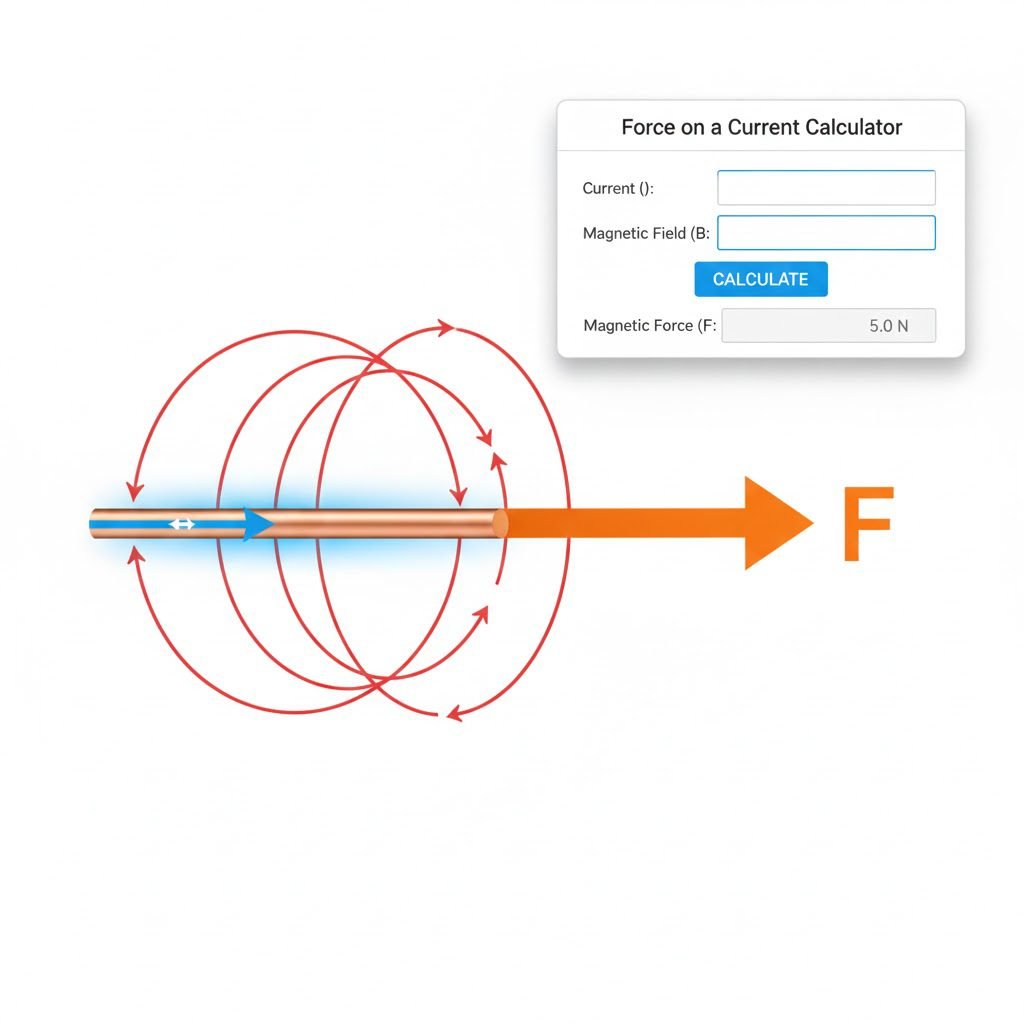
5. Magnetic Force on a Current-Carrying Wire Calculator
Electric current flowing through a conductor in a magnetic field experiences a force F = I L × B, where I is current, L is the length of wire, and B is magnetic flux density. The Magnetic Force on a Current-Carrying Wire Calculator simplifies these calculations.
Engineers designing electric motors or actuators can instantly predict the magnitude and direction of forces, reducing errors in physical prototypes. For example, in an experimental motor lab, students can validate theoretical predictions with the calculator before assembling components. This tool highlights the value of electrical & magnetic calculators in practical engineering education.
6. Gauss’s Law Calculator
Understanding electric flux through surfaces is fundamental in electromagnetic physics. The Gauss’s Law Calculator applies Φ = ∮ E · dA to compute flux for various shapes and charge distributions.
Physics students and researchers use this calculator to explore electric fields around spheres, cylinders, and planes without performing tedious integrals manually. For example, calculating the flux from a uniformly charged sphere becomes instantaneous, aiding in homework, exams, or research projects. This makes Gauss’s Law calculations accessible to anyone using electromagnetic physics calculators.

7. Debye Length Calculator
Plasma physics and ionized gases require understanding how charges interact over distances. The Debye Length Calculator uses λD = √(ε0 k T / n q²) to determine the screening distance in a plasma, where ε0 is permittivity, k is Boltzmann constant, T is temperature, n is particle density, and q is charge.
In laboratories, researchers use this to predict particle behavior in plasma confinement or semiconductor environments. A real-life example is designing experiments in fusion research, where Debye length determines how electric fields interact with plasma clouds. This calculator offers hands-on insights in online EM field calculation tools.

8. Magnetic Permeability Calculator
The Magnetic Permeability Calculator determines the ability of a material to support magnetic fields using μ = B / H. Materials engineers and designers of magnetic circuits benefit from quick calculations to choose appropriate cores for transformers, inductors, and motors.
For instance, selecting a soft iron core for an electromagnet requires knowing its permeability to achieve optimal magnetic field strength. This calculator is an essential part of electrical & magnetic calculators for both learning and design purposes.

9. Magnetic Dipole Moment Calculator
The Magnetic Dipole Moment Calculator computes the magnetic strength and orientation of a loop or magnet using m = I A, where I is current and A is the area of the loop.
Hobbyists building electromagnets, engineers designing sensors, and students studying magnetostatics can use this calculator for precise predictions. For example, when creating a small magnetic compass or experimenting with magnetic fields in labs, this tool ensures accurate measurements, making it a reliable free electromagnetism calculator online.

10. Free Space Path Loss & Related RF Calculators
Reinforcing the importance of signal analysis, these calculators help in understanding electromagnetic wave propagation in real-world scenarios. They assist engineers and students in predicting signal loss over various distances and frequencies. Tools like the Free Space Path Loss Calculator become indispensable for network planning and RF engineering projects.

Practical Applications and Real-World Examples
Using these Electromagnetism Calculators, anyone can enhance learning, improve engineering designs, and perform professional-grade computations effortlessly.
Examples include:
-
Designing electric motors with precise magnetic forces using the Magnetic Force on a Current-Carrying Wire Calculator.
-
Predicting electron trajectories in magnetic and electric fields with the Lorentz Force Calculator.
-
Optimizing wireless network signals for maximum coverage using Free Space Path Loss calculations.
These calculators provide accurate, instant, and practical solutions, bridging theory and real-world application efficiently.
FAQs
Q: Are these calculators suitable for beginners?
Yes, each tool provides easy-to-follow input fields and explanations. Students and hobbyists can start using them without prior advanced knowledge.
Q: Can these calculators be used in professional engineering projects?
Absolutely. Many calculators like Free Space Path Loss or Lorentz Force are practical for engineers designing circuits, antennas, or magnetic systems.
Q: Do these tools provide SI unit consistency?
Yes, they follow standard SI units. Users are encouraged to ensure consistent input units for accurate results.
Conclusion
The Top 10 Online Free Electromagnetism Calculators are essential resources for students, professionals, and enthusiasts. By offering precise, fast, and reliable computations, these tools enhance understanding, streamline workflows, and improve practical outcomes. Integrating these calculators into learning or professional projects ensures accuracy, efficiency, and deeper comprehension of electromagnetic principles.