
Solvent Evaporation Rate Calculator
Solvent Evaporation Rate Calculator
Estimate the evaporation rate of common organic solvents and time to evaporate under given conditions. Useful for laboratory safety, coating processes, and ventilation planning based on international guidelines.
Solvent Evaporation Rate Calculator: Estimate Evaporation Time & Vapor Risk
In laboratory work, industrial coating, or chemical processing, knowing how fast a solvent evaporates is critical. The Solvent Evaporation Rate Calculator helps scientists, engineers, and safety officers estimate evaporation rates under real-world conditions. Imagine pouring a flammable solvent on a lab bench—without proper ventilation, vapors can build up, posing serious fire and health risks. This tool simplifies the calculation of evaporation time, helping users plan experiments, ventilation, and safety measures effectively.
Why Monitoring Solvent Evaporation Matters
Solvent evaporation isn’t just a matter of liquid disappearing—it’s directly linked to:
-
Vapor hazard and flammability risks
-
Coating uniformity in industrial applications
-
Laboratory air quality and ventilation requirements
-
Chemical waste and environmental impact
For example, acetone evaporates nearly seven times faster than n-butyl acetate, meaning fume hoods or proper ventilation are essential. Ignoring these rates can compromise both safety and experimental accuracy.
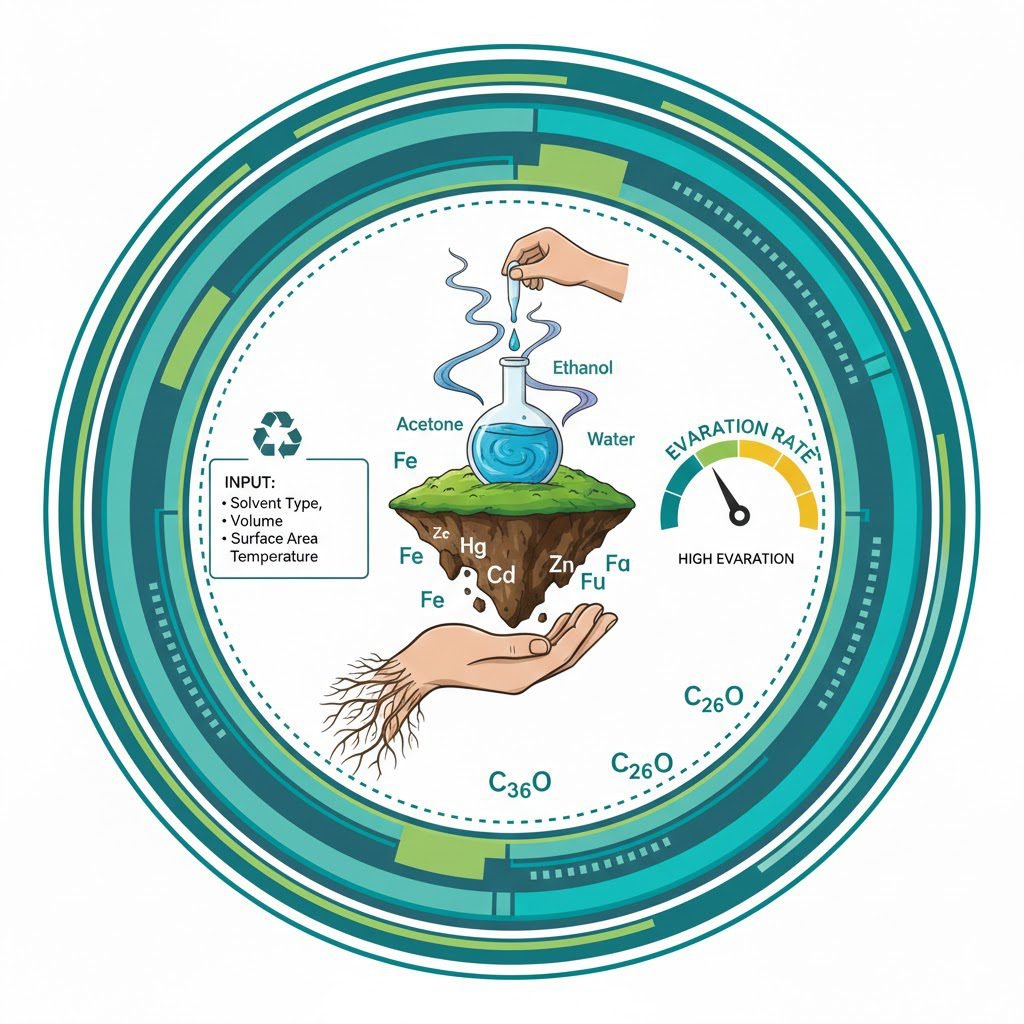
How the Solvent Evaporation Rate Calculator Works
The calculator estimates evaporation rate (g/min) and time to full evaporation based on user inputs. Here’s a breakdown:
Inputs
-
Solvent Type: Choose common organic solvents like acetone, ethanol, toluene, or water for reference. For less common chemicals, enter a custom relative evaporation rate.
-
Surface Area (cm²): Exposed liquid surface directly affects evaporation speed—the larger the area, the faster the rate.
-
Initial Volume (mL): Required to calculate total mass and estimate the time to evaporate fully.
-
Temperature (°C): Higher temperatures accelerate evaporation. The tool applies a rough approximation: every 10°C increase doubles the evaporation rate.
-
Ventilation Level: Good airflow increases evaporation, while stagnant air slows it down.
Outputs
-
Evaporation Rate (g/min): Mass loss per minute considering solvent type, area, temperature, and ventilation.
-
Estimated Evaporation Time: Displayed in minutes and hours.
-
Vapor Risk Classification: Slow, moderate, or fast evaporation, with safety recommendations.
Calculation Logic
The underlying formula follows a stepwise approach:
Where:
-
Base Rate ≈ 0.01 g/min per 100 cm² (for n-butyl acetate at 25°C)
-
Temperature Factor = 2^((T-25)/10)
-
Ventilation Factor = 1.5 (good), 1.0 (moderate), 0.4 (poor)
Example:
Suppose you have 50 mL of acetone on a 200 cm² surface at 30°C with good ventilation.
-
Base Rate = 0.01
-
Relative Rate for acetone = 6.3
-
Area Factor = 200 / 100 = 2
-
Temp Factor = 2^((30-25)/10) ≈ 1.414
-
Vent Factor = 1.5
Adjusted Rate:0.01 × 6.3 × 2 × 1.414 × 1.5 ≈ 0.267 g/min
Evaporation Time:Mass ≈ 50 mL × 0.8 g/mL = 40 gTime ≈ 40 / 0.267 ≈ 150 minutes ≈ 2.5 hours
Practical Examples & Scenarios
Example 1: Industrial Coating
A paint technician applies 100 mL of ethanol on a 300 cm² surface in a well-ventilated workshop at 25°C. Using the calculator:
-
Adjusted rate ≈ 0.108 g/min
-
Evaporation time ≈ 74 hours
Relevance: Ensures even drying and prevents excessive solvent vapor accumulation.
Example 2: Laboratory Experiment
A chemist leaves 20 mL of toluene in a fume hood on 50 cm² glassware at 35°C. Calculations show:
-
Adjusted rate ≈ 0.032 g/min
-
Time to evaporate ≈ 50 g / 0.032 ≈ 1562 min ≈ 26 hours
Relevance: Confirms prolonged ventilation is required to avoid vapor hazards.
Example 3: Environmental Assessment
Outdoor evaporation of n-hexane from a 500 mL sample spilled over 500 cm² with moderate airflow at 28°C:
-
Adjusted rate ≈ 0.435 g/min
-
Time ≈ 500 × 0.8 / 0.435 ≈ 919 minutes ≈ 15 hours
Relevance: Helps estimate solvent persistence in open-air spills for environmental safety planning.
Key Factors Affecting Evaporation
-
Solvent Volatility: Highly volatile solvents like acetone or hexane evaporate faster.
-
Surface Area: Doubling the exposed area nearly doubles evaporation speed.
-
Temperature & Humidity: Warmer, dry conditions accelerate evaporation.
-
Ventilation: Mechanical airflow increases vapor dispersion, reducing evaporation time.
Safety & Best Practices
-
Always use certified fume hoods for fast-evaporating solvents.
-
Minimize solvent volumes to reduce vapor exposure.
-
Monitor vapor levels using detection instruments when possible.
-
Seal containers when storing chemicals to prevent uncontrolled evaporation.
-
Check compatibility of solvents with surfaces to prevent hazards.
Related Tools You Can Use
-
Water Pump Energy Calculator – Estimate energy consumption for lab or industrial pumps.
-
Irrigation Efficiency Calculator – Optimize water distribution in agricultural setups.
-
Evaporation Loss Calculator – Calculate water or solvent loss over time for environmental planning.
-
Explore more Environmental Chemistry Calculators for lab and field applications.
FAQs
Q1: Can I use this calculator for mixtures of solvents?
A: Yes, but you must enter a weighted average of the relative evaporation rates based on each component’s volume fraction.
Q2: Does humidity affect evaporation rates?
A: Humidity slightly slows evaporation. This tool provides a standard estimate; for high-precision calculations, adjust rates based on local humidity.
Q3: Is the calculated time exact?
A: No, these are estimates. Actual evaporation depends on container shape, air currents, and ambient conditions. Always apply safety margins.
Conclusion
The Solvent Evaporation Rate Calculator is an essential tool for scientists, engineers, and safety officers. It provides fast, reliable estimates of evaporation speed and vapor risk, helping ensure safer labs and optimized industrial processes. By testing different scenarios, you can plan experiments, improve ventilation, and reduce chemical exposure.
Try the calculator today and explore related tools to manage solvent use, energy, and environmental impact effectively. Safety, efficiency, and accuracy are just a few clicks away.



