Hydropower Potential Calculator
Hydropower Potential Calculator
Estimate the theoretical and practical hydropower generation potential from a stream or river site based on international engineering standards (IEC/IRENA).
Hydropower Potential Calculator: Estimate Energy from Any River or Stream
Imagine standing beside a river and wondering how much clean energy you could generate if you harnessed its flow. Small rivers or streams may seem modest, but with the right technology, even micro-hydro plants can produce reliable electricity for homes, villages, or small industries. This is where the Hydropower Potential Calculator comes in—a practical, easy-to-use tool designed for engineers, environmental planners, and renewable energy enthusiasts to estimate hydropower potential accurately based on real-world engineering standards like IEC and IRENA.
Whether you’re planning a small hydro project or analyzing the feasibility of a medium-sized dam, this tool converts hydraulic data into actionable insights, helping you make informed decisions without complex manual calculations.
Why Estimate Hydropower Potential?
Hydropower is one of the oldest and most reliable sources of renewable energy. Understanding the potential energy of a site is crucial before any construction or investment. Here’s why:
-
Optimize resources: Avoid overestimating output and wasting capital.
-
Feasibility planning: Identify whether a site is suitable for run-of-river, storage, micro, or pumped storage systems.
-
Environmental compliance: Predict energy output without causing ecological harm.
-
Cost-benefit analysis: Estimate annual energy generation to plan for ROI.
Even small errors in estimating flow rate, net head, or efficiency can lead to significant financial and operational mistakes. Our calculator simplifies this with automated calculations and step-by-step guidance.
How the Hydropower Potential Calculator Works
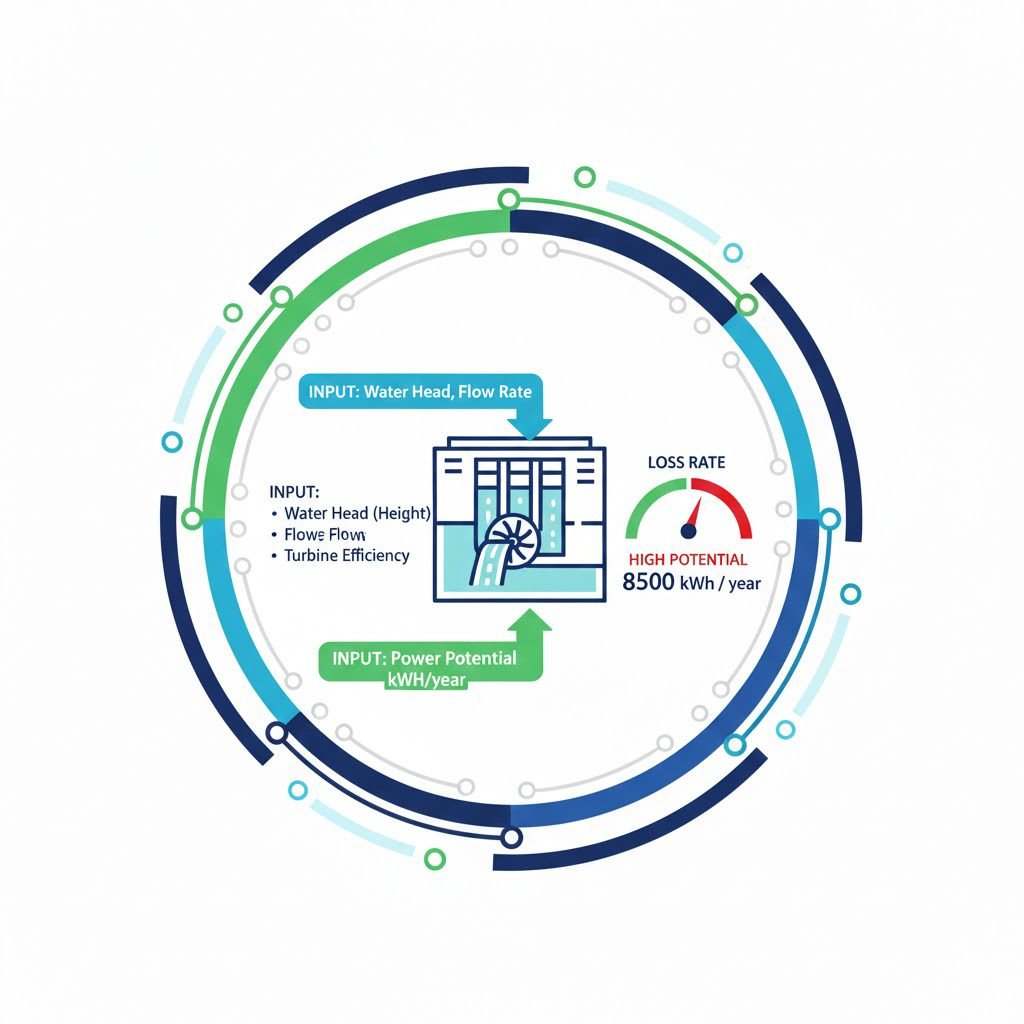
The calculator transforms hydraulic inputs into hydropower outputs using internationally recognized formulas. Here’s a breakdown:
Required Inputs
-
Water Flow Rate (Q, m³/s): The volume of water passing per second.
Example: A stream with 5 m³/s flow. -
Net Head (H, meters): The vertical height difference water falls.
Example: A dam with 50 meters of net head. -
Overall System Efficiency (η, %): Accounts for turbine and generator losses. Typical modern turbines are 80–92% efficient.
-
Plant Capacity Factor (%): Measures how consistently the plant operates at full power over a year. Run-of-river plants may have higher capacity factors than storage plants due to flow consistency.
-
Site Type: Choose between Run-of-River, Storage/Reservoir, Micro-Hydro (<100 kW), or Pumped Storage.
Core Calculation Logic
The theoretical power is calculated using the fundamental hydropower formula:
Where:
-
ρ= Water density (1000 kg/m³) -
g= Acceleration due to gravity (9.81 m/s²) -
Q= Flow rate (m³/s) -
H= Net head (m)
Practical power accounts for system efficiency:
Annual energy production is estimated as:
Example: With 5 m³/s flow, 50 m head, 85% efficiency, and 50% capacity factor:
P_theoretical = 1000 × 9.81 × 5 × 50 / 1000 ≈ 2452.5 kWP_practical = 2452.5 × 0.85 ≈ 2084.6 kWAnnual Energy ≈ 2084.6 × 8760 × 0.5 / 1000 ≈ 9126 MWh/year
Output Metrics
-
Site Type: Confirms selected plant type.
-
Flow Rate & Head: Key hydraulic inputs.
-
System Efficiency & Capacity Factor: Operational parameters.
-
Theoretical and Practical Power: Core performance indicators.
-
Annual Energy Production: Estimate of yearly output.
-
Hydropower Potential Level: Categorized as Limited, Good, or Excellent for feasibility assessment.
Practical Examples
Example 1: Run-of-River Micro-Hydro
-
Flow: 2 m³/s
-
Net Head: 15 m
-
Efficiency: 80%
-
Capacity Factor: 60%
Outcome: ~235 kW practical power → suitable for village-level supply.
Example 2: Storage Hydropower Plant
-
Flow: 10 m³/s
-
Net Head: 70 m
-
Efficiency: 90%
-
Capacity Factor: 50%
Outcome: ~6170 kW practical power → large-scale regional supply feasible.
Example 3: Pumped Storage Scenario
-
Flow: 5 m³/s
-
Net Head: 100 m
-
Efficiency: 88%
-
Capacity Factor: 40%
Outcome: ~4314 kW practical power → ideal for peak-load balancing and energy storage.
Tip: Adjust flow, head, or efficiency values to explore seasonal variations, maintenance downtime, or turbine upgrades. The calculator reacts in real time, giving a clear picture of potential gains.
Related Calculators You Might Explore
-
Nanoparticle Pollution Calculator – Evaluate environmental impact of industrial runoff.
-
Plasticizer Leaching Risk Calculator – Monitor chemical contamination in water systems.
-
Biofilm Formation Risk Calculator – Assess water safety in pipelines.
-
Explore more environmental chemistry calculators for broader water quality and renewable energy analysis.
FAQs
Q1: Can this calculator estimate power for very small streams (<1 m³/s)?
A: Yes, the tool adjusts for low flow rates and can determine if a micro-hydro setup is feasible. Even small streams can power remote villages or farms.
Q2: Why does the capacity factor affect annual energy so much?
A: Capacity factor reflects actual operational time and flow variability. A lower capacity factor reduces annual energy, regardless of theoretical power.
Q3: How accurate is the practical power output?
A: It provides an estimate based on standard turbine efficiency and site inputs. For precise project planning, a detailed feasibility study including seasonal flow measurements is recommended.
Conclusion
The Hydropower Potential Calculator simplifies complex engineering calculations into an intuitive, user-friendly interface. By entering your site’s flow, head, and efficiency parameters, you instantly understand both theoretical and practical energy outputs, helping you plan small or large-scale hydropower projects.
Hydropower remains a reliable, renewable, and long-lasting energy solution, and testing different scenarios using this tool can guide decision-making and optimize investments. Explore related calculators for environmental monitoring and water quality to complement your energy planning.
Start experimenting with your site data today and see how much clean, sustainable energy your river can generate!