
Nanoparticle Pollution Calculator
Nanoparticle Pollution Calculator
Estimate the potential exposure risk to engineered nanoparticles in air or water based on measured or estimated concentration and environment type.
Nanoparticle Pollution Calculator: Assess Your Exposure Risk in Air and Water
Imagine walking into a busy urban street or turning on your tap for a glass of water, unaware that microscopic particles—engineered nanoparticles—might be around you. While invisible to the naked eye, these tiny particles can accumulate in the air you breathe or the water you drink, potentially impacting health over time. This is where the Nanoparticle Pollution Calculator comes in—a practical tool that lets you estimate your exposure risk quickly and accurately. Whether you’re an environmental professional, a concerned parent, or a workplace safety officer, understanding nanoparticle levels is now easier than ever.
What Are Nanoparticles and Why They Matter
Nanoparticles are materials with dimensions less than 100 nanometers. Common examples include:
-
Titanium dioxide (TiO₂) used in sunscreens and paints
-
Silver nanoparticles (Ag) in antimicrobial products
-
Zinc oxide (ZnO) in cosmetics
-
Carbon-based nanoparticles in industrial applications
Despite their widespread use, studies indicate that prolonged exposure—especially in air or drinking water—may contribute to oxidative stress, inflammation, and organ translocation. Regulatory guidelines are still emerging, so precautionary assessment is crucial.
Semantic insight: Understanding nanoparticle pollution connects to air quality, water chemistry, environmental health, and occupational safety.
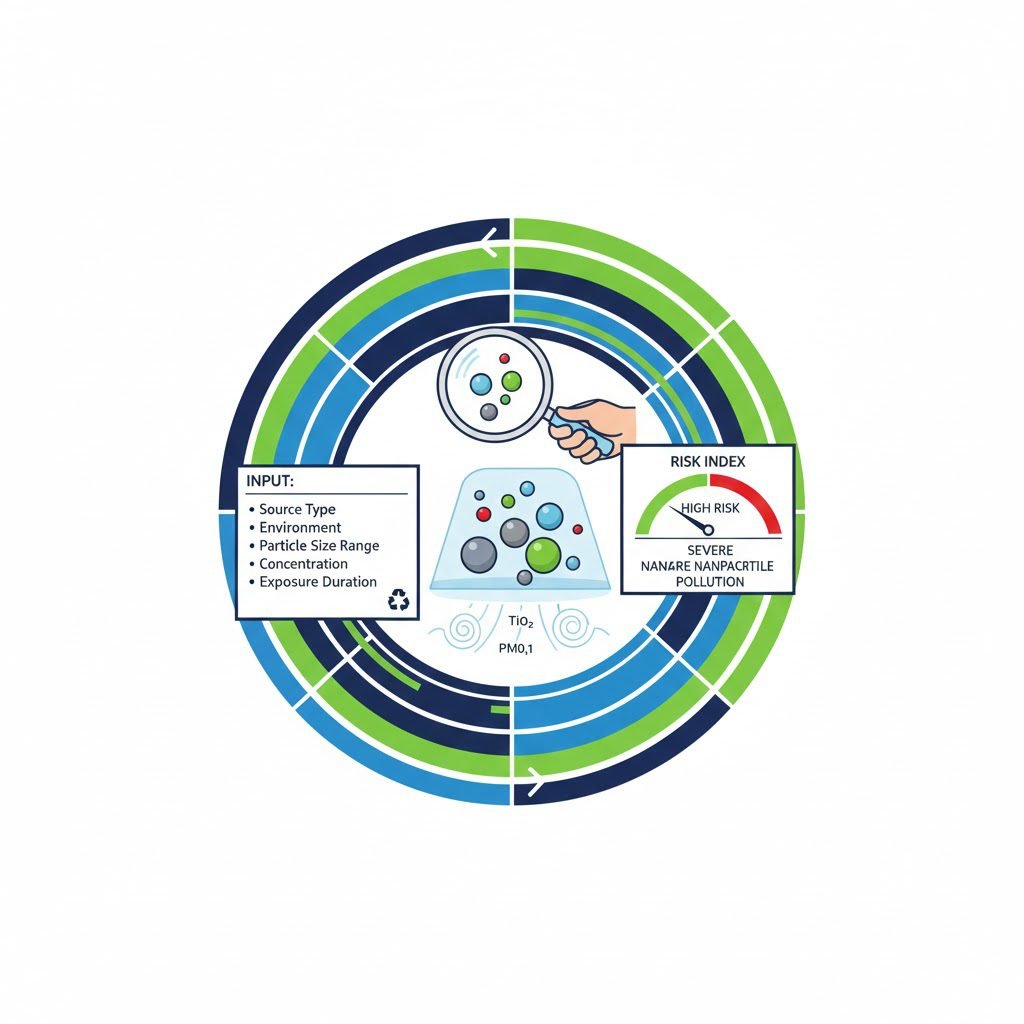
How the Nanoparticle Pollution Calculator Works
This calculator is designed for simplicity and accuracy, translating raw concentration data into clear risk levels.
Step 1: Input the Concentration
Enter the nanoparticle concentration measured in your environment:
-
Air:
particles/cm³ -
Water:
particles/mL
For example, urban outdoor air typically ranges from 10,000–50,000 particles/cm³, while treated drinking water often contains fewer than 10,000 particles/mL.
Step 2: Select the Environment
Choose the setting that reflects your exposure:
-
Indoor Air (home/office)
-
Outdoor Urban Air
-
Occupational/Workplace
-
Drinking Water
This selection adjusts the benchmark ranges, recognizing that risk differs by environment.
Step 3: Calculate Risk Level
The calculator uses benchmarks based on global research:
Reference ranges (example for outdoor air):
-
Low: ≤10,000 particles/cm³
-
Moderate: 10,001–50,000 particles/cm³
-
High: >50,000 particles/cm³
The tool visually highlights your risk:
-
Green = Low
-
Yellow = Moderate
-
Red = High
You also receive practical advice to reduce exposure.
Real-Life Scenarios and Step-by-Step Examples
Example 1: Indoor Air at Home
-
Concentration: 8,000 particles/cm³
-
Setting: Indoor Air
-
Calculation: 8,000 ≤ 5,000 (safe)? No → 8,000 ≤ 20,000 (moderate)? Yes
-
Result: Moderate Risk
Takeaway: Even in home environments, appliances like 3D printers or cooking smoke can elevate nanoparticle levels.
Example 2: Drinking Water Assessment
-
Concentration: 12,000 particles/mL
-
Setting: Drinking Water
-
Calculation: 12,000 ≤ 1,000 (safe)? No → 12,000 ≤ 10,000 (moderate)? No → High Risk
-
Result: High Risk
Takeaway: Consider filtration options or source testing in areas with known nanoparticle contamination.
Example 3: Occupational Exposure
-
Concentration: 150,000 particles/cm³
-
Setting: Workplace
-
Calculation: 150,000 ≤ 20,000 (safe)? No → 150,000 ≤ 100,000 (moderate)? No → High Risk
-
Result: High Risk
Takeaway: Implement ventilation, PPE, and monitoring in nanomaterial handling facilities.
Practical Tips to Reduce Exposure
-
Air: Use HEPA/ULPA filters, ventilate regularly, limit indoor nano-enabled product use.
-
Water: Use certified filtration systems, monitor local water quality reports.
-
Workplace: Follow occupational safety standards, conduct routine nanoparticle measurements.
Pro Tip: Use the calculator to test different concentration scenarios, helping you make informed decisions for both home and work environments.
Why Use This Tool?
-
Provides instant feedback on nanoparticle pollution risk.
-
Supports decision-making for health and safety.
-
Bridges the gap between complex scientific data and practical action.
-
Encourages data-driven environmental awareness.
Related Environmental Chemistry Tools
-
Coral Reef Water Chemistry Calculator – assess marine chemical balance
-
Algae Bloom Risk Calculator – predict harmful blooms in water bodies
-
Ocean Acidification Impact Calculator – track carbon-driven ocean changes
-
Environmental Chemistry Tools – explore a full suite of related calculators
Frequently Asked Questions (FAQs)
1. Are nanoparticles dangerous at low concentrations?
Most studies suggest low environmental concentrations pose minimal immediate risk, but cumulative exposure—especially in occupational settings—can be concerning.
2. How are nanoparticles measured?
Accurate measurement often requires specialized equipment like Scanning Mobility Particle Sizers (SMPS) or Transmission Electron Microscopy (TEM). The calculator provides a practical estimation based on benchmark values.
3. Can I reduce nanoparticles in drinking water?
Yes. Using micro/ultrafiltration systems, activated carbon filters, or reverse osmosis units significantly reduces nanoparticle levels.
Conclusion
The Nanoparticle Pollution Calculator empowers you to understand the invisible world of nanoparticles in air and water. By combining real scientific benchmarks with practical advice, the tool helps users assess risk, make informed choices, and protect health. Try different inputs, explore related tools, and keep track of your environment—knowledge is the first step to safer living.



