How to Create Self-Healing Hydrogels for Biomedical Use
How to Create Self-Healing Hydrogels for Biomedical Use
How to Create Self-Healing Hydrogels for Biomedical Use is no longer just a concept in futuristic labs—it is a practical solution addressing real-world biomedical challenges. Imagine a scenario where a wound dressing not only protects a healing injury but can repair itself after minor damage, maintaining its integrity and therapeutic efficiency. This is where self-healing hydrogels become invaluable.
Hydrogels are soft, water-rich polymer networks with extraordinary versatility. Their ability to absorb water while maintaining structure makes them perfect for biomedical applications such as drug delivery, tissue engineering, and wound healing. But conventional hydrogels often fail under stress—they tear, degrade, or lose functionality. Self-healing hydrogels overcome this limitation by restoring their structure autonomously, improving durability and clinical effectiveness.
In this guide, we will explore the science, design principles, preparation methods, and real-world applications of self-healing hydrogels, supported by formulas, examples, and practical insights.
Understanding Self-Healing Hydrogels
What Are Hydrogels?
Hydrogels are three-dimensional polymer networks capable of retaining large amounts of water. They are used widely in medicine due to their biocompatibility and flexibility. Key properties include:
-
High water content (>90%)
-
Soft, elastic nature similar to biological tissues
-
Permeability for nutrients and drugs
-
Biodegradability for safe biological interaction
What Makes a Hydrogel Self-Healing?
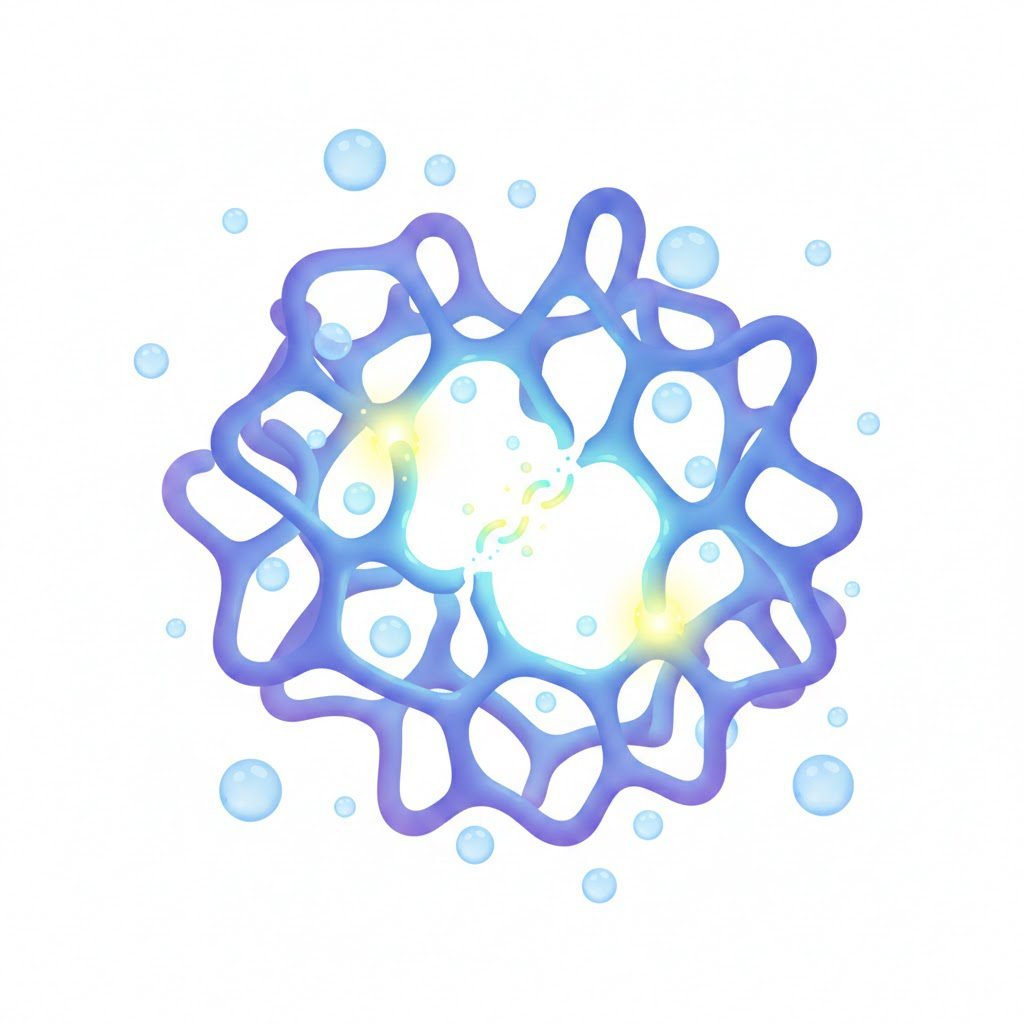
A hydrogel is self-healing when it can restore its structure after physical damage without external intervention. This property arises from dynamic interactions within the polymer network, such as:
-
Hydrogen bonding – reversible attraction between molecules
-
Ionic interactions – reversible electrostatic bonding
-
Dynamic covalent bonds – bonds that can break and reform
-
Supramolecular host–guest interactions – molecular recognition that restores structure
These mechanisms enable hydrogels to recover shape and function after cuts or mechanical stress, making them highly attractive for biomedical use.
Biomedical Applications of Self-Healing Hydrogels
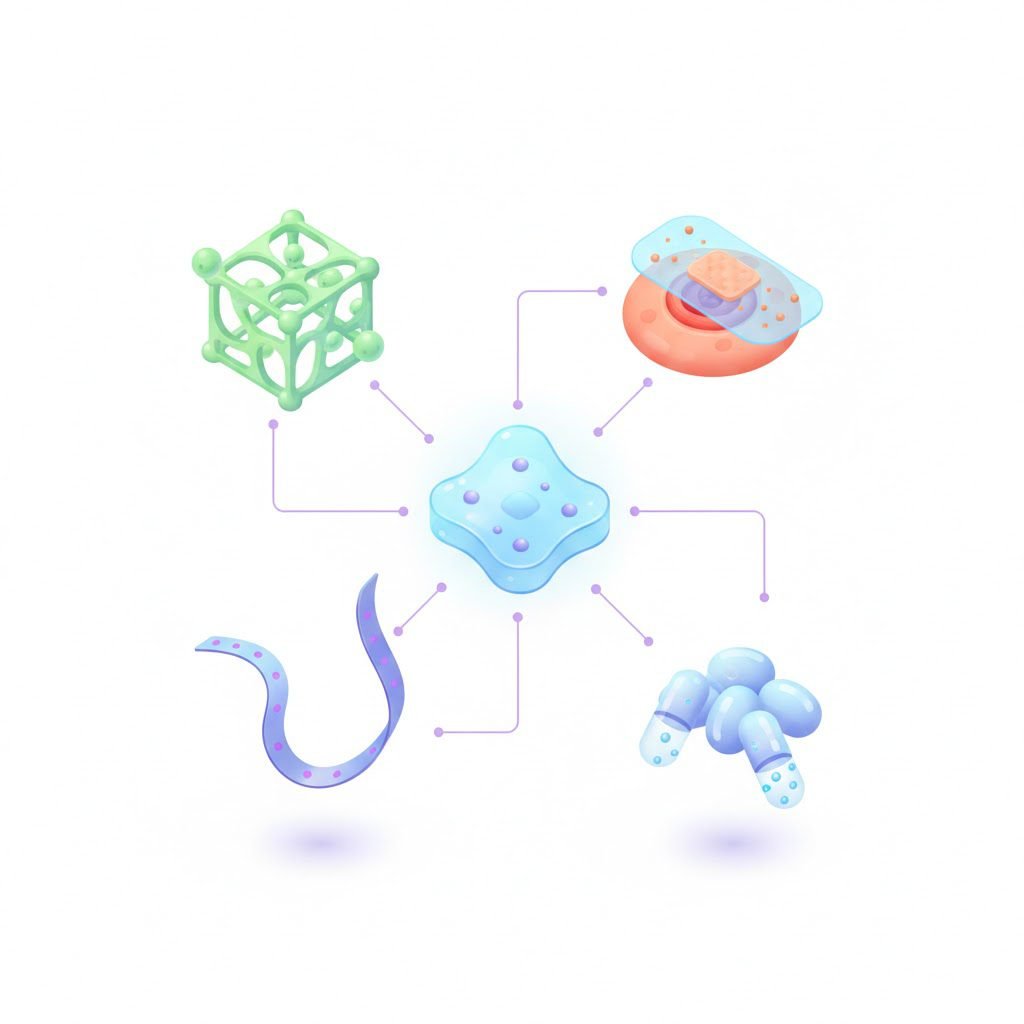
Self-healing hydrogels have transformative potential in medicine:
-
Wound Healing
Hydrogels can act as protective, self-repairing wound dressings, maintaining moisture and preventing infection while repairing minor tears autonomously. -
Drug Delivery Systems
Drugs encapsulated in hydrogels can be released in a controlled manner, even after minor mechanical disruption. -
Tissue Engineering
These hydrogels mimic the elasticity and self-repair properties of tissues, aiding in scaffold formation for regenerative medicine. -
Soft Robotics and Sensors
Their self-healing nature ensures durability in flexible biomedical devices that require repeated movement or deformation.
Core Components of Self-Healing Hydrogels
To design a self-healing hydrogel for biomedical use, understanding its building blocks is essential.
1. Polymers
Hydrogels are composed of polymers that form a crosslinked network. Common polymers include:
-
Natural polymers: Chitosan, alginate, gelatin
-
Synthetic polymers: Poly(vinyl alcohol) (PVA), Poly(ethylene glycol) (PEG)
Natural polymers are preferred for biocompatibility, while synthetic polymers offer tunable mechanical strength.
2. Crosslinking Agents
Crosslinking enables network formation. Self-healing relies on dynamic crosslinks, which can be:
-
Reversible covalent bonds (e.g., Schiff base, disulfide bonds)
-
Non-covalent bonds (hydrogen bonding, host–guest chemistry)
3. Additives for Biomedical Performance
-
Nanoparticles for mechanical reinforcement
-
Growth factors or drugs for tissue regeneration
-
pH or temperature-responsive agents to trigger healing
Step-by-Step Guide to Create a Self-Healing Hydrogel
Materials Required
-
Poly(vinyl alcohol) (PVA)
-
Chitosan
-
Glutaraldehyde (as a crosslinker)
-
Deionized water
-
pH buffer (if drug incorporation is planned)
Methodology
Step 1: Polymer Solution Preparation
-
Dissolve 5 g of PVA in 100 mL of deionized water at 90°C with stirring.
-
Dissolve 2 g of chitosan in 50 mL of 1% acetic acid.
Step 2: Crosslinking
-
Mix PVA and chitosan solutions slowly.
-
Add 0.5 mL glutaraldehyde dropwise while stirring at room temperature.
-
Allow the mixture to sit for 12 hours at 4°C to form a gel network.
Step 3: Testing Self-Healing
-
Cut the hydrogel into two pieces.
-
Bring the cut surfaces into contact for 2–3 hours at room temperature.
-
Observe that the hydrogel restores its integrity, demonstrating self-healing behavior.
Formula for Crosslink Density:
ν=C×ρν = C × ρ
Where:
-
ν= crosslink density (mol/cm³) -
C= concentration of crosslinker (mol/L) -
ρ= polymer density (g/cm³)
This formula helps estimate the mechanical robustness of the hydrogel network.
How to Create Self-Healing Hydrogels for Biomedical Use
Optimizing Hydrogel Properties
1. Mechanical Strength
-
Adjust polymer concentration: Higher polymer content increases stiffness.
-
Tune crosslinker amount: More crosslinking improves durability but can reduce self-healing efficiency.
2. Healing Efficiency
-
Healing efficiency (
HE) can be quantified as:
HE(HE (%) = (σ_healed / σ_original) × 100
Where:
-
σ_healed= stress hydrogel withstands after healing -
σ_original= stress hydrogel withstands initially
Example: If σ_healed = 0.9 MPa and σ_original = 1.0 MPa, then:
HE=(0.9/1.0)×100=90HE = (0.9 / 1.0) × 100 = 90%
3. Biocompatibility
-
Incorporate natural polymers like gelatin or alginate.
-
Avoid toxic crosslinkers or residues.
Real-Life Example: Wound Dressing Hydrogel
Scenario: A patient with a chronic diabetic ulcer needs a dressing that remains intact under movement.
-
A hydrogel composed of PVA-chitosan with dynamic Schiff base crosslinks is applied.
-
The patient bends the knee; the hydrogel sustains minor tears.
-
Within hours, the hydrogel heals autonomously, maintaining moisture and protecting the wound.
Benefit: Reduced dressing changes, lower infection risk, and faster healing.
Related Guides
-
How to Fabricate Flexible Electronics with Conductive Inks – example of material design for bioelectronics.
-
How to Analyze Crystal Structures in Advanced Materials – helps understand polymer network structure.
-
How to Develop Photocatalysts for Water Purification – inspiration for nanoparticle integration.
-
How to Recycle Plastic Waste into High-Value Materials – advanced polymer processing insights.
Advanced Techniques to Enhance Self-Healing
1. Supramolecular Chemistry
-
Using host–guest molecules like cyclodextrin improves healing speed and mechanical flexibility.
2. Stimuli-Responsive Hydrogels
-
pH or temperature triggers healing or drug release.
-
Useful for targeted therapy in inflamed or infected tissues.
3. Nanocomposite Hydrogels
-
Incorporate nanoparticles like silica or graphene oxide for mechanical reinforcement and bioactivity.
How the Hydrogel Creation Tool Works
Imagine an online tool that helps design self-healing hydrogels:
-
Inputs: Polymer type, concentration, crosslinker type, environmental conditions
-
Outputs: Predicted self-healing efficiency, tensile strength, swelling ratio
-
Calculation Logic: The tool uses formulas for crosslink density, stress-strain analysis, and polymer-solvent interactions.
User Interaction Prompt:
Try changing polymer ratios or crosslinker type in the tool to see real-time predictions on mechanical strength and healing efficiency. This helps tailor hydrogels for specific biomedical applications.
FAQs
Q1: Can self-healing hydrogels be used internally in the body?
Yes, if biocompatible and biodegradable polymers are used, they can serve in drug delivery and tissue scaffolding. Always confirm with regulatory guidelines.
Q2: How fast can a self-healing hydrogel repair itself?
Healing speed depends on the type of dynamic bond and environment. Typical times range from minutes to a few hours at room or body temperature.
Q3: Can these hydrogels deliver drugs?
Absolutely. Drugs can be encapsulated within the hydrogel network and released in a controlled manner, even after minor mechanical damage.
Conclusion
Creating self-healing hydrogels for biomedical use combines polymer science, dynamic chemistry, and practical biomedical design. By understanding polymer selection, crosslinking mechanisms, and optimization parameters, one can engineer hydrogels that restore themselves, deliver drugs efficiently, and support tissue regeneration.
Practical examples, like wound dressings and tissue scaffolds, highlight the real-world value of these materials. Tools for hydrogel design allow customization and predictive insight, helping researchers and biomedical engineers develop applications faster and more safely.
CTA: Test different polymer ratios, crosslinkers, and stimuli conditions using advanced hydrogel design tools to find the ideal formulation for your biomedical application.